Get Full Government Meeting Transcripts, Videos, & Alerts Forever!
Get email alerts on the Traffic Safety topic
No spam. Unsubscribe anytime.
Nantucket commission to release draft Traffic Safety Action Plan for 21-day public review
Summary
The commission authorized release of a draft Traffic Safety Action Plan for public comment Aug. 1–21, a step consultants said will help the island pursue federal SS4A funding and guide corridor-focused safety work.
The Nantucket County Commission voted to release a draft Traffic Safety Action Plan for a 21-day public comment period beginning Aug. 1 and ending Aug. 21, the commission decided after a presentation by consultants from Nelson Nygaard and Kittelson Associates.
The plan, prepared with support from Nelson Nygaard and Kittelson Associates, uses a “safe systems” approach and aims to reduce fatal and serious-injury crashes on the island. Drew Van Hengel of Nelson Nygaard told the commission the plan sets a goal to cut fatal and serious-injury crashes from an average of about 3.8 per year to roughly 2 per year by 2030 and to an average of about 1 per year by 2040, with an ultimate long-term goal of zero such crashes.
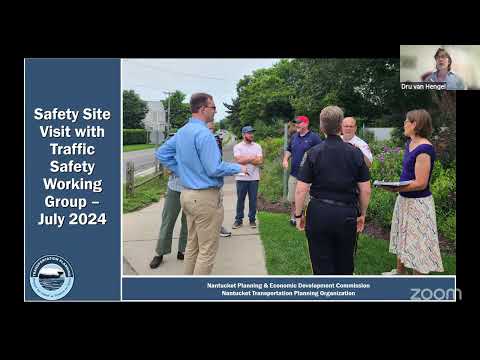
Consultants described the plan as both data-driven and community-informed. It relies on a crash analysis (2018–2022), public engagement that yielded about 1,200 survey responses and more than 2,200 map “dots,” and a network screening that prioritized corridors and locations for interventions. Zach Gable of Nelson Nygaard summarized crash patterns, saying single-vehicle crashes — often run-off-road events involving trees, fixed objects or deer — accounted for most fatal and serious crashes, and that severe crashes were concentrated in both downtown and at transition points on rural roads.
Why it matters: The plan is framed to align with the U.S. Department of Transportation’s Safe Streets and Roads for All (SS4A) funding. Consultants said adopting the action plan would position the commission to apply for remaining implementation funding from SS4A, to request technical assistance, and to use the plan’s prioritization factors when scoping capital and maintenance projects.
Key elements and priorities - Safety approach: The plan adopts a safe-systems framework that emphasizes slower speeds, separation of conflicting modes, safer roadway design, and stronger post-crash care for the island’s limited medical resources. - Prioritized corridors: Consultants highlighted five corridors as early priorities: Old South Road; Surfside Road; Sparks Avenue; Bartlett Road; and Pleasant Street. The plan includes concept-level recommendations for each corridor and systemic (network-wide) countermeasures. - Community input: Consultants said the plan incorporated an island safety tour, briefings with the select board and staff, and online engagement described above. - Data notes: The consultants’ crash dataset covers 2018–2022; public engagement and more recent local reports were used to supplement the analysis.
Debate and concerns raised Commissioners and members of the public stressed several issues the commission asked staff and consultants to highlight in the public review: ebike safety and classification, enforceable speed limits, localized problem spots not yet reflected in crash reports (for example narrow roads or sightline/vegetation encroachment), the need for routine maintenance (signage, striping), and sensitivity to historic character when considering treatments such as roundabouts. Drew Van Hengel said, “no one should be killed or seriously injured on island roads,” phraseology he used to summarize the plan’s vision. Consultants noted existing state statutes limit local authority on some ebike classifications and recommended tracking ebike involvement in local crash reports.
Next steps and vote Consultants recommended a public comment period from Aug. 1–21 and that the commission consider adoption of the plan at its Aug. 25 meeting, contingent on how staff and consultants address public comments. The commission then approved a motion to authorize the 21-day public comment period; the recorded roll-call votes in favor included Dave (aye), Joe (aye), John (aye), Hillary (aye), Mike (aye), Christina (aye), Bud (aye) and the chair (aye). The motion text recorded in the meeting packet was: “authorize the release of the traffic safety action plan for a 21 day public comment period beginning on August 1 and concluding on August 21.”
Implementation context Consultants and staff said the plan is intended to inform — not automatically override — existing capital projects and MassDOT efforts already under way (for example, Milestone/Nobadeer-related intersection projects). Staff emphasized that many of the plan’s recommendations range from low-cost maintenance (signs, striping, high-visibility crossings) to larger capital solutions that will require additional engineering and funding. Staff also noted flexibility in the schedule if the public-comment period produces substantial new issues: the commission could extend review or consider changes at a subsequent meeting.
Ending The plan and appendices — which consultants said will include expanded crash-history tables, engagement summaries and treatment images — will be published for comment. The commission and staff said they expect public comments to help identify locations and issues not reflected in historical crash data and to guide final prioritization and project sequencing.