Get Full Government Meeting Transcripts, Videos, & Alerts Forever!
Get email alerts on the Public Safety topic
No spam. Unsubscribe anytime.
Panama City fire chief explains ISO class‑2 rating, staffing changes and station 'what‑if' scenarios
Summary
Fire Chief Keith Collier briefed the Panama City Commission on the department's Insurance Services Office (ISO) class‑2 rating, staffing levels, station locations and how proposed budget cuts and station consolidations would affect response times and coverage, especially in Panama City North and growing neighborhoods such as Sweetbay.
Chief Keith Collier gave the Panama City Commission a data‑focused briefing on Tuesday night explaining why the department is staffed and equipped as it is, how the Insurance Services Office (ISO) rating shapes decisions, and what would happen to response times if stations were consolidated.
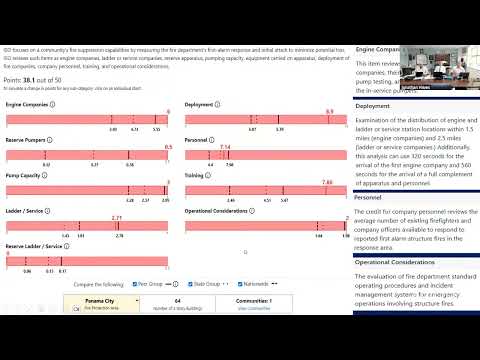
Collier told commissioners the department’s last ISO evaluation was in 2022 and “we received a class 2 rating.” He said that rating applies to Panama City proper and is shared with Panama City North under the current coverage arrangement, and that of about 40,000 fire departments evaluated nationwide only 1,729 hold a class 2 — placing Panama City in roughly the top 4 percent.
The rating, Collier said, is a points‑based system (0–105.5) made up of water supply, fire department capabilities, emergency communications and community risk reduction. “We have 2,077 hydrants located within Panama City proper and Panama City North,” he told the commission, and noted the department conducts more than 2,800 annual fire inspections and more than 25,000 hours of training per year. Collier acknowledged 79 hydrants are out of service — roughly 3.8% of the total — and said those outages are scattered and generally do not affect ISO test selections.
Commissioners pressed Collier on staffing, coverage and response times. The department’s FY25 daily staffing was 25 per shift (minimum 22); the proposed FY26 staffing was described as 24 per shift with a minimum staffing level returning to 20, a change Collier said reflects budget freezes that left three positions unfunded. Collier explained how minimum staffing affects the number of personnel that can respond to an initial structure fire: with full staffing the initial alarm force can include 10–13 personnel; at minimum staffing that drops to about 10.
On response times Collier cited NFPA 1710 guidelines and ISO expectations: “For fires, we are supposed to be with our first unit on scene within 5 minutes and 20 seconds,” he said, and reported the department’s average first‑unit time for fire calls as 5 minutes, 8 seconds and 4 minutes, 28 seconds for EMS calls. He said the department’s average initial full‑alarm response time (two engines, an aerial and a battalion chief) is 7 minutes, 8 seconds against a 9 minute, 20 second benchmark. Collier also warned that roughly 40% of calls overlap — meaning multiple units are out simultaneously — which can degrade response times when units are committed elsewhere.
Collier ran “what‑if” response models for the commission showing how coverage would change if stations were removed. He said closing Station 3 and reassigning its apparatus to Station 1 would increase travel times in parts of the southern service area and could reduce protection for critical infrastructure around Millville and the port. A similar scenario that removed Station 5 produced larger coverage gaps in northern Panama City proper and the Suite Bay/Venetian area; commissioners noted Suite Bay is growing and may eventually total thousands of homes.
Commissioner Josh Street, who took a response‑time emphasis, summed up a common theme in the discussion: “I’m from the opposite perspective. I’m, like, solve for response times.” Commissioner Granger urged the commission to consider ISO impacts on insurance costs; Granger said his review suggested a class‑2 rating “is gonna save resident anywhere from 200 to $800 a year in homeowners insurance,” while Collier cautioned that carriers weight ISO differently and individual savings vary.
Collier also reviewed specialty teams and equipment. He described the department’s Urban Search and Rescue (USAR)/technical rescue capability, a 17‑person fireboat contingent funded in part by port security grants, and a 12‑member dive team that participates in a first‑of‑its‑kind Joint Agency Water Strike Team agreement used across the region. He said the department has deployed teams regionally and expected more state and federal taskings as larger federal deployments are reduced for cost reasons.
The presentation also touched on capital needs. Collier said station reconstruction and apparatus replacement were on the capital improvement list: he estimated rebuilding Station 4 would cost roughly $2.5–$3.5 million and cited an earlier figure for rebuilding Station 5 in the $10–$13 million range. He described a multiyear capital need that staff included in the city’s unfunded requests but did not present a formal financing plan during the workshop.
The chief said the department is preparing a five‑year strategic plan as part of its accreditation work and will present that plan to the commission for direction. He closed by summarizing the department’s priorities: maintain ISO performance, improve water system scoring via ongoing infrastructure work, sustain training and inspections, and seek capital funding to replace aging stations and apparatus.
Ending: Commissioners did not direct an immediate station closure or vote on staffing; instead the discussion closed with requests for follow‑up data and for staff to continue coordination with Bay County on automatic aid and mapping updates. The commission scheduled more budget workshops and follow‑up presentations for staff and the fire chief in the coming weeks.