Get Full Government Meeting Transcripts, Videos, & Alerts Forever!
Get email alerts on the Marina Fuel Canopy Variance topic
No spam. Unsubscribe anytime.
Punta Gorda board recommends city council approve variance to allow fuel‑pump canopies at Isles Yacht Club
Summary
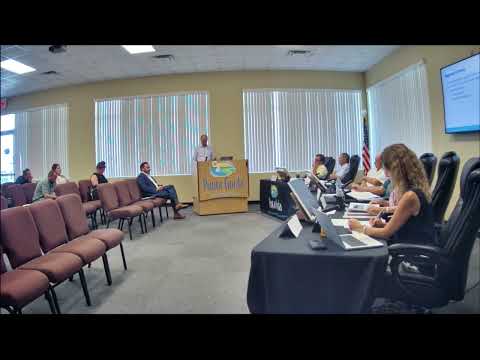
The Punta Gorda Board of Zoning Appeals voted unanimously on July 28 to recommend that City Council approve a variance allowing two small canopies over the Isles Yacht Club fuel pumps at 1780 West Marion Avenue.
The Punta Gorda Board of Zoning Appeals voted unanimously on July 28 to recommend that City Council approve a variance allowing two small canopies over the Isles Yacht Club fuel pumps at 1780 West Marion Avenue.
Board members said the canopies address safety and environmental concerns for staff and customers fueling vessels on the club’s approved floating dock, and noted the 25‑foot upland setback required by the city’s waterfront code cannot be met at the dock’s location.
Rachel Berry, the city zoning official, summarized the application (V02/2025) and the code sections staff reviewed, saying the request is for “a variance from setback requirements to allow fuel pump covers on the existing floating dock” and that staff had considered Chapter 26 (waterfront properties), Chapter 6 (construction within waterways) and the variance criteria in Section 16.1 of the Land Development Regulations. Berry told the board that staff “has not received any comments from anyone” opposing the application and that the agent had provided additional material after the staff report was finalized.
Applicant and supporters argued the canopies are a safety measure and a public benefit. Doug Scheid, introduced as an Isles Yacht Club officer, told the board that boat fueling “takes anywhere from maybe 15 minutes if you got a little fishing boat, upwards of an hour if you've got a cruiser that you're putting 700 gallons of fuel,” and said shade makes safe fueling more practicable. Derek Rooney, attorney for the applicant, noted overlap between Chapter 6 (canal/boat structures) and Chapter 26 (land development) and said that distinction may affect the permitting route. Sherry Gaston, the applicant’s agent from Waterway Canopies, said the proposed canvas structures meet design requirements and stressed they are built for high winds: “Our canopies… are rated up to a 170 miles an hour.”
Public commenters who spoke supported the variance. Todd Reebel, a Punta Gorda resident, said the canopies would reduce safety risks for people and staff at the fuel dock. Charles Wally, a club member and former Board of Zoning Appeals chair, urged approval and described similar private clubs and uses that provide community benefit. No public speaker reported opposition at the hearing.
Board discussion focused on two variance criteria in Section 16.1(b): whether strict application of the setback would create an undue hardship and whether the use requested is permitted in the district. Several members said employee safety and the practical impossibility of meeting a 25‑foot upland setback on a floating dock satisfied the undue‑hardship standard. Board members also debated whether the canopy should be evaluated under the recreational‑facility canopy provision (Section 4.39) or as a structure controlled by Chapter 6; several members said Section 4.39’s language for permanent shade canopy structures tied to recreational facilities was directly applicable.
Board members noted the applicant submitted a maintenance agreement committing to remove or secure fabric during high wind events; Berry confirmed that commitment is included in the materials the board received. The applicant and agent also cited local precedents: a retractable or permanently attached canopy at Fisherman’s Village that speakers said has existed for several years.
After discussion the board voted to close the public hearing and then moved to recommend approval of variance V02/2025 to City Council. The board’s recommendation will be sent to City Council, which the zoning official said would consider the matter at a workshop on Aug. 20.
The BZA’s action is advisory; City Council must grant any final permit or direct another permitting path (for example, a canal construction special permit under Chapter 6). Board members also asked staff to consider whether the land development code should be revised to clarify when canopies are allowed where workers are present at fueling stations. That possible code clarification was flagged for council discussion at the Aug. 20 workshop.
Votes and formal actions at the hearing are recorded in the board’s minutes and will accompany the recommendation forwarded to City Council.