Get Full Government Meeting Transcripts, Videos, & Alerts Forever!
Get email alerts on the Energy Policy Carbon Capture topic
No spam. Unsubscribe anytime.
House Speaker Pro Tempore Mike Johnson tells youth he opposes eminent domain for carbon capture, urges local votes; discusses LHSAA oversight and redistricting
Summary
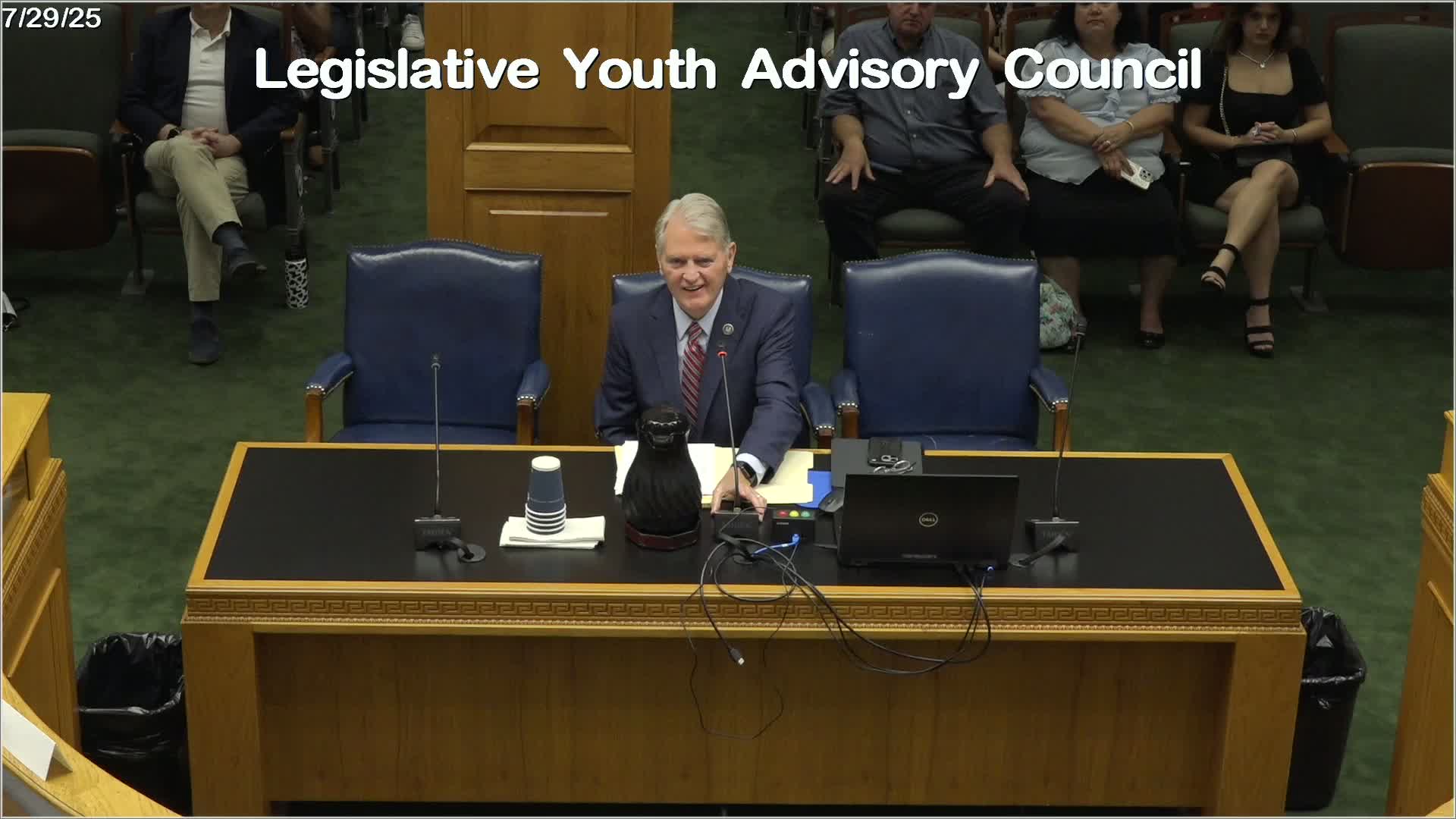
Speaker Pro Tempore Mike Johnson spoke to the Legislative Youth Advisory Council about public service, said he will sponsor bills to bar eminent domain for carbon-capture projects and to allow local-option votes, described a bipartisan review of the private LHSAA and defended recent redistricting litigation and timelines.
Speaker Pro Tempore Mike Johnson visited the Louisiana Legislative Youth Advisory Council and urged the students to pursue service while outlining several policy priorities, including legislation he plans to file to block the use of eminent domain for carbon-capture projects and to give local voters the option to approve such projects.
Johnson said he will “bring a bill to make it completely, to completely strike that portion of the law that makes it a possibility” for eminent domain to be used for carbon-capture pipelines and related infrastructure, and that he also intends to file a local-option bill giving parish voters an election on whether to allow projects in their community.
The remarks came during a wide-ranging Q&A in which the speaker pro tem described carbon-capture proposals in central Louisiana as “a very emotional question” for some communities and said, in part, that “there are smart people on both sides of the issue.” He emphasized he is not a scientist and framed his proposals as protecting private property and local decision-making.
Why it matters: Johnson’s twin proposals—removing the authority to use eminent domain for carbon capture and creating an electoral local-option—would shift both the legal tools available to developers and the locus of final approval toward parish voters if enacted. He framed the local-option approach as analogous to local votes on gambling or alcohol sales.
Johnson also discussed oversight of the Louisiana High School Athletic Association. He described LHSAA as “a private corporation. It's not a public corporation,” and said that, because LHSAA uses public facilities and affects roughly 90,000 student-athletes, he formed a 10-member, bipartisan committee to review operations and collect concerns from coaches, parents and athletes. He invited students to attend the committee’s meetings; he said the first meeting was scheduled for 10 a.m. in a Senate committee room and that the committee planned monthly meetings through late winter with a report and possible legislative recommendations to follow.
On redistricting, Johnson described recent congressional map litigation and said the U.S. Supreme Court asked for additional argument in the Louisiana case; he said the next round of briefs and argument would likely occur later in the year with a decision to follow. He also described the tension between the Voting Rights Act and equal-protection principles when drawing districts and said population shifts to southern Louisiana have reduced representation for some northern and central parishes.
Asked what students could do, Johnson encouraged civic engagement and said he would welcome suggested bills from the council and contact from students: “I would love to have a bill come from this body, a suggested bill, and be able to work with you to carry one through the system,” he said.
Ending: Johnson closed by reiterating his belief in local control and public service, and encouraged the students to remain involved in civic life.