
Committee hears testimony on bill to require residential explosive-gas detectors
Get AI-powered insights, summaries, and transcripts
Subscribe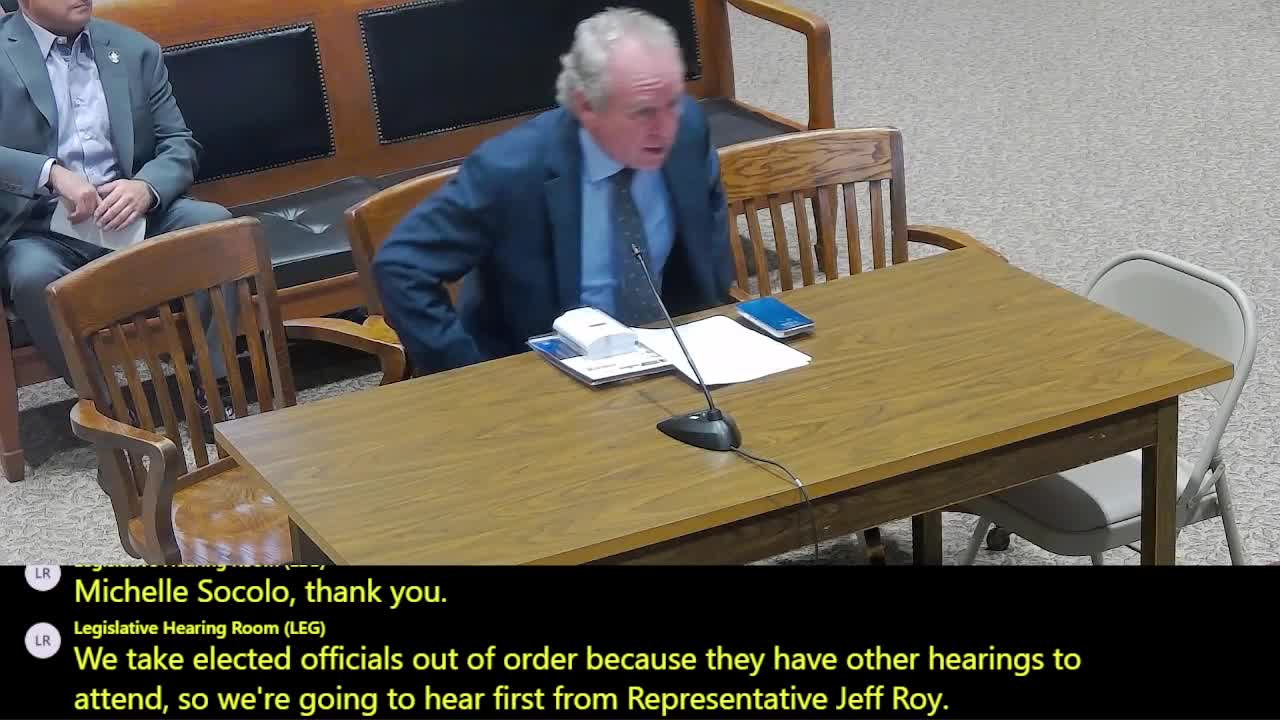
Summary
Lawmakers and witnesses urged the Joint Committee on Public Safety and Homeland Security to report out H.2689, a bill that would require certified explosive-gas detectors in residences that use gas appliances; testimony included family members of propane explosion victims, industry representatives, and standards bodies.
Representative Jeff Roy urged the joint committee to report favorably on H.2689, saying the bill would require installation of explosive-gas detectors in dwellings that use gas-fueled appliances and that such devices are commercially available and affordable. "In short, this bill is about modernizing our safety standards in protecting lives," Roy told the committee. He described the measure as modeled on carbon-monoxide detector requirements and said it would apply only where explosive gas is used.
The bill drew personal testimony from Susan Brown, who said her in-laws, Nancy and Robert Brown, died in a 2015 propane-fueled explosion at their residence. "For $23, my in-laws . . . would still be here," Brown told the committee, describing the device price and urging lawmakers to act. Representative Roy and other witnesses described similar incidents and noted that some movable or outdoor propane leaks can still allow gas to accumulate inside a home.
Industry and standards witnesses supported the proposal. Chris Brzee of the National Electrical Manufacturers Association told the committee that H.2689 fills a gap because fuel-gas detection is not required in some model codes and cited a 2024 NFPA report estimating thousands of home structure fires annually tied to natural- and LP-gas ignition. He said other states and utilities have deployed or required natural-gas alarms. Jason Cohn, speaking for Kidde, and another industry witness said requiring certification to consensus standards (referenced to UL standards in testimony) would help ensure devices perform as intended.
Witnesses addressed technical and practical questions from committee members. Representative Michelle Sicolo and others asked whether battery-only devices exist; witnesses said many units are plug-in with battery backup and some battery-operated designs are available from other manufacturers. Committee members asked about costs; Representative Roy cited examples ranging from about $19.99 to close to $100 and said many widely available devices are in the low‑twenties price range.
Testimony made a distinction between discussion and decision: the hearing provided evidence and arguments for the bill and included requests that the committee report the bill favorably. There was no committee vote on H.2689 during the hearing. Public-safety and standards witnesses said the measure would align with existing NFPA and ICC safety discussions and that certification (UL tests referenced in testimony) would be important to implementation.
The bill's proponents emphasized limited scope and parity with existing detector mandates; they said the measure would require detectors only in dwellings that use explosive gases. Industry witnesses offered to work with the committee on technical language and certification references. The committee received written and oral testimony and took no final action on the bill at this session.