Get Full Government Meeting Transcripts, Videos, & Alerts Forever!
Get email alerts on the Executive Session topic
No spam. Unsubscribe anytime.
Everett School Committee votes to enter executive session over litigation with Tehiliani plaintiffs
Summary
The Everett School Committee voted 10-0 on July 28, 2025, to go into executive session to discuss strategy related to collective bargaining or litigation in the case Tehiliani et al v. Everett School Committee et al, citing Massachusetts General Laws, Chapter 30A, Section 21(a)(3).
The Everett School Committee voted unanimously July 28 to enter executive session to “discuss strategy with respect to collective bargaining or litigation,” citing Massachusetts General Laws, Chapter 30A, Section 21(a)(3), and identifying Tehiliani et al v. Everett School Committee et al as the matter at issue. Chairperson Hurley made the motion, Mayor Di Maria moved it, and Miss Babcock seconded. A roll-call vote recorded 10 members in the affirmative.
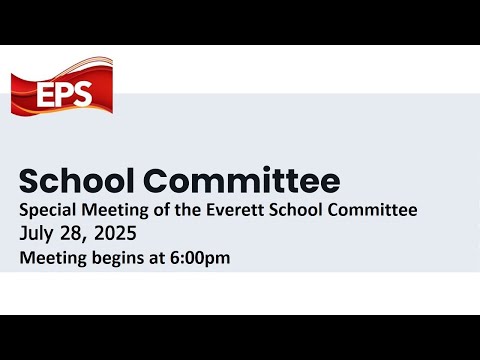
The move to executive session was announced during the special meeting called at 6:03 p.m. Superintendent Hart called the roll and confirmed a quorum of 10 members. Chairperson Hurley told the committee the session would include invited participants: Superintendent Hart and attorneys Galvin, Beringer and Held. The chair also stated the meeting would adjourn in executive session. The committee entered executive session at 6:06 p.m.
Under Massachusetts General Laws, Chapter 30A, Section 21(a)(3), a public body may meet in executive session to discuss strategy where an open meeting could have a detrimental effect on the litigating position of the public body. The committee’s statement cited that statute and named the pending case, Tehiliani et al v. Everett School Committee et al, as the subject. No other substantive discussion or public comment about the litigation or bargaining strategy took place on the public record at the special meeting prior to the vote.
The committee’s action was procedural: it authorized staff and its legal counsel to confer in private under the statutory exemption. The transcript records the roll call votes by member name and the committee’s exit into executive session; it does not record further deliberations or any public directions, motions on the merits of the case, or timetable for returning to open session.
The special meeting agenda listed the executive-session item as the only substantive matter. Future public updates will depend on whether the committee returns to open session and what, if any, disclosures are permitted by law or agreed upon by counsel.