
City attorney summarizes Florida ethics rules for commissioners
Get AI-powered insights, summaries, and transcripts
Subscribe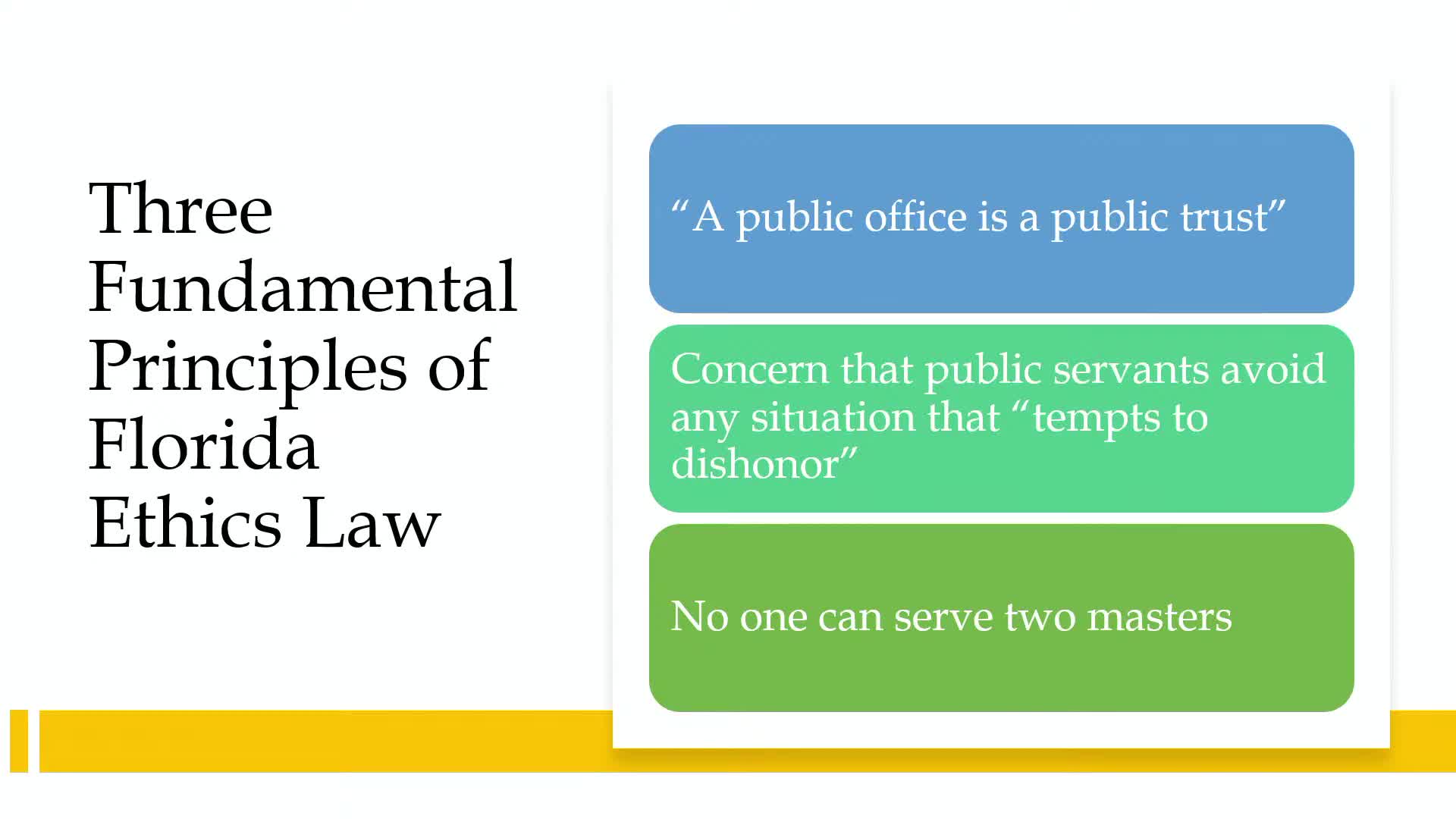
Summary
At a workshop, the city attorney briefed commissioners on Florida ethics laws—chapter 112 topics including gifts, voting conflicts, misuse of position and contracting with the city—and gave examples and reporting requirements.
At a City of Eustace commission workshop, the city attorney summarized Florida ethics law, focusing on provisions that commonly arise for municipal elected officials.
Lehi, the city attorney, opened the ethics portion by saying, “A public office is a public trust,” and reviewed Chapter 112 of the Florida Statutes and related reporting obligations. She explained the law’s core aim: ‘‘to prevent and avoid conflicts of interest’’ where private interest ‘‘tends to lead to disregard of a public duty or interest.’’
Lehi covered several recurring subjects: solicitation or acceptance of gifts, compensation intended to influence official action, doing business with one’s agency, misuse of position, conflicting employment or contractual relationships, voting conflicts, and nepotism. She said officials must report certain gifts and file financial disclosures; a gift over $100 generally must be disclosed and gifts from lobbyists have special thresholds for reporting. She explained an accepted remedy for perception problems: paying fair market value to the giver within 90 days to ‘‘cure’’ an improper gift.
On doing business with the city, Lehi used a local example: a lease that predates a current commissioner’s service. She said such an arrangement is not automatically invalid but ‘‘if it were to come back to the commission for renewal, . . . that commissioner would have to recuse himself’’ because of the financial interest. On voting conflicts she advised officials to read agendas carefully and contact legal counsel ahead of meetings when in doubt. If a voting conflict exists, it must be disclosed on the record and a form completed for public records.
Lehi also noted statutory exceptions and practical considerations for small municipalities where a single vendor may be the only provider of a needed service.
No formal action was taken; the session was informational. Commissioners were urged to consult legal counsel before voting when a potential conflict exists and to make required verbal disclosures on the record and submit the statutory forms for any abstention based on conflict.