Get Full Government Meeting Transcripts, Videos, & Alerts Forever!
Get email alerts on the Solid Waste Intermodal topic
No spam. Unsubscribe anytime.
Hialeah council approves first reading for Waste Connections intermodal rail transfer with strict restrictions
Summary
On first reading the Hialeah City Council approved a special-use permit and variances for Waste Connections to operate an intermodal rail transfer facility, pairing the approval with a recorded declaration of restrictions that includes annual reporting, traffic review thresholds and escalating civil penalties for violations.
The Hialeah City Council approved on first reading a proposed ordinance to allow Waste Connections of Florida to operate an intermodal rail solid-waste transfer facility on a cluster of industrial parcels along Northwest 30th Court after the company pledged enforceable restrictions and operational controls.
Supporters said the proposal replaces an older on-site recycling operation with sealed containers, a lidding/delidding procedure and a rail-based transport cycle that the company and city traffic engineers said will modestly reduce truck trips. Melissa Tapinez, representing Waste Connections, told the council: "I would like to thank the mayor, the administration, city attorney, as well as all of you council members for working with us as we engage neighborhood stakeholders, business owners, and property owners in the area to proffer the strongest declaration of restrictions ever proffered here in the city of Hialeah."
The declaration of restrictions that Waste Connections offered and agreed to record in the public records includes a timeline for modernization, annual reporting, a commitment that loaded containers will be lidded and moved promptly (the company said delidding/lidding will be limited to about 15 minutes on-site), a requirement that containers not be cleaned or exposed on site (cleaning would happen at the landfill), traffic monitoring and resubmission of traffic analysis if operations increase by more than 20 percent, and a contribution to a transit-oriented-development trust fund to support pedestrian improvements.
The covenant also prescribes escalating civil penalties for violations and a path to revocation: the company agreed to a $5,000 fine for a first violation, $10,000 for a second, and a revocation process if violations accumulate (the recorded covenant limits revocation to situations meeting the covenant's standards). Council members repeatedly asked for and were shown site plans and renderings indicating demolition of the existing outdoor recycling sorting areas, added paving and drainage, perimeter walls, additional street trees and hedging, and a site circulation plan the applicant said prevents truck queuing on public streets.
During the public-comment period several residents had criticized prior city handling of waste operations and accused the council of unethical or illegal conduct in permitting decisions. Jose Ozzie, a resident who identified his address during public comment, asked why the council had permitted unspecified prior increases and said, "You're gonna allow 20% to increase every time they do a traffic study." Council members responded that the upcoming proposal would be publicly noticed, would be subject to the recorded restrictions, and that the changes represent a modernization of existing uses rather than creation of a new landfill.
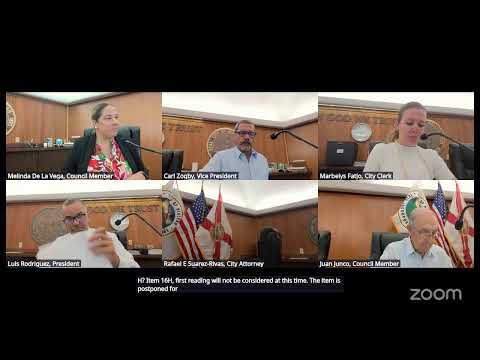
On the motion to approve the item on first reading the council recorded affirmative votes and the item was passed and set for second reading and public hearing on 2025-08-12. The ordinance and recorded declaration together create the legal obligations that the council relied on in taking the first-reading approval.
Background: the project site includes multiple parcels on Northwest 30th Court currently used for recycling and transfer operations; the applicant said manual sorting of contaminated recycling (which it estimated at roughly 75'to'85 percent contaminated) would end and that sealed intermodal containers moved by rail would replace open sorting for most material-handling activity. The applicant and city staff said the site already included a railroad spur that will be upgraded and reused.
The council's approval is a first-reading action; final action will come after the required public hearing and second reading on 2025-08-12.