Get Full Government Meeting Transcripts, Videos, & Alerts Forever!
Get email alerts on the Waste Management topic
No spam. Unsubscribe anytime.
Council backs stronger pay‑as‑you‑throw incentives and an every‑other‑week small‑cart option; staff to return with 2026 rates
Summary
Council gave staff direction to proceed with a revised solid waste rate structure that increases the financial incentive to choose smaller garbage carts and adds an every‑other‑week small‑cart service level; consultants projected increased diversion and noted a potential revenue shortfall risk that staff can manage from reserves
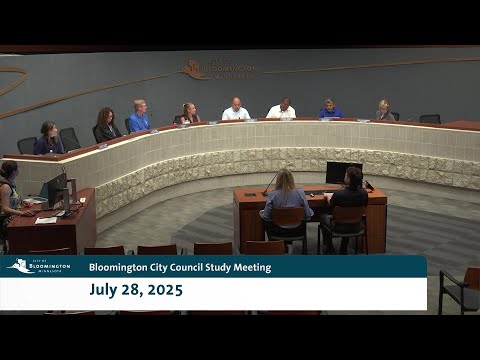
City staff and consultants presented updated 2026 solid waste rate recommendations at the July 28 study session and council signaled support for two core pieces of the plan: stronger price differentials that more sharply penalize larger garbage carts, and a new every‑other‑week service level for the smallest cart. Laura Horner, Bloomington solid waste program coordinator, described the proposal as a recalibration of the city’s pay‑as‑you‑throw (PAYT) structure to “encourage waste reduction” and to align resident prices more closely with actual disposal costs.
Consultant Dr. Lisa Skumatz (Skumatz Economic Research Associates) told council that national evidence shows PAYT is the most cost‑effective way to increase diversion because it creates a direct financial incentive to reduce landfill‑bound trash and to use recycling and organics programs. Skumatz summarized modeled effects: diversion gains from recycling, organics collection and source reduction together can reduce landfill material on the order of mid‑teens percentage points; she described a “sweet spot” for the price gap between consecutive cart sizes (roughly a 50–80 percent price increase for twice the service) that motivates customers to downsize rather than oversubscribe.
Staff framed the change against rising disposal costs. Horner said residential garbage from Bloomington is processed at the Hennepin Energy Recovery Center (HERC) and reported that HERC disposal costs rose about 34 percent from roughly $58 per ton in 2019 to about $78 per ton in 2024. The city’s negotiated contract changes (including direct payment for disposal) and the recent field and survey data from Bloomington were used to model subscriber reactions. Key modeling results presented to council included an expected increase in citywide diversion of roughly 15 percent under the recommended structure and a modeled revenue risk if residents reacted more strongly to incentives than projected: a shortfall of about $347,000 per year (roughly a 9 percent gap) in an aggressive reaction scenario. Horner said the city holds a capital reserve that could offset short‑term risk if behavioral change outpaced assumptions.
Council members generally supported adding an every‑other‑week small‑cart option and strengthening rate differentials. Council member D'Alessandro said he is “a huge proponent of every other week garbage” and asked for pedestrian data on current trail/bike usage to better forecast mode shift if facilities are enhanced. Council member Rivas supported the every‑other‑week option but suggested keeping current rates if that mitigates negative impacts for some residents. Several members emphasized communications and equity: staff said a utilities rate‑affordability task force and a racial equity impact assessment have been considered and that targeted outreach and existing assistance programs (for example, utility bill assistance through local partners) can be focused on households that might be more affected.
Timeline and next steps: staff will incorporate council input into the budget process, return with proposed rates during the budget development in October and hold a public hearing during the November adoption process so changes can be in place for 2026 if council approves. Staff also intends an early and targeted outreach campaign and a customer “blitz” so residents can choose cart sizes and haulers can prepare carts for an expected January rollout. Council provided verbal direction to proceed; no formal ordinance or rate adoption occurred at the July 28 study session.