
Proposed conversion of Clinton Hill church complex wins approval after commissioners request detailed conservation work
Get AI-powered insights, summaries, and transcripts
Subscribe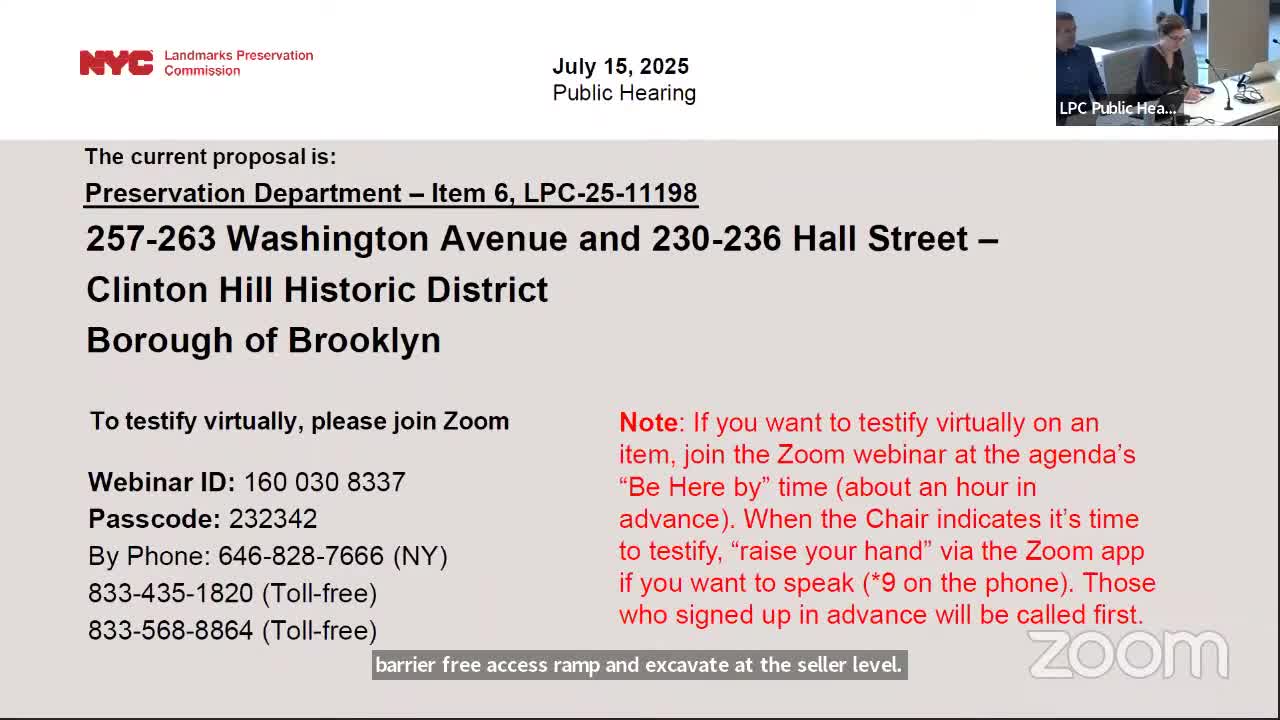
Summary
The commission approved an adaptive‑reuse plan to convert a vacant Clinton Hill church and adjoining parish house into 18 units, with rooftop and rear work and selective removal of stained‑glass panels containing religious iconography.
A proposal to convert the former Lutheran church complex at 257–263 Washington Avenue and 230–236 Hall Street in the Clinton Hill Historic District won Landmarks Preservation Commission approval on July 15 after an extended presentation and public testimony. The ownership team proposed adaptively reusing the two connected building segments — the 1894 neo‑Gothic church and a 1924 parish house — as residential units with new courtyards, a roof addition, a connector between the buildings, and restored and modified fenestration.
"We are before you today as the third owner," architect Brian Ripple said at the hearing, summarizing prior approvals and the building’s deteriorated condition. The plan calls for 11 apartments in the sanctuary block and four townhouse‑style units in the Hall Street parish house wings for a total of 18 dwelling units. To meet multiple‑dwelling‑law (MDL) light‑and‑air requirements the team proposed a new internal courtyard behind the transept, small rear insertions and inverted (cut‑in) dormers on the roof to provide compliant light to interior rooms.
The developer and architect described how they will treat historic fabric and decorative stained glass. Richard Diego, representing ownership, said the team surveyed the windows and identified maker‑attributions: "we found 3 Tiffany windows and 3 J.R. Lamb windows." The project will retain and restore non‑religious decorative glass in place where feasible, insert insulated glazing units, and remove panels with religious iconography for off‑site sale or donation. For several front lancet windows the team proposed relocating non‑religious dedication panels to upper arched sections and reinstating clear glazed, metal‑framed sash behind existing carved masonry tracery to provide daylight for apartments.
Commissioners and preservation advocates supported reusing the complex but pressed for care on several details. John Graham of the Victorian Society urged clarity on where removed windows and panels would go and recommended that significant maker windows be retained on‑site in public areas where possible. Commissioners asked for further specification of proposed framing and mullion profiles, and for additional documentation for proposed roofing materials; John Graham requested samples for the tower roof. Commissioner Goldblum urged salvaging authentic slate for the tower roof rather than synthetic slate. Several commissioners also recommended minimization of new visible rooftop elements and careful detailing of new metal cladding.
The commission's resolution approved the overall approach — the connector, rooftop and rear work, the courtyard, and the selective removal of stained glass with religious imagery — but required the applicant to work closely with LPC staff on final detailing, including: profiles and connections for new metal‑and‑glass window systems, documentation and justification for replacement roofing at the tower, the proposed patinated zinc cladding, and a plan for the long‑term disposition, protection and, where possible, reuse of significant stained glass panels. The applicant was also asked to provide fabrication and storage plans for removed stained glass and to explore keeping whole, high‑value windows (Tiffany/Lamb) on‑site in non‑residential or common spaces if feasible.