Get Full Government Meeting Transcripts, Videos, & Alerts Forever!
Get email alerts on the Public Realm And Transportation topic
No spam. Unsubscribe anytime.
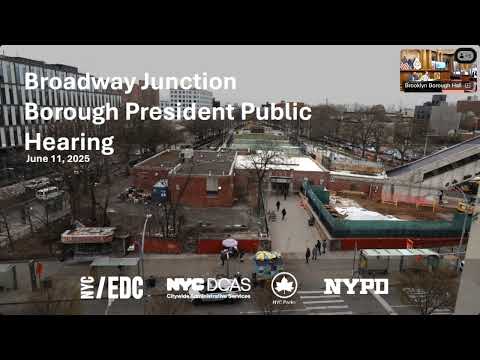
City agencies seek land‑use approvals for Broadway Junction public‑realm projects, NYPD relocation and MTA map change
Summary
City agencies presented plans on June 11 to reclaim public land around Broadway Junction Station, relocate NYPD Transit District 33, and advance a city map amendment to support an ADA station expansion.
City agencies presented plans on June 11 to reclaim public land around Broadway Junction Station, relocate the NYPD Transit District 33 facility, build two new public plazas and advance an MTA map amendment to support an ADA accessibility expansion.
Julianne Herskowitz of the New York City Economic Development Corporation told the borough board the project package has $130,000,000 in city and federal funding to improve pedestrian safety, add public open space and better connect neighborhoods to transit. “We are pleased to share that we have 130,000,000 in city and federal funding allocated to this project to improve pedestrian safety, create safer streets, better access to transit, and build new beautiful and accessible public open space in and around Broadway Junction Station,” Herskowitz said.
The public‑realm plan would deliver two new open spaces: an extension of Callahan Kelly Playground that reclaims about a half acre of parkland currently occupied by an above‑grade NYPD facility, and a roughly 5,000‑square‑foot plaza on the southeast corner of Van Sinderen Avenue and Fulton Street on an MTA‑controlled lot. The extension would create a combined park area of “over 4 acres” when combined with existing parkland, agency presenters said. The streetscape program includes improvements on Van Sinderen Avenue and Broadway to improve pedestrian and transit connections.
As part of the package, the NYPD would relocate Transit District 33 from an above‑grade, 15,000‑square‑foot facility within mapped parkland to a new purpose‑built four‑story, 35,000‑square‑foot building at a portion of 1508 Herkimer Street. Inspector Kenneth Gorman, commanding officer of Transit Borough Brooklyn, said the new facility is intended to meet operational needs without increasing staffing and will include a street‑facing community room and off‑street parking for the fleet. “This is a incredible project for us, not only to help the police department in the district, but also to help us be a better partner to the community,” Gorman said.
The project ties to a separate MTA accessibility program. Arturo Espinosa of the Metropolitan Transportation Authority said the city map amendment request would formally transfer the street bed of Sackman Street into park jurisdiction as MTA expands station access and constructs new overpasses to connect platforms and entrances. Espinosa said the MTA is working with Parks and that the map change follows prior community board review; Community Board 16 voted to approve the map change in May.
Parks staff highlighted the restored parkland benefits. Elizabeth Ernish, an urban planner at the New York City Department of Parks and Recreation, said Callahan Kelly Playground was parkland until 1982 and that restoring the former street bed to Parks jurisdiction would extend access to residents. “From 1945 until 1982, that was park. And then it was changed, and we're gonna bring it back,” Ernish said, noting that the new plaza would serve residents who currently live beyond a short walk to existing parks.
Agencies described implementation steps and workforce goals: EDC said design procurement for the streetscapes and Callahan Kelly extension is underway, with construction targeting 2028–2031 for the public‑realm projects. The NYPD facility construction is anticipated to begin in 2026 and complete by 2028. EDC said it set a 30% MWBE target for the Callahan Kelly design contract, will exceed a 7% federal disadvantaged business goal on streetscapes, set a 30% community‑hire labor‑hours target prioritizing NYCHA and economically disadvantaged neighborhoods, and announced $1,400,000 in funding to five local nonprofit workforce programs.
Public testimony included support from William Wilkins, executive director of multiple East New York economic development organizations, who urged agencies to deliver high‑quality design and stewardship. No formal vote was taken at the borough board hearing; the borough president's office will review the applications and submit recommendations to the City Planning Commission, which will hold subsequent hearings.
Distinguishing discussion from action: agencies requested borough board approval for four discretionary land‑use actions and presented supporting plans; Community Board 16’s May approval of the MTA map amendment was noted as a prior formal action. The borough board did not record a decision on the requests at the June 11 hearing.
Attribution: quotations and factual statements in this article are drawn from testimony by Julianne Herskowitz (EDC), Inspector Kenneth Gorman (NYPD Transit Borough Brooklyn), Elizabeth Ernish (NYC Parks), Arturo Espinosa (MTA), and public testimony by William Wilkins.