Get Full Government Meeting Transcripts, Videos, & Alerts Forever!
Get email alerts on the Rates Debt topic
No spam. Unsubscribe anytime.
Officials and witnesses spar over acquisition price, debt and timing of rate increases
Summary
Witnesses at the PURA hearing described a purchase structure that replaces investor equity with tax‑exempt debt and funds capital spending; company witnesses said capital needs, not acquisition premium, will drive early rate requests while municipal officials warned customers could face sustained increases.
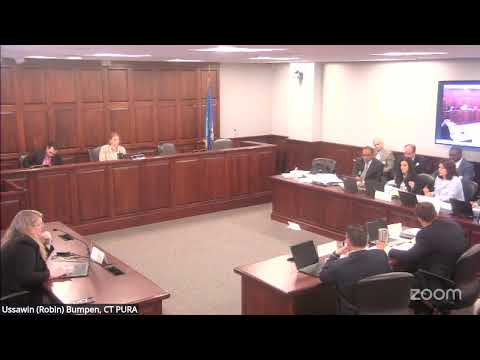
Panel witnesses and municipal officials at the Public Utilities Regulatory Authority hearing gave extended testimony about how the proposed sale of Aquarion to the Aquarion Water Authority (AWA) would be financed and how that financing would affect customer rates.
Lede: Company witnesses said the acquisition will be financed primarily with debt and that early rate requests would be driven by planned capital investment; municipal officials and interveners pressed for details on the purchase price, issuance costs, and which costs will be recovered from ratepayers.
Nut graf: The parties discussed a base purchase price and sources/uses figures cited in application materials, estimated issuance and transaction costs, how acquisition‑related debt would be structured and allocated, and two competing frames for future rates: the applicants' model of long‑term savings from tax‑exempt financing versus town officials' concern about near‑term rate pressure.
Key numbers and claims presented at hearing - Purchase price and sources/uses: Company witnesses and interrogatory exhibits discussed a base purchase price figure presented in filings near $2.25 billion and a sources‑and‑uses total on the order of $2.61 billion (transcript references to a 2.614‑billion total in the sources/uses table). Witnesses said there are conventional purchase‑price adjustments in the purchase and sale agreement. - Acquisition and issuance costs: Counsel and witnesses discussed an estimated $50,000,000 for issuance and related transaction costs (underwriters’ fees, bond counsel, surety for debt reserve, other acquisition‑related costs). - Net utility plant and fair value: Net utility plant for Aquarion plus Torrington was reported in testimony and interrogatories at about $1.765 billion (rounded), and company witnesses said a preliminary fair market value adjustment of around $300 million was estimated for an opening balance sheet, plus an intangible asset estimate (assembled workforce/reputation) on the order of ~100+ million (preliminary figures mentioned). Witnesses described preliminary accounting that would record a substantial portion of a premium as opening balance sheet fair‑value adjustments and intangible assets. - Projected savings: The applicants’ presentation and witness testimony cited a model showing approximately $365,000,000 in projected savings over the first 10 years compared with continued investor‑owned ownership (company witness called that an updated exhibitable number derived from an M&A advisor). Witnesses noted the savings estimate depends on assumptions about tax‑exempt debt spreads and cost of capital. - Rate projections and timing: Company witnesses said AWA’s first rate request would be ‘‘a little under $18,000,000’’ (testimony referencing OCC 42) and described it as representing roughly an 8.35% first‑year increase in their model; other filings referenced larger illustrative numbers (a $64,000,000 revenue deficiency figure was discussed as a comparative investor‑owned scenario and characterized in testimony as producing roughly a 31% impact in a hypothetical case). The company said a rate application would take at least six months to implement and that they do not expect to request acquisition relief in a first filing, saying the early rate requests were driven by a capital program.
Company position summarized Applicants’ witnesses said: (a) the deal is financed to replace equity with lower‑cost tax‑exempt debt, producing modeled net savings across a 10‑year horizon; (b) acquisition debt and capital needs will both be funded from debt but the first rate filings are aimed at funding the capital program rather than direct recovery of the acquisition premium; and (c) the debt structure can be optimized so acquisition debt is repaid or amortized in particular ways that reduce near‑term rate pressure.
Municipal and consumer concerns Municipal witnesses and public commenters repeatedly asked for clear accounting and timeline detail: how much of the acquisition debt will be embedded in rates, whether current rates can cover existing debt service without a new increase, and how the company will treat the excess of purchase price over net utility plant (how goodwill or premium will be treated for ratemaking). Ridgefield and New Canaan officials said even if long‑term savings exist on paper, the near‑term rate path shown in exhibits (multi‑year increases beginning with an immediate multi‑percent bump in the applicants’ model) is a source of deep concern for ratepayers on fixed incomes.
Uncertainties and evidence requests Hearing participants requested late‑file exhibits and modeling clarifications: company witnesses agreed to provide additional late‑filed exhibits for a net present value calculation of the 10‑year projected savings, a breakout of the components of the $365,000,000 savings, and a version of the AWA 10‑year revenue model with a hypothetical removal of an approximately $500,000,000 component of the acquisition (the transcript records late‑file exhibit marks for several items).
What PURA will weigh PURA will review the factual record (purchase price, fair value adjustments, sources/uses, debt structure and terms) and model sensitivity to interest rate spreads and rating assumptions; commissioners and interveners will assess whether projected savings are robust across plausible financing scenarios and whether initial and near‑term rate requests are justified by capital needs rather than acquisition premiums.
Ending: Parties agreed to submit additional exhibits and late‑file materials; municipal officials said those materials are essential for assessing whether the acquisition plan and the debt issuance strategy will protect ratepayers in the near term.