Get Full Government Meeting Transcripts, Videos, & Alerts Forever!
Get email alerts on the Governance topic
No spam. Unsubscribe anytime.
Town officials warn AWA governance plan hands control to outside authority majority
Summary
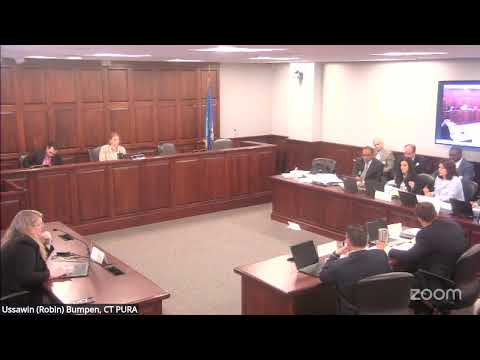
Town officials from New Canaan, Ridgefield and other Aquarion service communities told the Public Utilities Regulatory Authority hearing that the governance structure set out for the Aquarion Water Authority (AWA) hands meaningful control to outside appointees and risks weakening local oversight.
Town officials from New Canaan, Ridgefield and other Aquarion service communities told the Public Utilities Regulatory Authority hearing that the governance structure set out for the Aquarion Water Authority (AWA) hands meaningful control to outside appointees and risks weakening local oversight.
In testimony and public comment, First Selectman Diana Carlson of New Canaan said the AWA structure “eliminating PURA’s regulatory expertise and allowing the purchaser to essentially regulate itself is a recipe for disaster for our towns,” and argued a 60‑member representative policy board (RPB) would be impractical as a check on the authority board. First Selectman Rudy Marconi of Ridgefield testified the large RPB and proposed majority of Regional Water Authority (RWA) appointees would reduce residents’ ability to influence decisions that affect rates, capital projects and land use.
Why it matters: The enabling legislation (special act creating AWA, amended by Public Act 24‑1) assigns key powers to two bodies: an authority board that will make many operational and financial decisions, and a large RPB drawn from municipalities in the Aquarion service area. Several municipal officials said the statutory design—calling for a majority of RWA‑appointed authority members during transition—would give control to officials who are not residents of the communities they would govern, raising concerns about conflicts of interest and democratic accountability.
Testimony highlights and objections - Carlson (First Selectman, New Canaan) told the panel she and constituents value Aquarion’s existing, long‑standing regulation by PURA and are worried that shifting final approval for rates, budgets and capital projects into an RPB that is “a 60‑person board” will produce less careful review than PURA’s processes. She said the RPB’s size and part‑time membership would limit its ability to scrutinize complex utility decisions. - Marconi (First Selectman, Ridgefield) stressed the local service consequences, including for seniors and other rate‑sensitive households, and said the RWA/ AWA arrangement places decision‑making power at the authority level while the RPB would be positioned to only “rubber stamp” authority proposals. - Mayor Michael Loretti of Shelton, in public comment, told the hearing his city has been well served by Aquarion and said he is “not sure” where the public benefit is in transferring control to a different governing structure.
How the proposed governance would work, as explained at the hearing - The enabling legislation sets the AWA authority board and a 60‑member RPB of municipal representatives. During the initial period, members of the RWA authority would serve in AWA roles until AWA’s governing bodies are constituted. - The RPB will have role(s) that include reviewing and approving certain large capital projects, bond issuances and land dispositions, and has committees such as finance and consumer affairs that will review technical materials before RPB consideration. Municipal officials told the hearing they are unclear how committee inputs and committee votes will translate into effective oversight for many technical or financial decisions.
Questions raised and requested changes Municipal witnesses repeatedly asked for one or more of the following: clearer, written guarantees on how authority and RPB powers would be exercised; assurance that AWA’s governing majority would not be controlled by out‑of‑area appointees; or a near‑term legislative or structural commitment that the AWA board composition would more closely reflect the Aquarion service area. Witnesses said they would “take under advisement” legislative changes but could not commit to immediate fixes.
What was not decided No final change to the enabling law or binding schedule for appointments was adopted at the hearing. Parties discussed the possibility of conditions or post‑approval commitments, but municipal witnesses said statutory change, not a nonbinding memorandum, would be the surest remedy.
Looking ahead Municipal leaders asked PURA to weigh whether the statutory framework preserves adequate consumer protection and whether processes (interrogatories, OCA review, public hearings) can substitute for continued PURA oversight. Several witnesses asked for more concrete, written commitments on board composition or RPB mechanisms to prevent conflicts and ensure local input.
Speakers quoted in this article are identified in the meeting record as First Selectman Diana Carlson (New Canaan), First Selectman Rudy Marconi (Ridgefield) and Mayor Michael Loretti (Shelton).