Get Full Government Meeting Transcripts, Videos, & Alerts Forever!
Get email alerts on the Housing Eviction topic
No spam. Unsubscribe anytime.
Schenectady council introduces 'good cause' eviction local law but defeats motion to schedule public hearing, 4-2
Summary
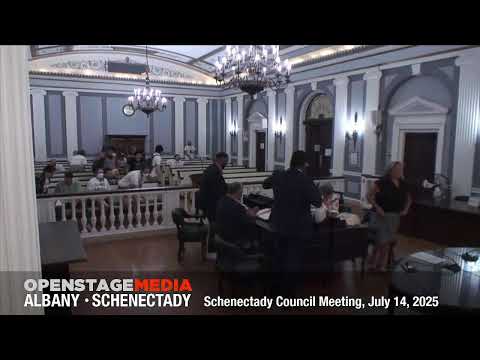
The Schenectady City Council introduced a local law to prohibit evictions without good cause on July 14, 2025, after a lengthy public comment period. A separate motion to call a council public hearing on the proposal was defeated 4-2; the local law remains introduced and will lay over according to statutory timelines.
The Schenectady City Council on July 14 introduced a local law to add Article 5, §2-10-20 to the Schenectady City Code, a measure described in the meeting as a local prohibition of eviction without good cause. After about two hours of public comment from tenants, landlord representatives, advocates and other residents, the council voted down a motion to call a formal public hearing on the proposal by a 4-2 margin.
The local law language was read into the record at the start of the meeting; Council Member Mutavarin moved to call a public hearing and Council Member Patrick seconded the motion. During the roll call on the motion, Council Member Porterfield explained she was voting yes because “this is simply calling for a public hearing, giving the public an opportunity,” but the motion failed. Council members who were recorded saying “no” during the roll call included Mancini, Mutavarin and Patrick; the clerk recorded two affirmative votes and the presiding officer later stated the motion was defeated 4 to 2.
Why it matters: supporters say the measure would protect tenants from arbitrary or retaliatory displacement and curb steep rent increases; opponents — including groups representing small landlords and some individual property owners — warned it could increase costs, vacancies or legal burdens on owners. The debate drew roughly two dozen speakers and a mix of local and regional tenant-research data presented to council members.
Supporters’ arguments and testimony
Tenant advocates and many individual renters urged the council to opt into the state-authorized good cause eviction framework. Canyon Ryan, executive director of United Tenants of Albany, told the council his group’s analysis shows “1 in every 10 renters across the city face eviction here in Schenectady,” and summarized publicly available eviction types and rent trends he had distributed to the council. Several speakers referenced a mailed petition: Jamaica Miles said organizers submitted “194” signatures, of which “148” were from Schenectady residents.
Other tenants and advocates described personal hardship and health concerns. One speaker said the city should use the option New York State allows to adopt a local good-cause standard because “you can still evict someone for non payment of rent. You can evict someone for violation of the lease,” while adding that the law would prevent “random” or retaliatory non-renewals.
Supporters cited data on rents and income growth presented at the meeting. Canyon Ryan told council members that fair-market rents for 1- and 2-bedroom units increased by about 44% and 41% respectively between 2020 and 2025 while area median income rose about 17% over the same period, an imbalance Ryan said supports protections for tenants facing displacement.
Opposition from landlords and small-owner groups
Representatives of landlord organizations and several small property owners urged the council not to opt in. Chris Morris, who identified himself as founder and director of SLIC (an organized group of small landlords and property managers), described a voluntary preferred-properties program his group helped draft and asked the council to pause before adopting the state law locally.
Individual landlords and small-owner speakers cited operating-cost increases (insurance, materials, taxes, legal fees) and the time and expense of eviction as reasons to oppose adding a local good-cause rule. Several speakers said existing state law already provides remedies for retaliation and unsafe housing; one speaker identified New York State Real Property Law sections 223-b and 235-b as existing legal protections mentioned during testimony.
Legal and procedural status
The measure was formally introduced on the council agenda as “A local law to create article 5 section 2-10-20 to chapter 2-10 of the Schenectady City Code — prohibition of eviction without good cause.” The council separately considered a resolution to call a public hearing on that proposed local law; that resolution was the subject of the roll-call vote and failed 4-2. The presiding officer and the clerk explained on the record that the local law text has been introduced and will “lay before the council” for the statutorily required period; it was not adopted that night.
Quotes from the meeting
"What we can do, very realistically, is do what New York State has already given us the opportunity to do, which is pass good cause legislation in Schenectady," said James Cimino, a public commenter who identified himself as speaking in favor of good cause protections.
"1 in every 10 renters across the city face eviction here in Schenectady," Canyon Ryan, executive director of United Tenants of Albany, told the council while summarizing distributed data.
"Good cause eviction does not eliminate a landlord's right to evict," said Valerie Triano, a public commenter and local resident who urged the council to opt in, summarizing one of the law’s stated effects.
"This is simply calling for a public hearing, giving the public an opportunity," Council Member Porterfield said while explaining her affirmative vote on the motion to schedule a hearing.
What happens next
Because the local law language was introduced at the July 14 meeting, it will lie over according to the municipal code and the city’s corporation counsel’s explanation; a separate public hearing may still be scheduled later if the council reintroduces or reconsiders a motion to call one. Council members and multiple public speakers at the meeting urged additional data collection and outreach; some asked for studies of local eviction executions and holdover/nonrenewal practices before final council action.
The meeting record shows a heavily contested local debate on housing stability and landlord rights; the introduction of the ordinance keeps the measure on the municipal timeline but the failed hearing vote means the council did not immediately open the formal public-hearing phase required to advance this particular local-law adoption process.