Get Full Government Meeting Transcripts, Videos, & Alerts Forever!
Get email alerts on the Good Cause Eviction topic
No spam. Unsubscribe anytime.
Schenectady residents and landlords spar over opting into New Yorks good-cause eviction law
Summary
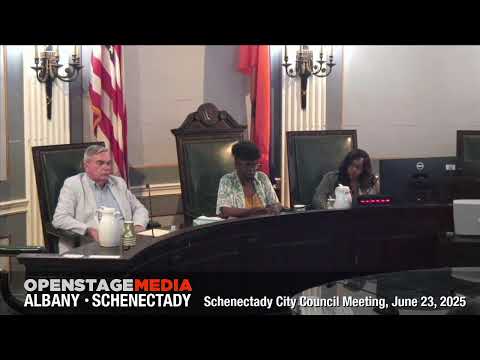
Dozens of residents, tenant advocates and landlords filled the public gallery at the Schenectady City Council meeting on June 23, 2025, to press the council on whether the city should opt into New York State's 2024 good-cause eviction law.
Dozens of residents, tenant advocates and landlords filled the public gallery at the Schenectady City Council meeting on June 23, 2025, to press the council on whether the city should opt into New York States 2024 good-cause eviction law.
Supporters said the law would give tenants stability and a safeguard against retaliatory nonrenewals; opponents said it would increase operating costs, prolong evictions and push small landlords out of the rental market.
The debate drew speakers from tenant-organizing groups and landlord associations, and several council members spoke in support of continuing a factual discussion about the ordinance.
"If that eviction can be avoided, it should be," said Colin McNamara, a member of the public who addressed the council during privilege of the floor. Several tenant advocates described cases where tenants said they faced sharp rent increases or nonrenewals after complaining about housing conditions. Bevin Francis, a tenant organizer with United Tenants of Albany, told the council the law "kept me in my home" and that it allows tenants to challenge rent increases and avoid retaliatory evictions.
United Tenants of Albany executive director Canyon Ryan described Albanys experience: the city opted in after state law allowed local opt-ins, and Ryan said municipalities can set policy choices such as the fair-market-rent exemption and the definition of a "small landlord." He said those design choices matter in determining who receives protection.
Opponents, including speakers identifying themselves as members of Schenectady Landlords Influencing Change (SLIC) and individual small landlords, said the law will raise legal and operational costs and make it harder to remove problem tenants. Chris Morrison, who identified himself as cofounder and director of SLIC, read a statement from a senior small-owner member who warned the law could push small owners "in the red" and force them to stop renting.
Speakers on both sides invoked exemptions and implementation choices discussed in other municipalities. Colin McNamara and others noted the meetings discussion of the fair-market-rent exemption; one speaker said the statute lists a 245% fair-market-rent exemption tier, and Canyon Ryan said Albany set that threshold at 345% to expand coverage in that city. Ellie Pepper, a longtime Schenectady homeowner who urged the council to opt in, summarized how rent increases are treated under the statute as a benchmark: "Under good cause, a rent increase is presumed unreasonable if it is higher than 5% plus the consumer price index," and she applied the councils regional inflation number as an example during public comment.
Several tenant advocates urged the council to pair any opt-in with tenant education and stronger code enforcement so tenants know and can use their rights. Proponents emphasized that owner-occupied small buildings and new construction are carved out by the state law and that municipalities can set definitions for small-portfolio landlords.
Council members spoke about weighing lived experience and written evidence. Council Member Williams and Council Member Farley each said they were persuaded that the measure merits careful review; Williams said he was a "huge supporter" of the policy given tenants' lived experiences, and Farley said he had read the law "front and back" and urged colleagues to do the same.
No formal vote to adopt or reject the state opt-in was recorded at the June 23 meeting; several council members said they expected further committee discussion. Council Member Williams said he looked forward "to having a candid factual discussion next week."