Get Full Government Meeting Transcripts, Videos, & Alerts Forever!
Get email alerts on the Operations And Cip topic
No spam. Unsubscribe anytime.
Punta Gorda utilities report: June flows near normal; city advancing alum tank replacement, ammonia conversion and meter‑reading contract
Summary
Utilities Director Tom Spencer reported June water and wastewater metrics and updated the Utilities Advisory Board on multiple capital projects, a new meter‑reading contract and upcoming plant tours.
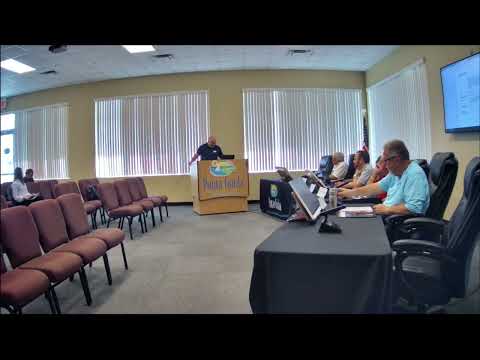
Tom Spencer, Punta Gorda’s utilities director, told the Utilities Advisory Board July 28 that system operations were within normal ranges for June and reviewed several capital projects and contract awards moving forward.
For June, Spencer reported the city’s average daily water to town was about 4.7 million gallons and peak daily water was about 5.9 million gallons; combined surface‑water and RO production capacity is 11.73 million gallons per day. “The combined surface water and RO production is 11.73,” Spencer said. He reported total to‑town production for June of 141,168,000 gallons and noted the reservoir level rose from 5.47 feet on June 1 to 5.84 feet as of the meeting. Rainfall for June was 8.35 inches, modestly above the long‑term average.
Spencer said blended water TDS (total dissolved solids) has averaged below 500 ppm and described normal seasonal variation at the intake. He also told the board the wastewater treatment plant’s average daily flow for June was about 2.98 million gallons, with a three‑month rolling average near 2.52 million gallons and a peak of about 3.81 million gallons.
Capital projects and contracts Spencer reviewed multiple ongoing capital projects and recent contract awards: the city has launched work on alum‑tank replacement and conversion from gaseous ammonia to liquid ammonium sulfate (a project combined with acid‑feed replacement), which staff said will increase operational flexibility. He said the alum and ammonia conversion kickoff meeting occurred recently and estimated about a one‑year completion horizon for the combined work, while noting some elements had been in planning and engineering for multiple years.
The board was also briefed on an award to Odyssey Manufacturing of Tampa for construction improvements related to alum and ammonia equipment, and on authorization for chrome coatings and tank interior coatings on master and booster tanks. Spencer said the city authorized a new meter‑reading agreement with Olameter under a per‑meter payment structure that includes deficiency penalties if meters are not read.
Spencer told the board that the city requested award authority under a master agreement to CDM Smith for biosolids handling and off‑site disposal and said CDM Smith has been instrumental in building the wastewater treatment plant improvements. He reported the wastewater plant remained ahead of schedule and on budget and that startup and training of a new diffuser system should enable flow tests in August.
Other staff updates and tours Spencer said an advanced metering infrastructure (AMI) study is ahead of schedule and that staff will host public tours of the water and wastewater plants; Spencer said he would personally guide several tours given robust community signups. He also said that several routine utility agenda items had been approved by city council and highlighted a resolution recognizing public‑works and utilities staff as first responders in alignment with federal guidance, the American Public Works Association and Florida statute 403.865 as an important formal recognition of operational responsibilities during storms.
What the board asked Board members pressed on project timelines, the history of long planning cycles for some large projects, and the need to secure grants and other funding. Spencer said the city is seeking grants, has filed notices of interest on some programs and expects notification of some grant opportunities within 30–60 days; the full application and selection process for grants typically can take months to a year. On the RO plant expansion and alternatives such as purchasing finished water, Spencer said the RO plant draws from wells and that prior water‑supply analyses found building out the RO plant was more cost‑effective than buying finished water via a Peace River connection, though he said alternative supply analyses could be pursued if council directs staff to do so.
Operational context Spencer framed the work as necessary to maintain current capacity and reliability rather than to add speculative future capacity: “The expansion of the RO plan isn't to meet any proposed or new growth. It's to meet the demand and the needs that are currently there,” he said.
Next steps Staff will continue CIP work, procurement for remaining projects, and outreach on grants. The board requested more detailed briefings on specific projects for future meetings and offered to participate in tours and outreach to help explain projects and timelines to the public.