Get Full Government Meeting Transcripts, Videos, & Alerts Forever!
Get email alerts on the Agritourism topic
No spam. Unsubscribe anytime.
Montgomery County committee hears state and local plans to standardize agritourism rules, add signage and marketing
Summary
County staff, state agencies and Visit Montgomery outlined ongoing studies and local steps to clarify agritourism definitions, add wayfinding signage and develop marketing while warning there are no immediate regulatory changes or votes.
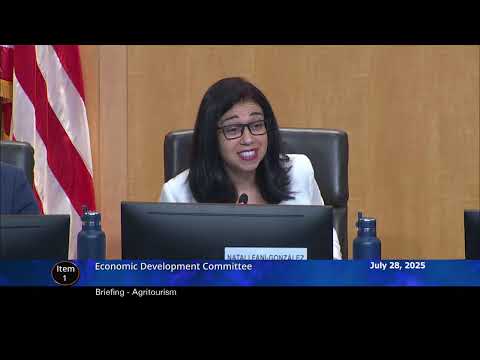
Natalie Fanny Gonzales, chair of the Montgomery County Council Economic Development Committee, opened a work session Wednesday to brief the council and stakeholders on state and county work on agritourism and “value‑added” agriculture. The session featured updates from the Maryland Department of Agriculture, the Maryland Department of Commerce, Montgomery County Planning, Montgomery County Office of Agriculture and Visit Montgomery.
County and state officials said the presentations were informational; no votes or formal policy actions were taken at the session. The discussion focused on three near-term products: a Maryland Department of Agriculture (MDA) guidance document expected in September 2025, a Maryland Department of Commerce study ordered by House Bill 1228 and local implementation steps including a $25,000 wayfinding grant administered through the county Office of Agriculture.
The Maryland Department of Agriculture presented a statewide guidance draft aimed at “establish[ing] a baseline understanding of the complexities of regulating agricultural enterprises as they expand toward consumer‑facing and value‑added functions.” Audrey Broomfield, representing the department, said the work grew from roundtable discussions across counties and that the guidance will not itself make formal state or local policy changes but will identify “topics, challenges, and opportunities” for regulators and stakeholders. “With an expected publication date in September 2025, the statewide guidance and analysis documented for value added agriculture is still being drafted and county visits are still being conducted,” Broomfield said.
Jen Lahat of the Maryland Department of Commerce said the department is staffing a high‑level study mandated by House Bill 1228 that will inventory existing data and stakeholders and build a work plan; Lahat said the study has an initial deadline the department expects to meet and that Commerce will convene local partners named in the bill — including Montgomery County Planning, the Office of Agricultural Services, University of Maryland Extension and Visit Montgomery — to identify data gaps and next steps.
Local planning and agricultural staff briefed the committee on county work already under way. Patrick Butler, Upcounty division chief for the Montgomery County Planning Department, summarized the county’s 2019 agritourism study, which he said identified more than 30 potential solutions to support agritourism while protecting the Ag Reserve’s primary farming purpose. Butler noted the study reached majority endorsement on many recommendations but that the advisory committee did not achieve consensus on more prescriptive zoning changes such as an overlay zone or new agritourism zoning standards.
Mike Schuffel, director of the Montgomery County Office of Agriculture, described an initial $25,000 MDA grant referenced in the state budget (Senate Bill 360) that the county will use for roadside wayfinding signs modeled on the state’s T.A.C. corridor signage program. “We believe we have a good path working forward at least for this initial $25,000 grant,” Schuffel said, adding the county expects to enroll roughly eight to 10 agritourism businesses in the pilot sign program and is coordinating with the Maryland State Highway Administration and the county Department of Transportation on jurisdictional issues for signs on state and county roads.
Visit Montgomery told the committee it is developing a branded agritourism product for the county, funded in part by an Economic Development Administration grant administered through the Maryland Office of Tourism. Kelly Groff, president and CEO of Visit Montgomery, said the marketing work includes farmer and consumer surveys, a brand audit and pilot tours; the consultant Civic Brand will present draft brand work in August and Visit Montgomery plans to test themed tours and a narrative tour product.
Committee members and presenters spent much of the session discussing the absence of a single county definition of agritourism and the operational uncertainty that creates for farmers and enforcement staff. County staff noted that the zoning ordinance currently does not contain a separate agritourism use; instead, agritourism activities are treated under the county’s definition of farming (Chapter 59). Staff presented policy pathways for the council to consider, including limited uses with strict parameters or conditional uses that would be reviewed by administrative hearings, to provide clear rules for outdoor event venues and other activities that fall between traditional farming and a commercial enterprise.
Council members raised workforce and land‑access concerns as central to the long‑term viability of county agriculture. Speakers emphasized the reliance of many pick‑your‑own operations on the federal H‑2A seasonal worker program, the aging demographic of farmers, and the difficulty new and beginning farmers face in acquiring land. County staff reported roughly 93,000 acres in the Ag Reserve and said about 24,000–25,000 acres are under purchase, development rights or easements at any given moment. Office of Agriculture staff and council members noted the county offers farmland preservation tools and has piloted programs with the state to assist new‑generation farmers, but they cautioned that land acquisition is time consuming and that multiple ownership forms (including trusts) complicate transactions.
No formal policy changes or votes were taken. Committee members directed staff to continue coordination with state agencies and local implementers and signaled interest in a future joint work session of the Planning, Housing and Parks Committee and the Economic Development Committee once the state and county studies are further advanced.
Montgomery County staff and state partners said they will hold public engagement events in the Ag Reserve and Upcounty areas after the MDA guidance and Commerce study are published so residents, legacy farmers and newer farmers can comment. The committee adjourned without action.