Get Full Government Meeting Transcripts, Videos, & Alerts Forever!
Get email alerts on the Housing Troubled Properties topic
No spam. Unsubscribe anytime.
County staff report sharp drop in troubled multifamily properties; new regulation and fixed scoring proposed
Summary
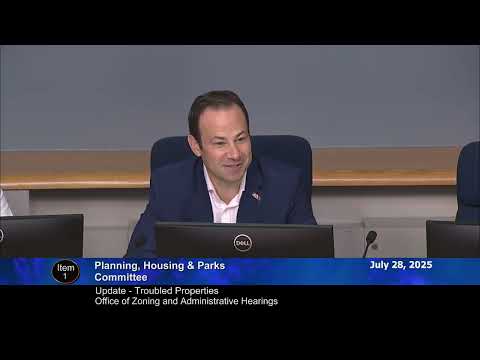
At a Planning, Housing and Parks Committee work session, Department of Housing and Community Affairs officials presented preliminary FY25 troubled‑properties data showing fewer troubled and at‑risk multifamily properties and outlined proposed changes to Executive Regulation 1‑25 to speed scoring, inspections and notification.
At a Planning, Housing and Parks Committee work session, Department of Housing and Community Affairs officials on July 15 presented preliminary fiscal‑year 2025 troubled‑properties data and described proposed changes to Executive Regulation 1‑25 meant to speed scoring and inspections and reduce repeat violations.
The report showed preliminary FY25 counts of about 30 troubled properties and 58 at‑risk properties, down from prior years, and described operational changes including a new fixed scoring method, a 30‑day target to provide inspection scores, and escalated fees for reinspections after the first two free visits.
The information matters because troubled‑property designations trigger annual inspections and enforcement steps intended to protect tenants’ health and safety. Committee members said the decline suggests improved compliance and that recent rent‑stabilization requirements are influencing owner behavior.
Scott Bruton, director of the Department of Housing and Community Affairs, and Nathan Bovell, division chief for community development, told the committee the FY25 numbers are preliminary and the department must finalize the full troubled‑properties report, which the county is required to submit by Sept. 15. "The full report for FY25 will be coming out later this fall," Bruton said. Nathan Bovell described the proposed regulation changes, including the move from a year‑end, average‑based quadrant system to fixed scores that can be issued within 30 days of an inspection.
Tamela Robinson, manager for code enforcement, provided inspection and operations detail: the department currently employs 37 full‑time inspectors, with two multifamily inspectors on extended leave and two program‑manager vacancies being recruited; typical time from a requested inspection to an on‑site inspection averaged about 90 days; compliant multifamily properties are inspected every three years, at‑risk properties typically every one to three years (usually two), and troubled properties are inspected annually while they retain that designation.
Staff said 12 properties resolved all noted violations between the initial inspection and the first reinspection in FY25, a signal of improved responsiveness. Of 21 properties that requested reinspections this year, 19 reinspections were performed; two were previously classified under earlier fiscal years and did not require a new inspection after meeting corrective requirements.
The proposed Executive Regulation 1‑25 amendments, staff said, would: - Replace the prior end‑of‑year quadrant averaging method with fixed TV (total violation) and SV (serious violation) score thresholds so a property’s designation (troubled, at‑risk, compliant) can be determined within 30 days of scoring; if both TV and SV are high the property is troubled, if only one is high it is at‑risk, and if both are low it is compliant. - Allow properties a pathway to change a troubled or at‑risk designation by requesting inspections and meeting set corrective actions rather than waiting through the fiscal‑year cycle. - Set inspection fees so the first and second inspections are free and subsequent requested inspections incur escalating fees, mirroring existing reinspection fee structures. - Require the department to notify properties of their scores within 30 days of scoring analysis being complete.
Bovell said the fixed‑score approach was a major request from property owners because it provides predictability, but that it would also allow faster mitigation of hazards for tenants. "It gives better predictability. It allows us to respond much more quickly," he said.
Committee members and staff described operational changes that likely contributed to the lower counts: many large property owners engaged third‑party maintenance contractors or consultants to perform pre‑inspections, assist with corrective action plans and tenant work‑request logs, and to accompany county inspectors to make and quickly remediate identified violations. Bruton and Bovell said the department will further review tenant work‑request logs to determine whether tenant service requests are being resolved as part of those changes.
Staff described internal and interagency steps to simplify complaint handling for tenants who contact multiple county offices. The Office of Landlord Tenant Affairs and the Office of Rent Stabilization sit within DHCA and consult daily on intake; division staff are coordinating with the Office of Consumer Protection on draft standard operating procedures to route incoming complaints to the appropriate office and to ensure feedback loops among offices.
Committee members asked how the department would detect short‑term or cosmetic fixes, such as freshly painted over mold. Robinson said some practice may temporarily conceal conditions but that complaint intake and follow‑up reinspections remain tools to catch recurring or concealed hazards; staff said they will scrutinize corrective action plans and tenant request logs for troubled properties and may schedule follow‑up inspections sooner than the routine cycle when warranted.
Staff also reported work to upgrade the inspectors’ field application, an iOS app used to collect photos and inspection data. Bruton said the county has contracted coders to reduce crashes when large property uploads occur and to speed data export so scores can be calculated more quickly.
No formal committee action was taken on troubled‑property policy at the session. Staff said they are in discussions with the county attorney and expect to transmit the finalized Executive Regulation 1‑25 to the council in September for formal consideration; the final FY25 troubled‑properties report will be submitted by the statutory Sept. 15 deadline.
Next steps: DHCA will finalize the FY25 troubled‑properties report for the council, continue work on Executive Regulation 1‑25 with the county attorney and stakeholders, complete the field app upgrades, and publish standard operating procedures coordinating intake among DHCA programs and related offices.