Get Full Government Meeting Transcripts, Videos, & Alerts Forever!
Get email alerts on the Dui Suppression topic
No spam. Unsubscribe anytime.
Judge grants suppression of blood-test evidence in Patrick Moss DUI case, finds officer conduct coercive
Summary
A State Court of Clayton County judge granted Patrick Moss’s motion to suppress blood-test results, finding that the officer’s conduct and sequence of events produced coercive consent while Moss was in custody.
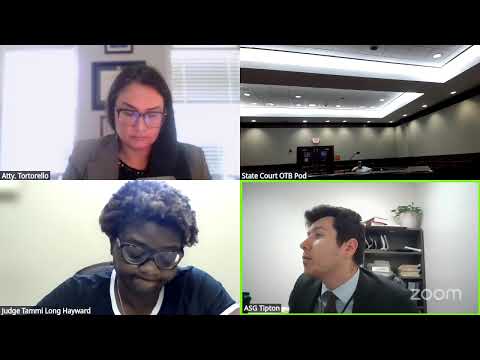
Judge Tammy Long Hayward granted a motion to suppress blood-test results in State of Georgia v. Patrick Moss after finding that the totality of the circumstances showed the defendant’s consent to a blood draw was obtained through coercive police conduct. The hearing on the motion unfolded before Judge Hayward in a criminal motions calendar session in Courtroom 304.
At a hearing, defense attorney M.J. Tortorello argued that Moss’s consent to a state-administered blood test was not voluntary and was the product of coercion, citing Kendrick v. State and contending that Officer Stanley Shelby’s language and the timing of requests while Moss was in custody rendered the consent invalid. Tortorello told the court: “This was not a valid consent made by my client based on the totality of the circumstances as he was under arrest and was told by the officer that he needed to take the blood test.”
Assistant Solicitor General William Tipton opposed suppression, arguing the state had followed standard procedures: the implied-consent card was read, later a consent form was presented, and the defendant signed. Tipton cited case law and urged the court to find the consent knowing and voluntary.
The hearing included the stipulation by both sides to play portions of Officer Shelby’s body-worn camera. Shelby testified he read the implied-consent warning at the scene, that Moss initially declined field sobriety testing, and that later, at the jail during intake more than an hour after arrest, Shelby asked again about a blood test. Shelby testified he took Moss’s nod as consent and that he had shown Moss a document for signature related to the blood draw.
Defense counsel highlighted video excerpts in which Shelby says, “you have to submit to the blood test,” and noted that Moss appeared to stare and then nod while in custody. Tortorello emphasized that Moss was under arrest and had been in custody for roughly an hour and 40 minutes by the time the jail intake request occurred. The defense argued those facts and the officer’s statements rendered any consent involuntary under the Fourth Amendment.
After hearing argument, Judge Hayward ruled that, based on the totality of the circumstances — including the order in which implied consent was read, the timing of the arrest and subsequent jail processing, and the officer’s statements while Moss was in custody — the officer’s actions were coercive. The court stated it would “grant the motion to suppress and find that the fruits of the blood test should be suppressed.”
The court directed that a written order be prepared (clerk Miss Powell was identified to prepare the order) so parties could proceed as needed. No jury or bench trial decision was made at that hearing; the ruling suppresses the blood-test evidence only. The parties may pursue other evidence or seek appellate review according to applicable procedure.
Speakers in the hearing included Judge Tammy Long Hayward; M.J. Tortorello, attorney for Patrick Moss; Assistant Solicitor General William Tipton for the State; Officer Stanley Shelby of the Clayton County Police Department; and Patrick Moss, the defendant.
Background and context: the defense relied on Georgia case law (Kendrick v. State) and federal Fourth Amendment principles summarized in Schneckloth v. Bustamante to urge exclusion of the blood-test results as coerced. The prosecution cited precedent requiring suppression only where coercion or force is shown and emphasized that an implied-consent reading was given at the scene and that a later written acknowledgment was completed. The court’s suppression order explicitly rests on its assessment of coercion under the totality-of-the-circumstances test.
What this means: The suppressed blood-test results cannot be used by the State at trial unless the ruling is reversed on appeal or unless the State obtains admissible laboratory results through another lawful method (for example, a warrant-based procedure). The court’s finding addresses only the voluntariness of the consent to the blood draw; other charges and evidence not affected by the suppressed sample remain subject to normal proceedings.
Ending: The court instructed Miss Powell to prepare an order reflecting the suppression. No immediate further dispositions were made on the underlying DUI counts at the hearing; the case record will reflect the court’s suppression ruling and any subsequent filings by the parties.