
Lansing City staff recommends keeping mill levy flat at 41.909 mills as assessed valuation rises
Get AI-powered insights, summaries, and transcripts
Subscribe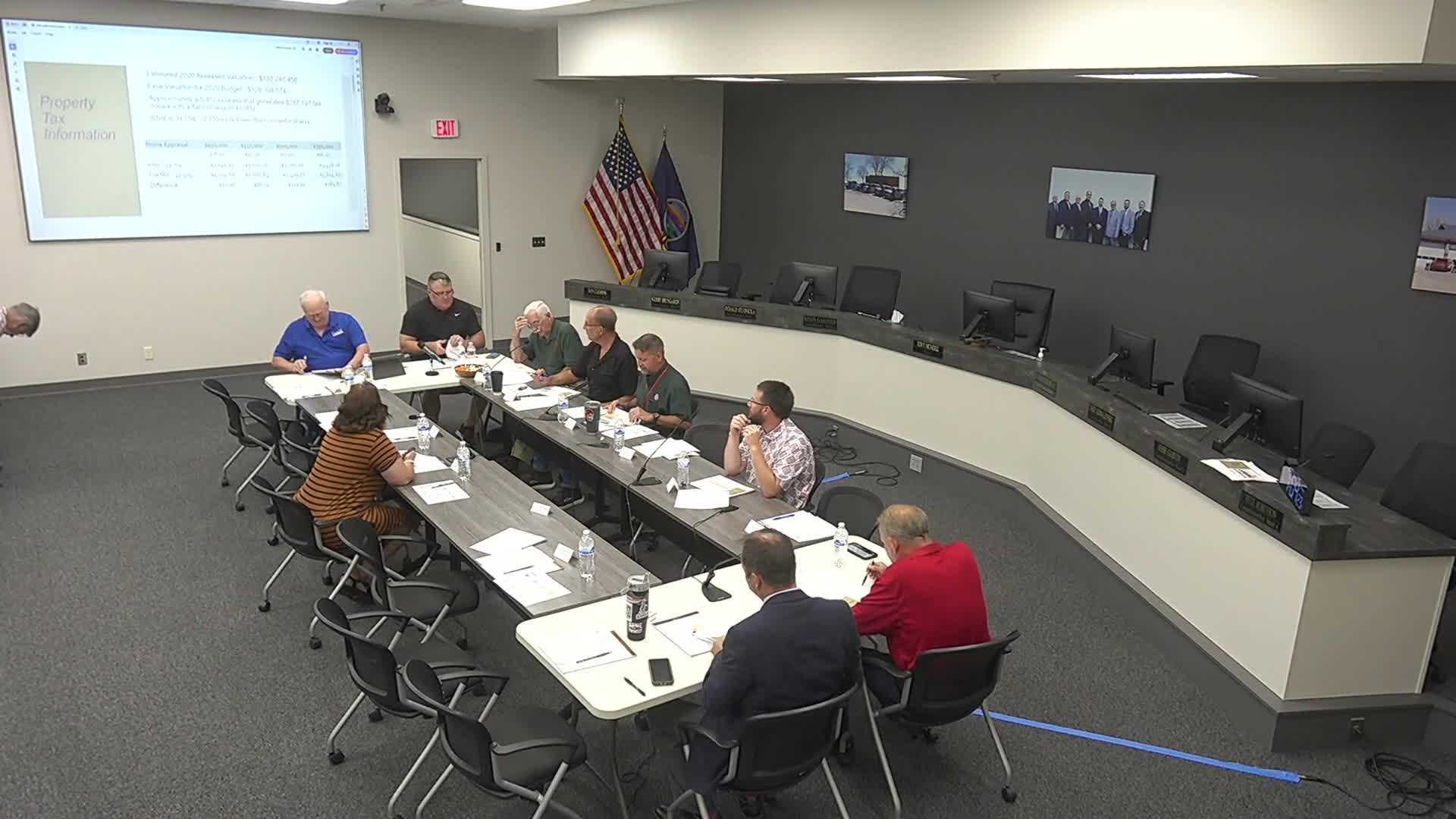
Summary
City staff told the Lansing City work session the estimated assessed valuation rose slightly, generating roughly $287,000 more in tax revenue; staff proposed holding the mill levy at 41.909 mills, budgeted $225,000 for a comprehensive plan and plans to notify the county clerk and publish a hearing notice this summer.
At a Lansing City work session, staff said the city’s estimated assessed valuation arrived at $133,000,247,450, about $287,000 higher than the final 2025 valuation, and proposed keeping the 2026 mill levy flat at 41.909 mills.
That proposal matters because the higher valuation would generate roughly $287,000 in additional ad valorem tax revenue while the budget already includes $225,000 for a comprehensive plan, a staff member said.
City staff explained the difference between the city’s proposed flat mill levy and the revenue-neutral (R and R) rate. “For the 2026 budget, the R and R rate would be 39.754,” the staff member said, adding that maintaining the proposed 41.909 mills would yield more tax dollars than the R and R figure.
Officials walked the council through how a flat mill levy would affect typical homeowners, noting examples for houses ranging from $250,000 to $750,000 and stressing that the figures discussed were annual property-tax differences. The staff member emphasized the city portion only: “This is just the city,” referring to the tax-change examples.
Council members asked about the comprehensive-plan line item and whether the $225,000 figure was a firm contract price or an estimate; staff responded it was an estimate and that proposals were expected in early 2026. The presenter said the $225,000 was “baked in” the draft budget and that some contingency was included because exact proposals had not yet been received.
Staff reviewed fund-by-fund impacts and reserve levels, saying the city’s ending reserve was 2.7% at the end of 2024 and that a conservative beginning balance for 2026 had been modeled; staff said the projection would “maintain us for right now” but would not substantially rebuild reserves. They noted prior years of using reserves when budgets were revenue-neutral.
The presentation covered constraints on mill-levy-controlled funds: certain levies are effectively fixed by purpose (debt service, library, fire). The library budget must meet state conditions to qualify for grants, staff said, and Delaware Township currently pays 9 mills for fire service — a factor the city tries to match when setting its levies.
Capital projects and special funds were discussed. Staff said leftover bond proceeds from the parks/aquatic facility will be transferred to the debt service fund when the aquatic project is complete, and that the Town Center sanitary-sewer project’s completion is likely to slip to about October because of rock in the project area. The Police Equipment Reserve Fund’s anticipated cost for in-car camera systems was reported to have decreased after staff confirmed the needed camera count.
On timeline and next steps, staff said the city must notify the county clerk about any intent to exceed the R and R by July 20 and proposed publishing the public notice on Aug. 1, with the required hearing scheduled between Aug. 20 and Sept. 20. Staff noted the state changed the hearing procedure this year — the hearing must be opened, then a vote taken, then the hearing closed — and said they will remind the council of that sequence at the formal hearing.
After the presentation, staff said they would notify the county clerk of the city’s intent to publish a flat mill-levy notice unless the council directed otherwise.
Less critical details discussed included special-parks revenues (staff budgeted $130,000 for the pool and reported $48,000 in receipts so far), and the council heard that transfers from the general fund to special parks would be considered later in the season only if revenues fell short of operating costs.