
DHCD outlines FY2026 federal housing allocations, schedules follow-up public hearings
Get AI-powered insights, summaries, and transcripts
Subscribe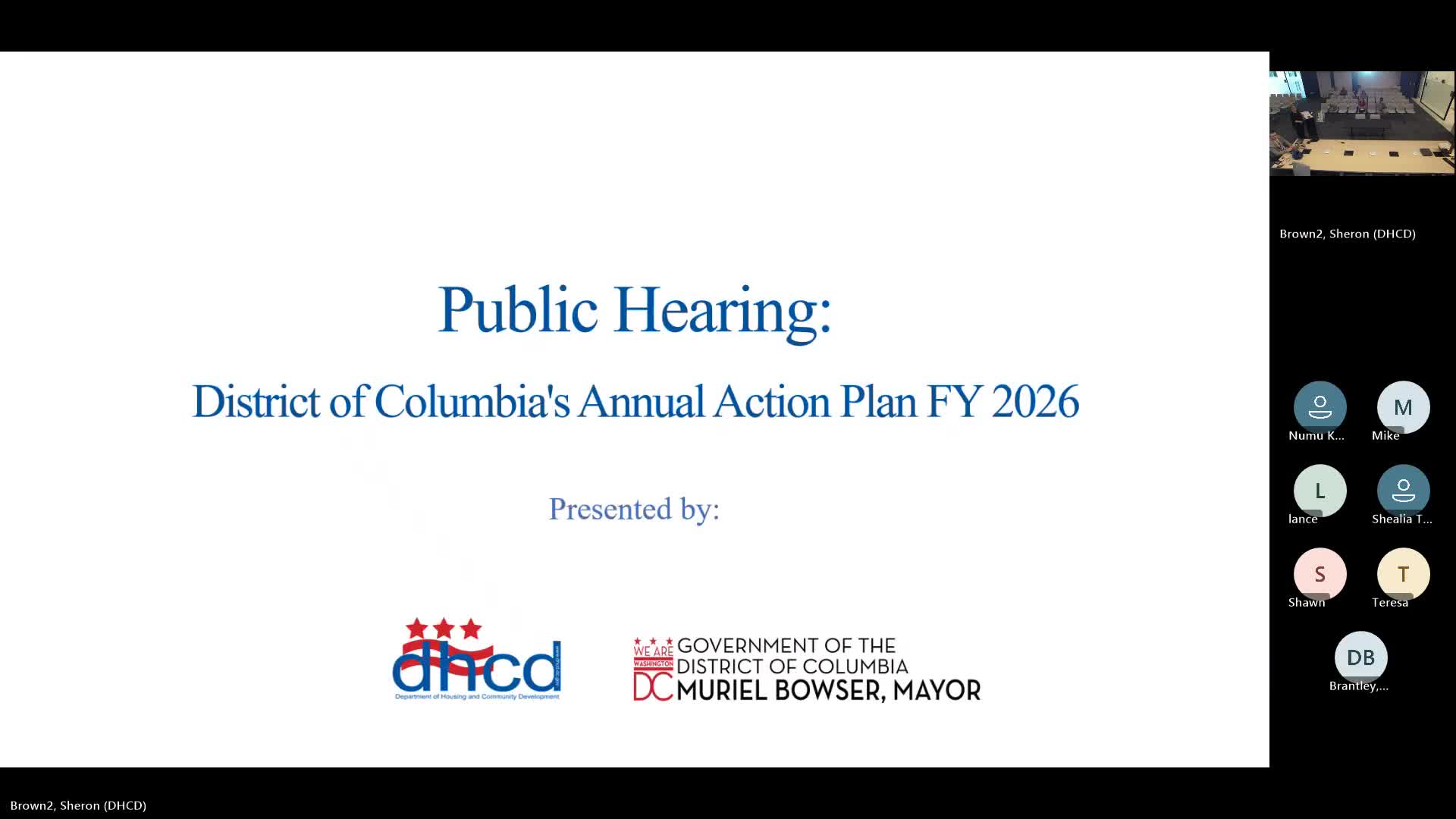
Summary
The District Department of Housing and Community Development presented its fiscal year 2026 Annual Action Plan at a public hearing, detailing how HUD entitlement funds totaling tens of millions of dollars would be allocated across housing preservation, homeownership assistance, small business support and homelessness services.
WASHINGTON — The District Department of Housing and Community Development presented its fiscal year 2026 Annual Action Plan at a public hearing, detailing how HUD entitlement funds totaling tens of millions of dollars would be allocated across housing preservation, homeownership assistance, small business support and homelessness services.
A DHCD staff member, speaking on behalf of Colleen Green, director of the Department of Housing and Community Development, said the agency will submit the plan to the U.S. Department of Housing and Urban Development on April 16 and opened the floor for public comment. “The funds mentioned are known as entitlement funds awarded by HUD,” the staff member said, listing Community Development Block Grant (CDBG), HOPWA, HOME, ESG, the National Housing Trust Fund and the Recovery Housing Program.
The presentation said the district expects about $15,000,000 in CDBG entitlement funds and a $40,000,000 Section 108 loan guarantee; roughly $12,800,000 for HOPWA; $5,800,000 for HOME; about $3,100,000 from the National Housing Trust Fund; $1,600,000 for the Recovery Housing Program; and roughly $1,300,000 in Emergency Solutions Grant (ESG) funds. The plan describes program uses: CDBG to support small-business technical assistance, façade improvements, housing counseling and first-time homebuyer down‑payment and closing-cost assistance; HOPWA for rental assistance and housing for people living with HIV; HOME for financing affordable developments and first-time homebuyer assistance; and ESG for rapid rehousing and shelter operations.
Nut graf: The Annual Action Plan is the one-year implementation document of the five-year consolidated plan that must meet HUD requirements; it allocates federal entitlement funds across programs and agencies and is informed by public hearings and a comment period. DHCD emphasized the plan aligns entitlement dollars to goals including preserving existing affordable housing, expanding the affordable stock, strengthening homeownership, fostering small and local business development and preventing and ending homelessness.
Public commenters at the hearing raised concerns about whether the proposed funding levels and program designs respond to needs in the District’s lower-income wards and to small property owners. A business owner who identified themselves as a Washingtonian raised concerns that available funds do not sufficiently help small landlords—particularly in Ward 7 and Ward 8—pay for building repairs and thereby prevent displacement and homelessness. “There may not be enough monies … to help protect business owners like me to help prevent homelessness,” the speaker said.
Resident Sheila Tyson, who identified herself as a native Washingtonian and senior, asked the agency to define what “affordable” means for DC residents rather than relying on HUD definitions and urged DHCD to prioritize smaller-scale property owners over large developers. “I need DHCD to define affordability. Don’t give me HUD’s term. Give me DC’s term,” Tyson said. Another commenter suggested examining tiny‑house options and asked whether existing programs such as HPAP might be adapted for smaller‑scale or portable housing solutions.
DHCD staff responded that some questions—such as voucher search time limits and landlord participation—are specific to the District of Columbia Housing Authority and encouraged commenters to email detailed questions so staff could route them appropriately. Sharron Brown, who the presenter identified as timekeeper and DHCD staff, said DHCD would put contact information in the chat and invited attendees to follow up by email or phone.
The hearing closed with staff noting a second public hearing on the action plan is scheduled for Aug. 5 at 1 p.m., offered both in the same room and online, and that a December 19 hearing will review accomplishments for fiscal 2025. The presentation materials and the action plan are posted on the DHCD website; the presenter gave a mailing address and an email (email.questions@dc.gov) for written comments.
Ending: The public comment period remains open; DHCD said it will accept written comments through the posted channels and incorporate public input before finalizing the plan for HUD submission. The agency also encouraged residents with infrastructure concerns tied to nearby development to meet with staff afterward so DHCD could direct them to appropriate resources.