
St. Joseph County drainage board hears residents' concern over large dewatering and discharge permits tied to data‑center construction
Get AI-powered insights, summaries, and transcripts
Subscribe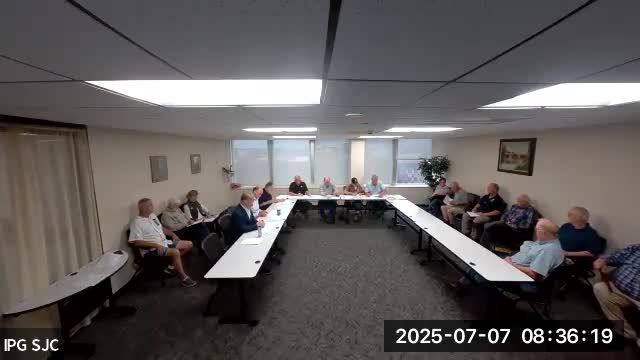
Summary
At a St. Joseph County Drainage Board meeting, farmers and residents urged stronger review and coordination on discharge permits after hearing proposals that could pump tens of millions of gallons per day into local ditches and longstanding complaints about a city‑tied retention pond.
At a St. Joseph County Drainage Board meeting, residents and landowners pressed the board to use its permitting process to limit or more closely review discharge tied to construction dewatering for large data‑center projects, saying proposals to pump tens of millions of gallons per day risk flooding and long‑term damage to farmland and downstream waterways.
The concerns centered on a frequently cited figure of 52,000,000 gallons per day for construction dewatering, a petition with nearly 90 signatures from downstream landowners, and long‑running complaints about a city‑connected retention pond that commenters said has been used to carry street runoff into private ditches rather than acting as a monitored retention basin.
Why it matters: Audience members said the volume and frequency of proposed pumping — coupled with persistent water‑quality problems — could raise water levels in irrigation ditches, damage banks, harm crops and affect downstream communities that rely on the same waterways. Speakers pressed the board to coordinate with the county health department, the Indiana Department of Environmental Management and state legislators and to consider perpetual monitoring of discharges during construction.
Residents and farmers gave detailed accounts of past and present flooding. Farmer Steve Mathis (57572 Mayflower Road, South Bend) told the board, “Where does anybody get the right to pump 52,000,000 gallons of water a day? 52,000,000 gallons, period,” and described decades of local irrigation wells and how large‑scale dewatering could drop water tables used for on‑farm irrigation. Dan Caruso of New Carlisle said Peerless Water reported an aquifer recharge rate “of 44 to 46,000,000 gallons per day,” and added that a 52,000,000‑gallon‑per‑day figure, if accurate, would exceed that number.
Several speakers linked present issues to historical changes after an ethanol plant closed and the city reconfigured drainage and sewer taps into a nearby pond. A longtime resident said the pond originally received cooling water from an ethanol plant and later became a city outlet; commenters said the city’s use of the pond now sends stormwater and street runoff into downstream ditches.
Board staff and counsel described the limits of the drainage board’s authority. Marcel (board attorney) told the room that the drainage board’s regulatory power is principally over water quantity in county‑regulated ditches and that it does not regulate water quality; he noted sampling and permitting for discharge are typically administered by other agencies. The transcript records that the county health department and IDEM have been contacted previously about the site and that state and federal agencies have also been engaged.
Speakers urged the board to act as a coordinator: to invite the health department, IDEM, the EPA and local officials to a joint discussion; to require clearer maps and public notice for permit applications; and to consider forming task forces tied to the drainage board (for example, a Juday Creek task force was suggested) to address cumulative impacts from multiple data‑center projects. Steve Francis of Clay Township recommended proactive steps: “You can form task forces… which can deal with some of these problems,” and urged the board to allow public input before votes on major permits so affected residents can be heard in time to influence decisions.
Public commenters also raised technical and long‑term concerns: they said earlier approvals for other industrial discharges had increased daily volumes without corresponding long‑term ditch upgrades; that some ditches already show signs of bank erosion and vegetation (curly pondweed/pond growth) that reduce conveyance; and that retention basins built on muck soils have limited effective capacity. Several speakers warned of economic impacts if productive farmland is repeatedly flooded and said downstream systems — including waterways that ultimately flow toward the Kankakee and Illinois rivers — could be affected.
Formal board business recorded at the meeting included routine approvals and procedural votes. The board approved the May minutes; approved contractor payments subject to review of the work; and voted to withdraw or dismiss an absent applicant’s discharge request (applicant listed in the record as Andy Kramer). Each motion was presented and carried during the meeting as shown in the transcript.
The meeting closed with several speakers repeating requests for central coordination among county departments and state regulators, and calls for better public notice and monitoring of temporary dewatering discharges linked to large construction projects. Several residents said they will continue organizing and expect to return with more signatures and requests that permit conditions include monitoring and stronger limits on discharge locations and volumes.