Get Full Government Meeting Transcripts, Videos, & Alerts Forever!
Get email alerts on the Pud Open Space topic
No spam. Unsubscribe anytime.
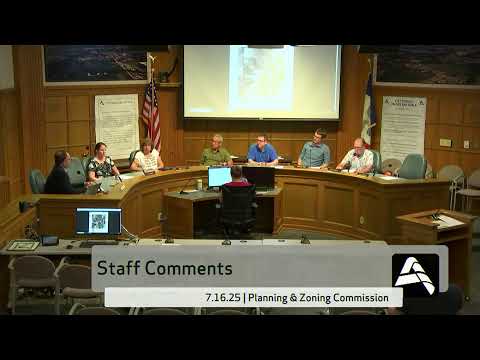
Ames planning commission backs removing mandatory 10% PUD open-space set‑aside for infill projects
Summary
The Ames Planning and Zoning Commission voted to recommend the City Council eliminate a 10% common open‑space requirement in the PUD overlay for infill sites (two acres or smaller), leaving open‑space decisions to case‑by‑case review under PUD purpose standards.
The Ames Planning and Zoning Commission recommended that the City Council remove the Planning Unit Development (PUD) overlay rule that requires a 10% common open‑space set‑aside for infill projects two acres or smaller.
The move means developers seeking a PUD for small infill sites would no longer have a fixed 10% open‑space requirement; instead, the commission said, each project would be judged against the PUD purpose statement and design standards on a case‑by‑case basis.
City planning staff told the commission the amendment was requested by an applicant working on a South Fourth Street project and that the change would apply to future infill PUDs citywide. “The proposal in front of you is a request to formally amend the PUD overlay to eliminate the 10% open space set aside requirement for the infill projects,” staff said. Staff explained the city originally adopted the 10% set‑aside to match base zoning requirements in growth‑area districts (FSRL and FSRM), and that the rule remained when the PUD tool was later applied to smaller, infill parcels. Staff noted most zoning districts inside the city do not have a mandatory set aside, and recommended removing the fixed requirement so planners and commissioners can assess public or private open space against PUD purpose language for each site.
Commission discussion focused on predictability and precedent. One commissioner asked whether the city should replace the 10% rule with a smaller fixed number to give developers certainty; staff replied that removing the rule would create a body of precedents over time and that an alternative – defining usable open space on a per‑unit basis – would require more specific definitions (for example, excluding front yard setbacks as usable space). Staff explained the city would still be able to require open space where appropriate under the PUD purpose statement, which calls for providing “a variety of private and common open space areas corresponding to smaller lot sizes.”
Public commenters addressed related neighborhood concerns but were reminded the text amendment discussion concerned only the PUD open‑space standard, not site‑specific design details. The commission moved to recommend alternative 1—elimination of the 10% common open space requirement for infill projects with single‑family attached dwellings—and the motion passed.
The recommendation will go to the City Council for final action. If council does not approve the amendment, applicants for infill PUDs would still need to design projects that meet the existing 10% set‑aside requirement.