
Parks commission directs staff to survey neighbors, vet professional options for Mun Woods, Emma McCarthy Lee deer control
Get AI-powered insights, summaries, and transcripts
Subscribe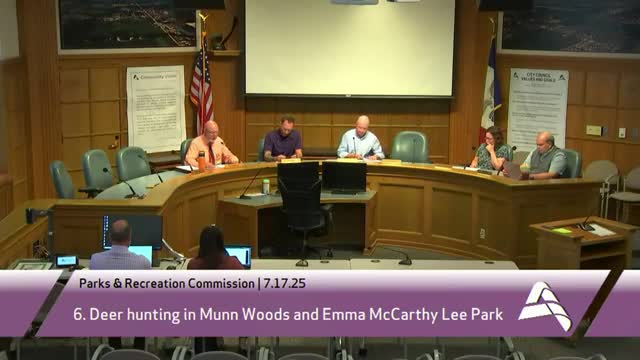
Summary
After multiple residents described heavy deer pressure, the Parks and Recreation Commission voted to have staff gather neighborhood feedback and consult professional stakeholders on population-management alternatives for Mun Woods and Emma McCarthy Lee Park, with results to return at the August meeting.
The Parks and Recreation Commission on July 17 voted to direct staff to survey neighbors near Mun Woods and Emma McCarthy Lee Park and to solicit input from professional stakeholders on alternatives for reducing local deer numbers.
Commission members said they wanted more localized input before recommending any change to city policy. The motion, which included a friendly amendment to require staff to investigate population-management alternatives alongside public opinion, passed on a voice vote with no recorded opposition.
The commission’s action responds to several letters to city council and three residents who spoke at the meeting describing heavy localized deer use. Resident Max Rothschild, who said he has lived at 511 Oliver Circle for more than 30 years, told commissioners, “In the 30 plus years we’ve lived in the region, the deer population has probably increased 10,000 fold.” Rothschild said the animals damage landscaping, increase vehicle-deer collisions and reduce property values; he recommended allowing bow hunting and later reproductive controls after numbers are reduced.
Another resident, James Bernoff of 3511 Oakland Street, urged the commission to consider professional contractors for any cull, citing experience with firms that work in other communities. Kathy Schnabel of 3629 Woodland Street told the commission she was concerned about the long-term ecological effects of high deer densities on forest regeneration.
Staff and commissioners discussed practical issues that would affect any local hunt: the city’s current urban deer program follows Iowa Department of Natural Resources (DNR) seasons, and staff noted that historically only a fraction of available permits are used. According to staff remarks at the meeting, roughly 30% of available city permits are claimed and of those only about 30% result in a harvest—yielding only a few deer removed annually, a level commissioners said would not meaningfully reduce the population.
City staff recommended a targeted outreach plan that would combine a mailed survey to addresses closest to the parks with broader electronic outreach. Staff said a mailing area similar to prior neighborhood efforts (roughly Ontario to Lincoln Way and Highland to North Dakota) would be used so that answers could be stratified by proximity. The commission asked staff to return with a map, summarized responses and any additional technical information (population counts, permitting logistics, professional contractor options) at the August meeting.
Commissioners and staff also highlighted alternatives to a typical city permit hunt. Options discussed included contracted professional sharpshooters, bow hunting, population surveys (winter flyovers using infrared), depredation tags on private property, and fertility-control programs; commissioners emphasized that some approaches require coordination with state agencies, private landowners or outside contractors. Staff noted chronic wasting disease had been detected in Story County last year, a factor commissioners said increases urgency to better understand local population dynamics.
What happens next: staff will draft and mail a neighborhood survey and post an online version for broader public input; they will solicit information from professional stakeholders and wildlife experts and return to the commission at its August meeting with the survey results, a map of the outreach area and a menu of management alternatives for further recommendation to city council.