Get Full Government Meeting Transcripts, Videos, & Alerts Forever!
Get email alerts on the Tax Abatement Affirmative Action topic
No spam. Unsubscribe anytime.
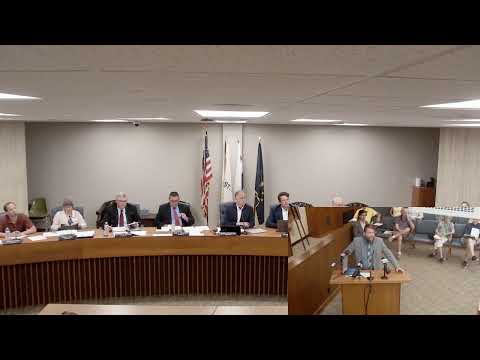
Council opens public hearing on ‘Fairness and Equal Treatment’ ordinance to strip affirmative‑action language from tax‑abatement policy
Summary
St. Joseph County Council members heard more than two hours of public testimony on a proposal to remove affirmative‑action language from the county tax‑abatement policy; the petitioners said the change would promote "equal treatment," while a broad coalition of community groups urged the council to retain the language.
St. Joseph County Council members heard more than two hours of public testimony on a proposal to remove affirmative‑action language from the county tax‑abatement policy, an item introduced as the "Fairness and Equal Treatment Ordinance" by Councilwoman Amy Drake and Councilman Andy Rutten.
The petitioners said the ordinance would remove references to affirmative action and DEI (diversity, equity and inclusion) from the county's abatement policy and related application requirements. Drake and Rutten framed the proposal as an effort to require equal treatment and move away from government preferences tied to identity. Rutten told the council the measure responds to recent federal and state action and argued that the county should set a local example.
At the same time, dozens of residents, local advocates and business groups addressed the council in a lengthy public hearing. Many speakers urged the council to reject the proposal, saying affirmative‑action language helps correct longstanding barriers to employment and opportunity for historically marginalized groups. Trina Robinson, president of the local NAACP branch, and other community leaders said removing the language would disproportionately harm Black, Hispanic and other underrepresented groups and would undercut safeguards in existing local practice.
Steven Whitmer and Clayton Selmer spoke in favor of removing affirmative‑action language, saying policies that treat people by race or gender are counterproductive and that the county should instead emphasize a merit‑based approach. Whitmer described his personal experience with hiring quotas in private industry and called affirmative action a "failed social experiment." Rutten and Drake repeatedly cited recent national and state developments, including the U.S. Supreme Court ruling on college affirmative‑action programs and state executive actions, as part of their rationale.
Opponents included local civil‑rights leaders, business coalition representatives, education and nonprofit leaders, and residents who described persistent disparities. Several speakers cited local data and national statistics on unemployment and wealth gaps to argue that affirmative action and DEI remain necessary policy tools to expand access to jobs and training and to ensure abated projects recruit from a diverse workforce. Roberta Milliken, who works in vocational rehabilitation, told the council that removing the language would reduce opportunities for people with disabilities and other protected groups.
Council members debated the scope and enforceability of affirmative‑action language. Several council members said they share concerns about the difficulty of enforcing some affirmative‑action measures, and Councilman Tanner proposed an amendment that would focus on compliance with federal nondiscrimination law and on requiring standardized equal‑employment reporting forms (EEO‑1 or similar) instead of the older affirmative‑action language. Councilman Catanzarite and others said they favored updating the ordinance but not removing language entirely without broader stakeholder engagement.
Council staff and members noted the original 2009 process that produced the county's tax‑abatement policy, which was developed with business, labor, faith and civil‑rights representatives. Opponents said the present proposal was filed without comparable outreach or coalition building. Several speakers urged the council to delay action and form a working group to update the policy collaboratively.
No final vote was recorded on bill 52‑25 during the meeting. After the public hearing closed, council members continued to discuss possible amendments including: (1) replacing affirmative‑action wording with a requirement that applicants comply with Title VII of the Civil Rights Act and federal Equal Employment Opportunity Commission (EEOC) reporting; (2) clarifying that tax abatement is voluntary for companies and that nonparticipating companies are not prohibited from doing business in the county; and (3) creating a more transparent reporting requirement for applicants that mirrors forms they already file with state or federal agencies.
Supporters of retaining affirmative‑action language said it is not a quota system but a tool to encourage stronger applicant pools and to document hiring outcomes over time. Several speakers described the 2009 ordinance development as the result of a broad, multi‑stakeholder process and urged the council not to dismantle that compromise.
Ending: The public hearing on bill 52‑25 closed with no vote; council members signaled interest in revising the proposal to include clearer reporting and references to federal nondiscrimination law but did not adopt any amendment during the session. The item will remain on the council's agenda for future action if members bring a motion to amend or adopt the ordinance.