Get Full Government Meeting Transcripts, Videos, & Alerts Forever!
Get email alerts on the Land Use Solar Policy topic
No spam. Unsubscribe anytime.
St. Joseph County Council approves property‑value guarantee for large‑scale solar with 1‑mile radius, excluding industrial zones
Summary
St. Joseph County Council passed an amended text change to the county land‑use code that requires large‑scale solar developers to enter property‑value guarantee agreements with nearby owners and to post a surety bond covering 20% of the assessed value of properties within a 1‑mile radius.
St. Joseph County Council passed an amended text change to the county land‑use code that requires large‑scale solar developers to enter property‑value guarantee agreements with nearby owners and to post a surety bond covering 20% of the assessed value of properties within a 1‑mile radius.
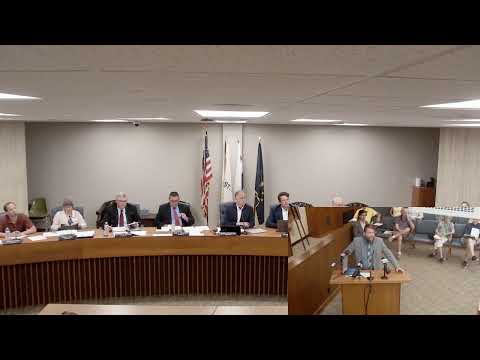
The measure, introduced as bill 17‑25 by Councilman Dan Schutzel, was approved as amended on a 5‑4 vote after more than two hours of public comment and legal questioning from council members and counsel. The council amended a version that initially proposed a three‑mile radius and broader coverage.
The amendment narrows the radius to one mile, limits the requirement to large‑scale ground‑mounted solar systems (county ordinance defines large‑scale as systems with more than 40,000 square feet of panel area), and exempts projects located in areas zoned industrial. The ordinance requires developers to execute a written property‑value agreement with property owners within the one‑mile zone and to provide the county with a surety bond in the amount of 20% of the assessed value of the properties within that radius. The text also supplies a standard form that the county would expect developers and owners to use.
Councilman Dan Schutzel, the petitioner, said the changes were meant to protect property owners while not burdening small rooftop or farm systems. "The three major changes are the three‑mile radius is reduced to one mile, the ordinance does not apply to areas that are zoned industrial, and the ordinance only applies to large‑scale solar energy systems," Schutzel said at the meeting.
Area Plan staff described how the guarantee would be administered. The ordinance sets out an appraisal and listing process if an owner lists a property for sale: a broker would be used to determine listing price and whether offers are below the listing price; if an owner accepts a lower offer, the solar system owner (guarantor) would be required to compensate the difference or purchase the property. The draft ordinance also states there would be no appeal from the agreement by either party.
The Area Plan Commission (APC) forwarded the bill to council with an unfavorable recommendation (5–3). APC staff and outside counsel flagged several legal questions for the council, including whether the text amendment could conflict with Indiana law that limits local restrictions on solar. Phil Garrett, who provides legal counsel to the economic development team, told the council that the ordinance may raise issues under Indiana Code 36‑7‑2‑8, which he described as preventing a unit from adopting any rule that "prohibits or unreasonably restricts the use of solar energy systems other than for the preservation or protection of the public health and safety." Garrett said the statute did not make the outcome certain but flagged it as a potential statutory conflict.
Council attorney discussion focused on procedure under Indiana Code 36‑7‑4‑607. Area Plan staff and the council attorney agreed that because APC had given an unfavorable recommendation, the county council may adopt an amended version but any amended ordinance must be returned to the Area Plan Commission for consideration; the commission then has 45 days to approve or disapprove the amendment. If the commission disapproves, the council must reaffirm its action to make the amendment final.
Public testimony was sharply divided. Supporters of the guarantee included residents who said they have seen home valuations fall near planned solar projects and witnesses who described payment agreements used by developers elsewhere as evidence that developers acknowledge potential impacts. Attorney Lorene White, who said she reviewed other Indiana county ordinances, told the council that at least eight Indiana counties have adopted property‑value guarantees and that she had not found litigation overturning those ordinances. "There are at least 8 counties in Indiana that have adopted property value guarantees as parts of their ordinance," White said.
Opponents included solar industry advocates, local solar business owners and labor and economic development groups who said the guarantee and bond requirement would make new solar projects prohibitively expensive and would discourage investment and local jobs. Brian Will of Citizens Climate Lobby said the ordinance would "close the doors and cost our county jobs" and could cause local manufacturers and installers to lose business. Several opponents cited studies finding little or no negative effect on nearby home values and urged the council to rely on the setbacks, screening and special‑use procedures already adopted in 2024.
Council procedure during the meeting included a failed motion to refer the bill back to committee (motion lost 7–2) before the public hearing, and later an amendment presented by Schutzel to the bill (the amendment passed 6–3). After the amendment passed, the council approved the amended ordinance 5–4.
Key quantitative terms in the ordinance as amended include a one‑mile radius around large‑scale solar projects, a surety bond equal to 20% of the assessed value of properties within that radius, and reference to the county definition of large‑scale as ground‑mounted systems with more than 40,000 square feet of panel area. Council staff said standard building permits are valid for three years; if a developer's permit that predates the ordinance expires without further application, a subsequent permit application would be subject to rules in force at the time of the new application.
The council directed the clerk to file the adopted ordinance. Because APC gave an unfavorable recommendation, the amended ordinance will be returned to the Area Plan Commission for consideration under Indiana Code 36‑7‑4‑607; the commission then has 45 days to approve or disapprove the council's amendments. Council members asked their attorney to provide a written memo on statutory conflicts before further action if the commission disapproves.
The ordinance will take effect according to the timeline in the county code and state statute if APC approves the amendments or fails to act within 45 days; if APC disapproves, the council must reaffirm to keep the amended version in effect.
Ending: The adoption marks a significant new condition on large‑scale solar development in St. Joseph County. Area Plan and county legal staff will now review the amended text under state law and the APC will consider the council's changes within the statutory 45‑day period. Public commenters on both sides said they expect further debate or possible legal challenges ahead.