Decatur council approves $1.13 million PFAS pilot study; utility says loan is forgivable
Loading...
Summary
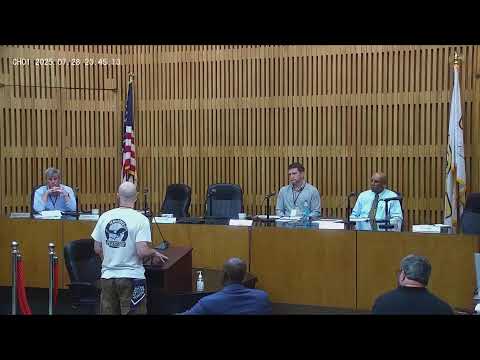
The Decatur City Council approved a $1,132,000 professional services agreement with Jacobs Engineering for a Phase 2 PFAS treatment pilot at the Decatur Utilities water plant and authorized an application for a state loan the utility says is 100% principal-forgiven. Public speakers pressed for benchmarks and clearer public reporting.
The Decatur City Council on July 8 approved a $1,132,000 professional services agreement with Jacobs Engineering for a Phase 2 on-site PFAS treatment pilot at the Decatur Utilities water treatment plant and authorized the utility to apply for a state loan to fund the work.
The study was described by Tom Cleveland, water resources manager for Decatur Utilities, as a full-scale pilot to test treatment technologies identified in an earlier Phase 1 bench study. Cleveland said the pilot is expected to run about 15 to 18 months to capture all four seasons of river water quality. "This is a study to do a phase 2, treatment pilot at our water treatment plant," Cleveland said. "The deadline currently is 3 years. Once they're promulgated, they're talking about extending that to 5 years, which would be 2029. DU ... remains in compliance with these regulations. We are below 4 right now."
Cleveland told the council the loan is structured through the state drinking-water finance program but that the principal is forgiven: "It is 100% principle forgiven. In other words, it is a grant." He also said the SRF loan will cover prior Phase 1 costs and allow Decatur Utilities to recover Phase 2 expenses reported at roughly $360,000.
Why it matters: the U.S. Environmental Protection Agency and state regulators have tightened limits for certain PFAS compounds; Decatur Utilities is testing technologies that could be used if stricter limits take effect. The council approved both the expenditure (Resolution 25‑1‑69) and the application for the state loan (Resolution 25‑1‑70) by 3‑0 votes.
Public commenters said the city should provide clearer milestones and more public reporting during the pilot. "I would like you all to consider voting yes on the PFAS pilot program," said Pat, a resident who urged the council to require milestones and transparency during the 15‑ to 18‑month pilot. Donna Underwood, a resident, urged more public meetings and easier public access to technical reports: "I would encourage the council to go ahead and vote yes on this. ... I would encourage you to, really ask the next council members to really try to make more of this information public, to have public meetings."
Council and staff responses said some implementation details remain to be worked out. Cleveland said the utility will "iron out all those details" and that "if the council chooses, we can come back and give you some additional information on that." The council did not attach specific reporting milestones to the approved resolution; council members and speakers noted the council could request updates during the study.
Clarifying details from the meeting: the Phase 2 study length was given as 15 to 18 months; staff said it was designed to capture seasonal variation in Tennessee River water quality. Decatur Utilities staff said the utility is currently below the proposed 4 parts per trillion regulatory level for PFAS; public speakers quoted PFOS historical readings from utility reports (2023: 8.25 ppt; 2024: 2.93 ppt; 2025: 3.13 ppt). The pilot agreement was described as approximately $1.13 million, and Cleveland said prior phase costs of about $360,000 would be covered by the program.
Next steps: Decatur Utilities will proceed with the pilot and the loan application. The council approved the expenditure and the loan application; staff said they can provide additional updates to the council if requested.