
Staff and commissioners discuss challenges of PUDs and legacy zoning; call for clearer phasing and expiration rules
Get AI-powered insights, summaries, and transcripts
Subscribe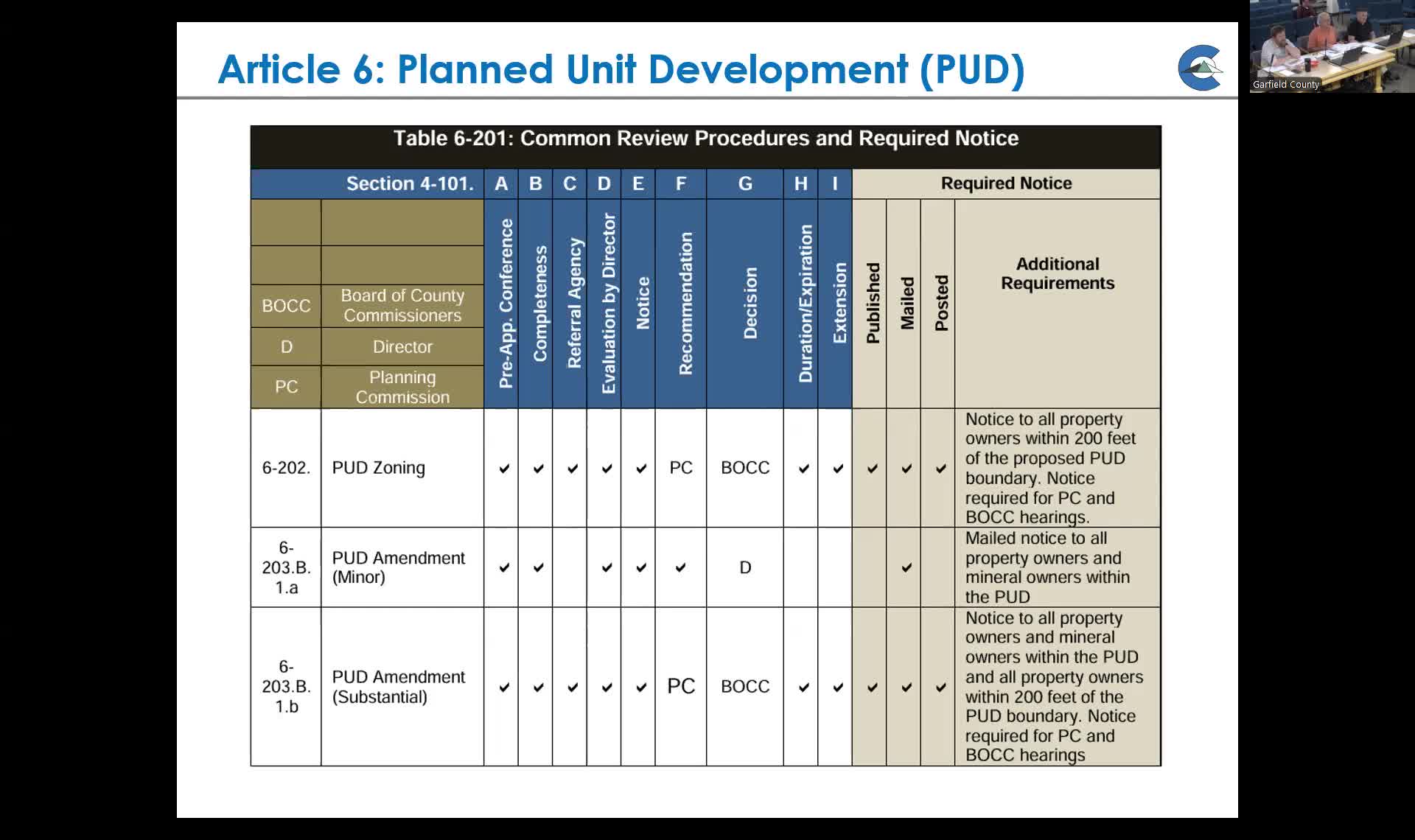
Summary
The commission spent substantial time on planned unit developments (PUDs): how zoning, phasing and development agreements interact, legacy PUDs that remain undeveloped and the county—s discretion to require updated technical reviews before plats proceed.
Planning staff told the commission that PUDs combine zoning, subdivision elements and a development agreement and so often need more intensive, multi‑agency review than a typical rezoning.
"PUD is zoning with subdivision and a development agreement," Philip said. He explained that PUDs let developers vary lot sizes and uses across a single site and that the county must examine water, traffic, wildlife and other resource impacts up front. Several commissioners said older PUDs in the county had been approved but never built out and asked whether the county should set firmer expiration or extension criteria.
Glenn and staff described three common paths after PUD zoning: (1) revoke or amend an existing PUD, (2) amend a subdivision to remove land from a prior plat, or (3) rezone and create a new PUD. Staff said development agreements typically include phasing and time triggers; that can create conflict when zoning was granted years or decades earlier and technical assumptions have changed. "When you grant zoning in 1992 and you don't come back to do a plat until 2025, are all those traffic assumptions, all those wildlife assumptions ... all need to be refreshed," Glenn said.
Commissioners and staff discussed examples (Rock Gardens, Riverbend/Coal Ridge and Nutrient Farms were referenced in conversation) and agreed staff should continue recommending stricter phasing triggers and clearer extension rules so the county can avoid open‑ended approvals. Staff noted the board of county commissioners retains ultimate authority to approve or deny extensions and that past practice has varied by project.
Ending: Staff said it will propose specific bylaw or code language to address PUD phasing, renewal and expiration as part of a broader bylaw/code update.