
CTSI outlines CAP coverage, deductibles and renewal timing to Garfield County commissioners
Get AI-powered insights, summaries, and transcripts
Subscribe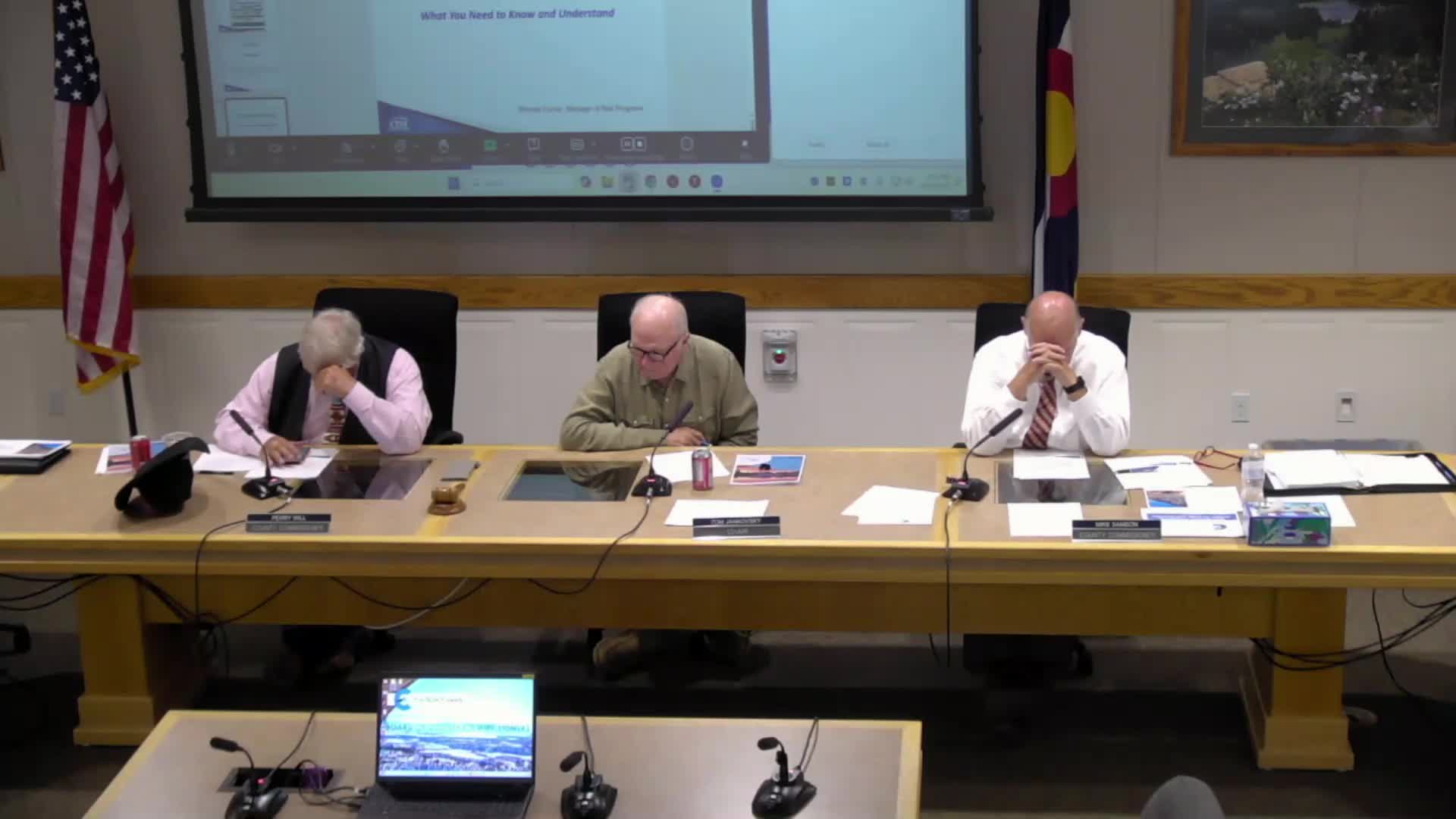
Summary
CTSI presenters reviewed the CAP insurance pool's structure, coverage limits, Garfield County deductibles and 2025 premium, and asked the board for direction on timing for a broker RFP tied to the 2026 renewal.
Meredith Burcham, executive director of the Colorado Counties Casualty and Property Intergovernmental Entity (CTSI), told the Garfield County Board of County Commissioners on Tuesday that CTSI and the CAP pools are “not insurance carriers” but county-owned risk pools created and governed by member counties.
The presentation centered on what is covered under the CAP pool, the limits and county-level deductibles, how the Garfield County $125,000 large-deductible program applies, the county’s 2025 contribution, and the timing options for shopping excess coverage and broker services ahead of the 2026 renewal.
CTSI staff gave a line-by-line summary of CAP coverage. “For public entity liability … the limit is $11,000,000 per claim,” said Rhonda Curran, manager of risk programs. Law-enforcement liability limits were described as $10,000,000 per claim; cyber (network liability) limits were listed as $1,000,000 per claim. Property limits are handled separately, with replacement-cost exposure reported per building and a noted $100,000,000 layer referenced on the pool schedule.
Curran explained how deductibles interact with Garfield County’s self-insured retention: the county’s $125,000 large-deductible applies per claim and sits alongside smaller, line-specific county deductibles. “If it was a law enforcement liability claim, we would pay the 125,000 plus the 60,000,” she said, describing how the county deductible and the pool retention stack in practice.
CTSI staff also described how the pool layers and aggregates work. “The pool pays the first $1,500,000 per claim,” Curran said, then an excess carrier layer attaches and an upper shared aggregate is available before the top layer is reached. She warned commissioners that while an individual claim might have an $11 million limit, multiple large claims can exhaust aggregates that cap overall payouts for the pool.
When commissioners asked about Garfield County’s 2025 contribution, Curran gave a figure: $732,753.52, which she said reflected the contribution after application of available equity credits. Staff noted the 2024 contribution had been $794,206 after equity was applied.
CTSI staff walked commissioners through common claim types and frequencies, noting for the pool the most frequent losses were driving/vehicle-related incidents (including backing and striking an animal), slip/trip/fall and weather-related claims. For Garfield County specifically, the top frequency drivers matched the pool’s top categories.
On special situations, Curran said airport liability for airport directors and some airport liability exposures are excluded from the public-entity liability line because airport risks are not “homogeneous” across counties; property and equipment at airports can be insured under the property schedule. She said the pool provides coverage for search-and-rescue teams only when they operate under the direction and control of the county sheriff; when control transfers to a borrowing county the borrowing county assumes liability.
Claims-handling procedures were outlined by Ines Cordova, CAP claims manager, who described the auto, general liability and property intake forms CT SI requires, evidence and documentation that speed handling and the subrogation and restitution steps pursued when another party is at fault. She said the pool enforces per-person and per-incident caps in some auto scenarios and that certain recoveries (subrogation/restitution) can take years to resolve.
Finally staff asked the commissioners for timing guidance on whether to run a full RFP to shop broker/excess-market services for the CAP renewal or to continue preparatory work and delay a formal RFP until early next year. County staff and commissioners discussed the tradeoffs — a full RFP can take 60–90 days and could push decisions into the late year, while a parallel preparatory process would preserve options without committing the county immediately. No formal procurement motion was made.
Commissioners asked for follow-up materials including (1) the large-deductible cost/benefit worksheet showing how Garfield County’s $125,000 retention affects contribution, (2) the CAP participant certificate/visual of layers and aggregates that CTSI had provided, and (3) the exposure worksheet for the 2026 renewal. CTSI staff said the county’s renewal inputs had been due June 16 and reminded commissioners that broker/excess-market timelines require data and carrier engagement well before the membership vote in fall.
The work session closed with staff agreeing to continue preparatory outreach and to return with requested documentation and timing options for a future commissioners’ decision.