Get Full Government Meeting Transcripts, Videos, & Alerts Forever!
Get email alerts on the Executive Limitations topic
No spam. Unsubscribe anytime.
Redmond SD 2J board reviews EL‑3 monitoring report, asks staff to split safety, equity and wellness sections
Summary
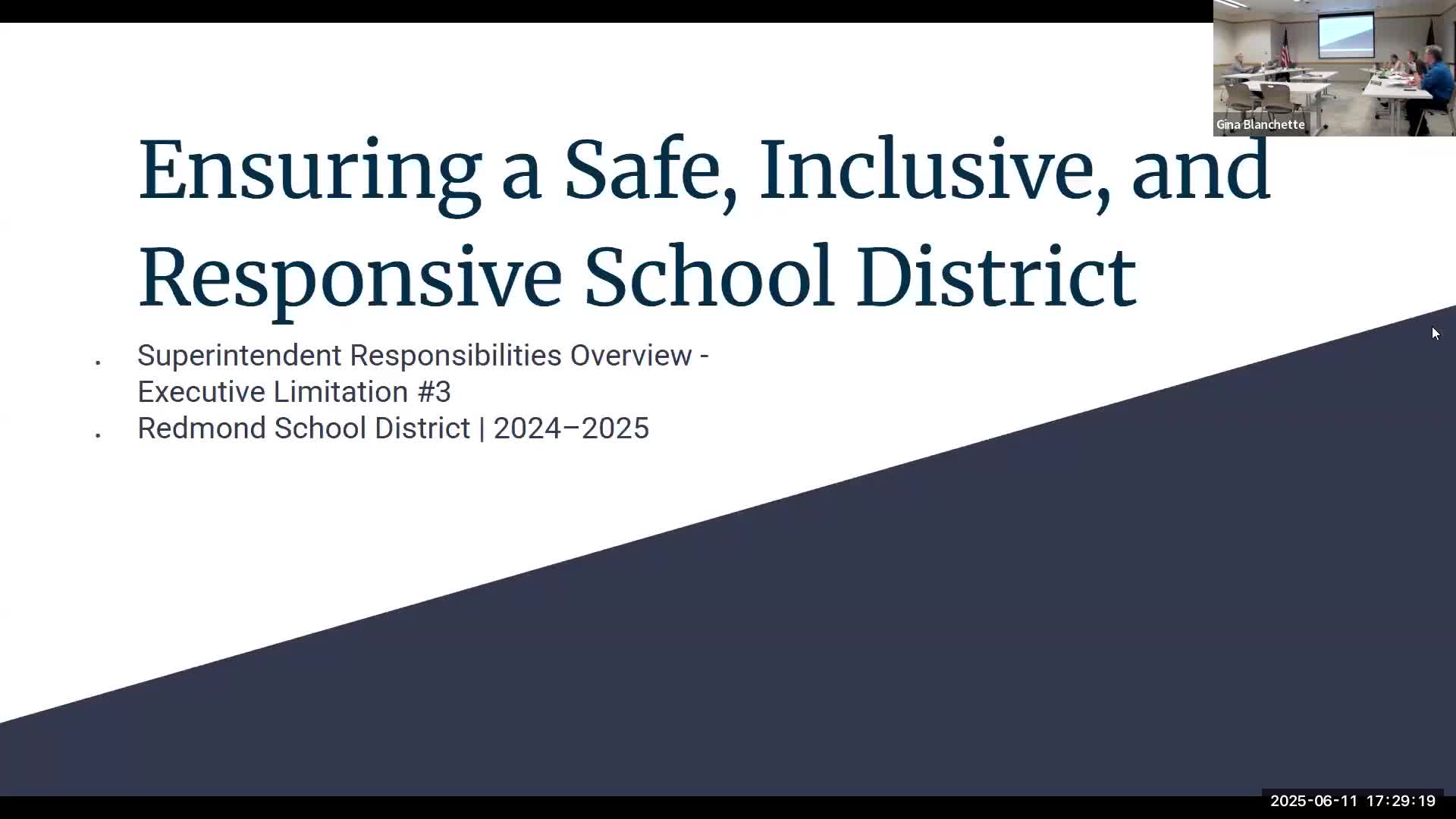
The Redmond School District board reviewed its first nonfinancial executive‑limitation monitoring report (EL‑3) at a Nov. work session, focusing on safety, equity and wellness and on how staff should present future reports.
The Redmond School District board reviewed its first nonfinancial executive‑limitation monitoring report (EL‑3) at a Nov. work session, focusing on safety, equity and wellness and on how staff should present future reports. The superintendent described the report as comprehensive but said staff have struggled to provide the specific, usable information the board requested.
Board members pressed staff for clearer, more actionable reporting and suggested splitting EL‑3 into separate sections for safety, equity and wellness so the district’s safety lead, HR/equity lead and wellness lead can each submit focused updates. Staff also outlined current emergency‑preparedness work, student‑information‑security measures and complaint‑management practices.
The superintendent summarized EL‑3 as a commitment “to maintain a safe, welcoming and inclusive environment, and foster respectful organizational culture,” and said staff created the report with the intent of meeting the board’s information needs. But, the superintendent added, “the staff has had a difficult time responding to this and creating a good report” when the three areas were combined.
On safety and emergency response, staff described ongoing investments: replacement of fire panels and intercoms, panic‑button systems, monthly drills for fire and other routine responses, and lockdown drills with students “a couple times a year.” Staff said they are testing new communications tools that can display a map of an alarm’s origin and notify police; a vendor originally selected did not work reliably on Chromebooks and staff told the board they are piloting an alternative. “We have 70% of our staff on Chromebooks,” the superintendent noted when explaining the vendor change.
The report also covered cybersecurity and student data protection. Staff said the district runs an annual cybersecurity drill, uses two‑factor authentication and notifies staff about phishing attempts. “We’ve gone to 2‑factor authentication, and we work hard to try and let people know when we have phishing schemes,” the superintendent said, citing recent spoofing emails that impersonated district staff.
On complaints and equity work, staff described a multi‑tiered approach that encourages informal resolution at the building level, escalates formal matters through the district timeline when necessary, and reserves the board as the final level of appeal. The HR/equity lead was identified as the staff contact for bias‑related and harassment reports that separate state legislation requires.
Board members asked for changes to make monitoring useful. Suggestions included: - Separate reporting for safety, equity and wellness so the responsible staff can provide targeted updates and clearer policy links; - One concrete example or “artifact” per section each year that shows what was done and where improvements are needed; - A small set of repeatable metrics (for example, a family‑survey “temperature” or counts/trends for recurring complaint categories) rather than an exhaustive list; and - A clearer, single‑page “frequently asked questions” link in staff email signatures to help families find complaint procedures and transfer information.
Staff said they will revise EL‑3 presentation format and return with a draft tuned to the board’s requests. There was no formal board vote; the exchange was a monitoring and direction‑setting discussion, not a policy change.
Board members and staff also noted points of operational context: lockdown protocols and SRO coordination are part of the district’s standard response protocol; lockdown notification tools must support Chromebooks because the majority of staff use them; cybersecurity exercises are performed at least annually; and complaint timelines sometimes run long because of complexity and collective‑bargaining protections for employees.
Board members repeatedly emphasized they want reporting that helps them see trends and problem areas (for example, a pattern of similar complaints) rather than repeating large policy lists each year. Staff agreed to reformat reporting, include representative examples and bring a revised EL‑3 monitoring report to a future meeting for review.
The board moved on to other agenda items after the monitoring discussion concluded; staff will revise EL‑3 materials and return for follow‑up review.