
District attorney briefs board on open meetings, serial communications and executive-session confidentiality
Get AI-powered insights, summaries, and transcripts
Subscribe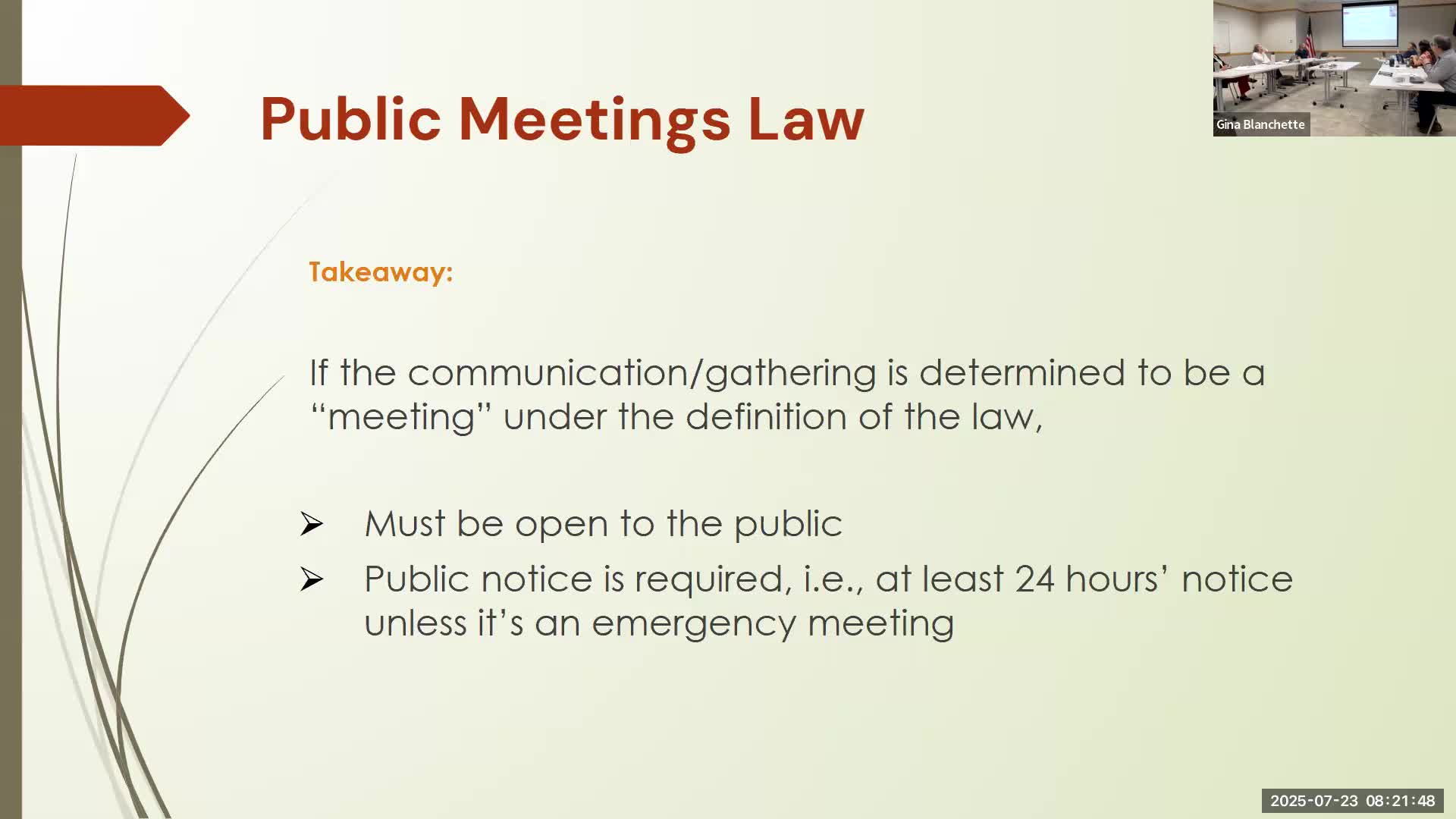
Summary
At a July 31 work session the district attorney reviewed public meetings law, risks of serial communications, how and when executive sessions may be used, and confidentiality obligations for personnel records, attorney-client privileged communications and student records under FERPA.
The Redmond School District's legal counsel gave the board a comprehensive briefing July 31 on public meetings law, serial communications and executive-session confidentiality that the board described as a refresher and a practical guide for everyday governance.
Counsel told trustees that board powers are exercised only collectively in a public meeting and warned about the risk of serial communications where a majority of members discuss district business outside a public meeting. She used the "telephone game" analogy: separate one-to-one or small-group contacts that cumulatively produce majority deliberation violate public meetings laws because they deny the public the opportunity to observe deliberations.
On executive sessions, counsel explained the legal limits: executive sessions are lawful only for specified reasons (e.g., attorney-client advice, labor negotiations, real estate negotiations, personnel deliberations) and the board must stay within the stated scope. She reminded the board that minutes are required for executive sessions but are not public. Counsel also explained the interplay between executive sessions and public records law: merely discussing a document in executive session does not make a public record exempt; the underlying public records law determines disclosure.
Counsel reviewed confidentiality rules that most frequently arise for districts: attorney-client privilege, personnel records (including superintendent evaluations), attorney advice that the board holds the privilege collectively, and student records protected by FERPA. She said that reckless disclosure of confidential student records can create individual liability and that privileged legal advice should not be disclosed by individual trustees without a board vote. The district's indemnification practice was explained: the district (through its insurer) generally defends board members acting within the scope of duties, but not for losses arising from malfeasance.
The board raised practical questions: how committees and superintendent advisory groups differ from board committees, whether Google Docs commenting can create an inadvertent public meeting, and whether the chair and vice-chair may consult with staff without forming a quorum. Counsel said casual communications by one or two members are lawful but cautioned that adding a third member may create a quorum for deliberation.
Why it matters: The briefing aimed to reduce handoffs that create legal exposure and to give trustees practical rules for day-to-day behavior (email use, texting, committee participation) so the public can see where and how decisions are made.
Next steps: Counsel offered to provide targeted memos and suggested an executive-session legal update cadence; the board asked staff to schedule additional training sessions.