
Attorney general's ethics opinion on food and gifts casts new limits on district-provided meals for board, committees
Get AI-powered insights, summaries, and transcripts
Subscribe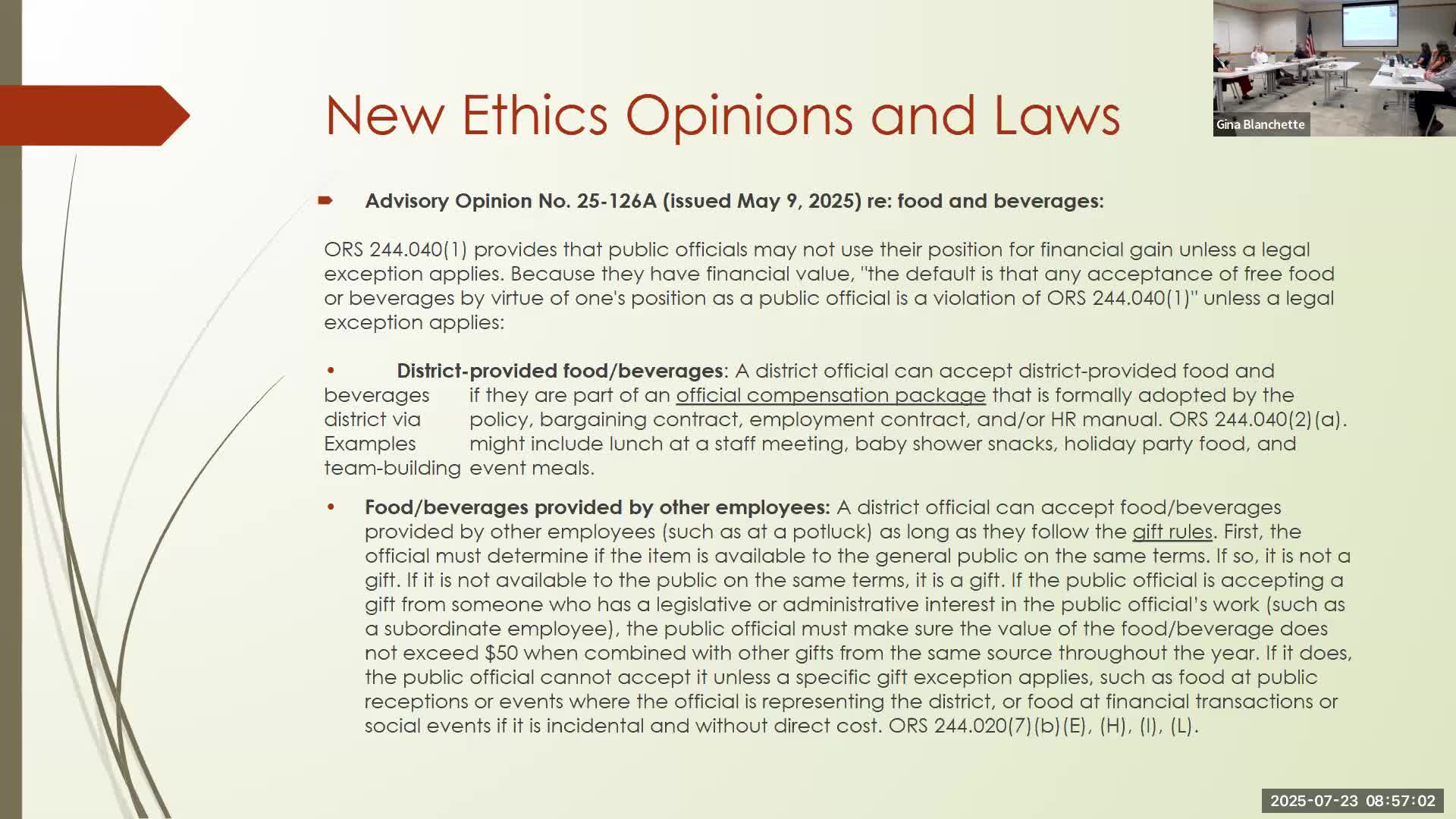
Summary
Redmond School District legal counsel told the board July 31 that a recent Oregon ethics opinion restricts when district-provided food and beverage can be accepted by public officials without triggering ethics or tax consequences.
Redmond School District legal counsel told the board July 31 that a May opinion from the Oregon Government Ethics Commission (OGEC) narrows when public officials may accept food and beverage provided in connection with their official duties, and that districts need to revise practices to avoid creating personal tax or ethics liabilities.
Counsel summarized the legal framework: Oregon's public ethics statutes (ORS chapter 244, as cited in the briefing) prohibit officials from using their position to obtain financial gain, and OGEC enforces the rules. Counsel said the new opinion treats food and beverage given to officials as a potential reportable economic benefit unless an exception applies, such as inclusion in a formally adopted compensation package (for example by board policy, contract, or HR manual).
The opinion has immediate consequences for routine practices the district and outside groups use to support meetings: catered meals for curriculum committees, working dinners for volunteer committee members, or provided refreshments at in‑district planning sessions. Counsel explained practical problems the opinion raises — tracking value of individual meals for tax reporting, applying gift‑limit exceptions, and the risk of creating disparate treatment among staff or board members.
Board members and staff discussed interim fixes and possible longer-term approaches. Counsel and administrators outlined options the district is exploring:
- Treat board meals as taxable compensation for individuals and account for it (administrative burden and payroll implications). - Add meals to an explicit compensation package via board policy or other formal instrument (may require bargaining or formal adoption). - Maintain no district-provided meals for boards and boards'sponsored committees until a statutory or bargaining solution is available.
Counsel said statewide associations such as OSBA and the teachers' unions are discussing legislative remedies; district staff said they have contacted regional and union partners to seek coordinated fixes. Board members expressed concern about optics and practicality: several noted many committee members and staff rely on in-meeting meals to participate after work hours.
Why it matters: the ethics opinion and state gift rules create individual liability for officials who accept reportable gifts. For the district, the opinion could require new administrative accounting and possibly bargaining negotiations if the district chooses to adopt a formal compensation approach for meeting meals.
What happens next: staff will coordinate with OSBA, labor partners and the district's auditors to craft operational guidance, and counsel will return with options for a policy path or bargaining approach that minimizes liability and preserves needed community engagement practices.