
Brighton staff outline options for zoning and controls on natural medicine businesses under Senate Bill 23-290
Get AI-powered insights, summaries, and transcripts
Subscribe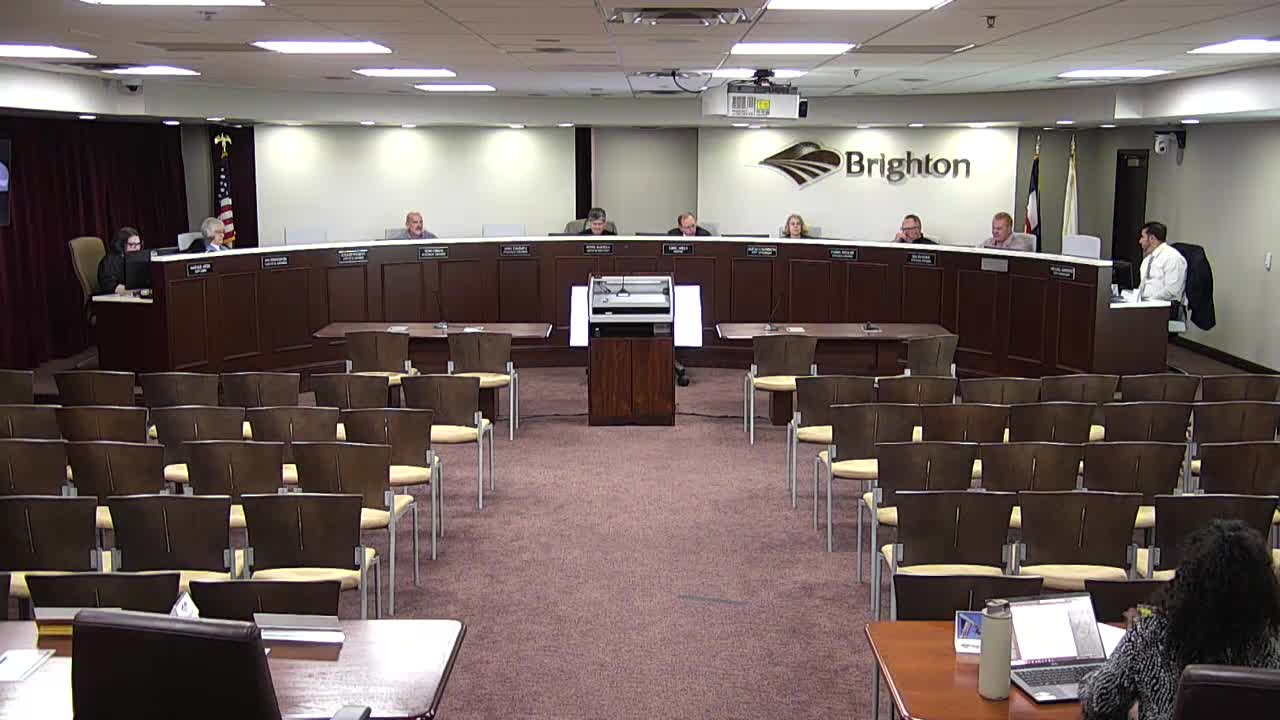
Summary
City staff presented proposed land-use code changes and options for time, place and manner restrictions after Colorado lawmakers implemented Senate Bill 23-290; council members asked staff to return with ordinance options and safety requirements such as ride-home rules.
Brighton councilmembers heard a staff presentation on July 15, 2025, about how the city can regulate natural medicine businesses after the passage of state Senate Bill 23-290 and its implementing rules.
The presentation matters because Senate Bill 23-290 creates state licensing and operational rules for natural medicine services and businesses while limiting local governments to time, place and manner restrictions; Brighton must decide how to incorporate those uses into its land use code without conflicting with state law.
Assistant City Attorney James Gallagher and Senior Planner Summer McCann told the council that the state initiative that led to SB 23-290 was approved by voters in November 2022 (53.64% statewide; 56.2% locally) and that the legislature enacted Senate Bill 23-290, signed by the governor on 05/23/2023. Gallagher said the final state rules became effective 10/01/2024 and that local governments may “enact ordinances or regulations governing the time, place, and manners manner of licenses issued pursuant to this Article 50 within its boundaries,” but may not “prohibit natural medicine facilities or create regulations that are unreasonable or conflict with state law.”
Staff summarized four use types the state statute contemplates: natural medicine healing centers; natural medicine cultivation; manufacturing; and testing facilities. McCann presented three staff options for how Brighton could respond in its land use code: (1) treat healing centers as the existing medical care category in the code; (2) create a new, separate natural medicine healing-center use; or (3) adopt a hybrid approach with a new industrial-style use for cultivation/manufacturing/testing and a defined healing-center use for therapeutic services.
As presented, staff recommended that cultivation, manufacturing and testing be established as a new use category—defined in Article 11 of the land use code—and allowed by right in industrial zones and by conditional use permit in some commercial/office parks. For healing centers, staff said the council could either treat them as a form of medical care (which would allow them wherever medical-care uses are permitted) or direct staff to draft a distinct natural medicine healing-center use that could be limited to specific zones. McCann noted that most healing centers would likely fit the city’s “medical care small” category (under about 10,000 square feet).
On time and manner, staff told the council they are limited by state preemption but may adopt less-restrictive buffers than the statute’s 1,000-foot school/childcare buffer (for example, some municipalities have set a 300-foot or 500-foot buffer). McCann and Gallagher said Brighton could also require a municipal business license in addition to the state license and could adopt local site standards (landscaping, screening, setbacks) that apply to building or site expansions. Gallagher recited state-regulated topics that remain under state authority, listing areas such as training and education of facilitators, dosage, security, waste disposal, and packaging and labeling.
Council members pressed staff on safety and operations. Council Member Snyder and Council Member Green asked whether the city could require a licensed driver or other proof of an arranged ride-home after on-site sessions; Snyder specifically said medical outpatient centers require a driver and called for a similar requirement if allowed by state law. McCann and Gallagher said some other cities have required proof of an alternative ride and that Brighton could pursue similar business-license or manner-based requirements if the state law does not prohibit them. The transcript also includes staff’s statement that limited personal cultivation for residences is allowed under state law in a defined area (singled out in the presentation as a 12-by-12-foot area) and that municipalities “cannot go higher than 1,000 feet” for school buffers.
No formal motion or ordinance was introduced at the study session. Staff characterized the item as study-session discussion and said they would return to the council with draft code amendments and options for council direction. The city manager said staff had received inquiries but no formal preapplications from prospective natural medicine businesses at this time.
Councilmembers asked staff to bring options back that would: (a) define where healing centers may locate (medical-care approach vs. new use), (b) define a new industrial use for cultivation/manufacturing/testing and identify appropriate zones, and (c) consider manner restrictions the council finds acceptable—examples discussed included hours limits, required licensed drivers or documented rides home, and a municipal business license requirement. Staff also identified the statutory and rule deadlines that led municipalities to prepare ordinances now.
Staff and council members agreed to return with draft language and a recommended path for formal ordinance introduction at a subsequent public meeting.
Brighton staff materials cited Senate Bill 23-290 and the state rulemaking that took effect Oct. 1, 2024, as the controlling state authority.