
Richmond board hears long grievance over unpaid overtime for paramedic training; final decision tabled to July 24
Get AI-powered insights, summaries, and transcripts
Subscribe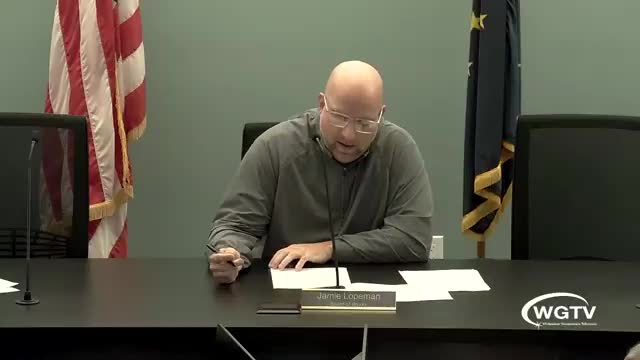
Summary
The Richmond City Board of Public Works and Safety heard hours of testimony July 17 on a grievance by firefighter Michael Stoltzfus over unpaid overtime for paramedic training. The board discussed federal labor rules, the contract''s 10-day grievance window and proposed remedies; members voted to table the case for a final answer on July 24.
The Richmond City Board of Public Works and Safety on July 17 heard extensive testimony in a grievance by firefighter Michael Stoltzfus over unpaid overtime while attending paramedic training and voted to table a final decision until the board's July 24 meeting.
The dispute centers on whether Stoltzfus is owed pay for time spent in a grant-funded paramedic program and, if so, how much. Board member Pals proposed a compromise motion to partially grant the grievance and pay half the contested overtime, with stipulations including written authorization by the fire chief for future classes and language intended to avoid altering existing contract provisions. That proposed motion drew sustained questioning from the union, fire administration and the board's legal advisers and was not adopted; the board instead voted to table the grievance to July 24 for a final answer.
Why this matters: The case raises questions about the interaction of the city's pre-employment and reimbursement agreements, collective bargaining terms (including a 10-day deadline for filing grievances), and federal wage-and-hour regulations that apply when training is required or directed by an employer. Union representatives warned that a partial remedy or inconsistent treatment could damage morale and recruitment; the chief's office and city attorneys warned of precedent and federal-law risk.
Most testimony came from union officials, firefighters and department leadership. Jordan Price, a union representative, said Stoltzfus followed department practice and was chosen for training based on seniority and scheduling: "he was within, his obligations and his seniority to be chosen and it was brought to him." Assistant Chief James Clark questioned the partial-payment approach on legal grounds: "If federal labor laws were not reviewed, how can we agree to this is 1 question. Because I don't know how we can agree to only pay for half." Chief Kinder told the board he could not support sending large numbers of firefighters to school at once for budget reasons: "I could not support it. I could not fund it."
Legal counsel cited federal regulations provided in the exhibits. The board's counsel read portions of 29 CFR 785.3 and 29 CFR 785.31 into the record, noting distinctions between voluntary outside training and training that is effectively required or directed by management. The board discussed a related contract provision that says any grievance settlement "related to this contract will be attached to this contract as an addendum," and members debated whether a settlement would create a binding precedent or could be limited so it would not change the grievance timeline.
Clarifying details emerged in the hearing record: Stoltzfus submitted an application to the training program on Sept. 2 (year noted in exhibits), signed a pre-employment/reimbursement agreement April 25, and the class began that August. Appearing figures in the exhibits show Stoltzfus logged 120 classroom hours and 408 clinical hours (528 total). At an estimated time-and-a-half rate of about $30 per hour, the union calculated roughly $15,840 owed for the class hours; the union noted final hours could change that figure by about $1,000. The course itself was grant-funded and had no tuition cost to the firefighter.
Board process and outcome: After extended discussion of procedural and legal issues'including whether the union's arguments invoked a "continuous grievance" doctrine that can extend filing timelines for recurring violations'the board accepted a motion to table the case. The board recorded a voice vote in favor of tabling to the July 24 meeting, the deadline set by the board's grievance-procedure timeline; the chair noted the board must provide a "final answer within 21 administrative working days" and that the deadline falls on July 24.
What was not decided: The board did not issue a final ruling on whether Stoltzfus should be paid in full, in part, or not at all. Board members and counsel said more precise language or evidence could be added to any settlement or addendum to avoid unintended contract changes. Union leaders told the board they seek full payment for members who signed the pre-employment agreement and complied with training obligations; the chief's office said future agreements should require written, advance chief approval for training that affects staffing and overtime budgets.
The hearing also made clear that at least one other firefighter in the same class (identified in the record as Jeremy Hodat) could be affected retroactively depending on the board's final ruling.
The board handled several routine agenda items at the start of the meeting (approval of minutes, claims for payment, payroll claims, handicap sign renewals and a curb cut) before taking up the grievance. The board will reconvene July 24 to issue its final answer.