Get Full Government Meeting Transcripts, Videos, & Alerts Forever!
Get email alerts on the Wind Energy topic
No spam. Unsubscribe anytime.
Des Moines County supervisors resume work on wind ordinance after legal review, debate over setbacks and insurance
Summary
Supervisors held a work session with county planners, a developer and public speakers to refine the county's wind-energy rules after legal advice flagged fee, bond and vague-standards issues; no ordinance changes were adopted but supervisors scheduled further sessions on setbacks and permitting.
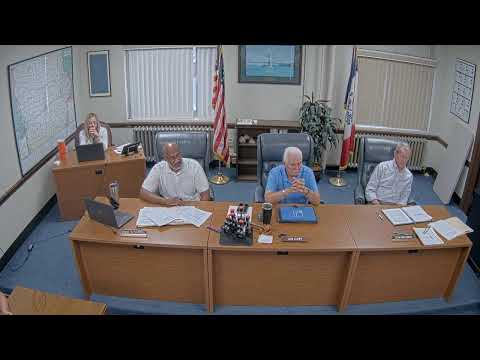
Des Moines County supervisors met in a public work session June 3 to continue rewriting the county's wind-energy ordinance after a legal review warned that parts of the existing text risk running afoul of constitutional limits and could be struck down.
The exercise followed public comment, a petition urging a moratorium and a presentation from a developer; the session focused on attorney guidance about fees, bonding language and vague phrases in the ordinance as well as technical protections such as setbacks, fire suppression and insurance.
The legal advice, as summarized to the board, said local regulation must respect the U.S. Constitution's due process, equal protection and takings-clause limits. The attorney called out three specific problems in the current ordinance: an unusually large permit-fee calculation, an inflated bond multiplier and multiple references that the county's actions must meet the "satisfaction of the Des Moines County Board of Supervisors," language the attorney recommended clarifying or quantifying to avoid being unconstitutionally vague.
Why it matters: county zoning officials and residents said the rules will determine whether large commercial turbines can be sited and how the county addresses safety, liability and property impacts. Developers and residents said they want predictable requirements; supervisors said they want rules that will survive legal challenge.
Key technical topics discussed - Setbacks: Supervisors debated whether to keep higher protections for occupied dwellings and civic buildings or to rely primarily on property-line setbacks. Several residents urged larger distances from homes than the draft currently requires; supervisors asked staff to return with options tied either to fixed distances or to a proportion of turbine tip height. - Permitting and fees: The county's planning staff and the attorney advised that permit fees must be tied to the actual administrative cost of review. The board discussed basing fees on the number of turbines or megawatt capacity rather than total acreage, and whether to issue a single permit per development (the approach favored by planning staff) or multiple permits per parcel or per turbine. - Insurance, bonding and decommissioning: Supervisors said they want stronger guarantees that a project's decommissioning and liability obligations will be met even if ownership changes or a company dissolves. The board discussed the current requirement for a bond that is reviewed periodically and whether escrow accounts would be required instead; the attorney warned that requiring escrow only for wind developers while allowing insurance or surety bonds for other industries could raise equal-protection questions. - Fire suppression and safety systems: Evie, introduced to the board as a developer with AES, described two hub-protection approaches used in the industry and said some turbine hubs deploy heat and smoke sensors with aerosol extinguishing agents that can suppress a detected fire "usually within, like, 15 seconds." Evie said some fire-suppression technologies that remove oxygen inside nacelles have raised safety concerns for technicians and that the Federal Aviation Administration (FAA) would also need to be involved for certain lighting systems. - Complaint resolution and enforcement: The board questioned whether an ordinance-level complaint-resolution process would be legally necessary or redundant if the ordinance establishes enforceable standards and penalties for violations; staff noted enforcement tools are available if a project is built contrary to approved site conditions.
Public input and developer statements - Cindy Newberry, a resident who came during public comment, told supervisors she had collected more than 500 petition signatures calling for a moratorium on wind siting; the board accepted the petition and said it would continue considering the timing of any pause. - Multiple residents raised concerns about debris field distances, ice throw and tornado vulnerability; supervisors asked staff to gather evidence and comparative setback charts from nearby counties.
Next steps and outcome No ordinance amendments were adopted at the session. Supervisors directed staff and planning consultants to draft clarified language addressing the attorney's three caveats (fees, bond multiplier and vague "satisfaction of the board" language), and scheduled another work session to focus specifically on setbacks and the permit-definition question (one permit per development versus parcel- or turbine-level permits). The board also asked regional planning to prepare a two-stage permitting approach (conditional approval followed by final permitting) and to return with fee models keyed to project scale.
Supervisors stressed they were balancing private property rights and public-safety concerns and want regulatory language that would withstand legal review. The county did not adopt a moratorium at the June 3 session; supervisors said a short targeted schedule of hearings could complete ordinance edits within a few months if the board chooses that path.