Get Full Government Meeting Transcripts, Videos, & Alerts Forever!
Get email alerts on the Public Safety Trees topic
No spam. Unsubscribe anytime.
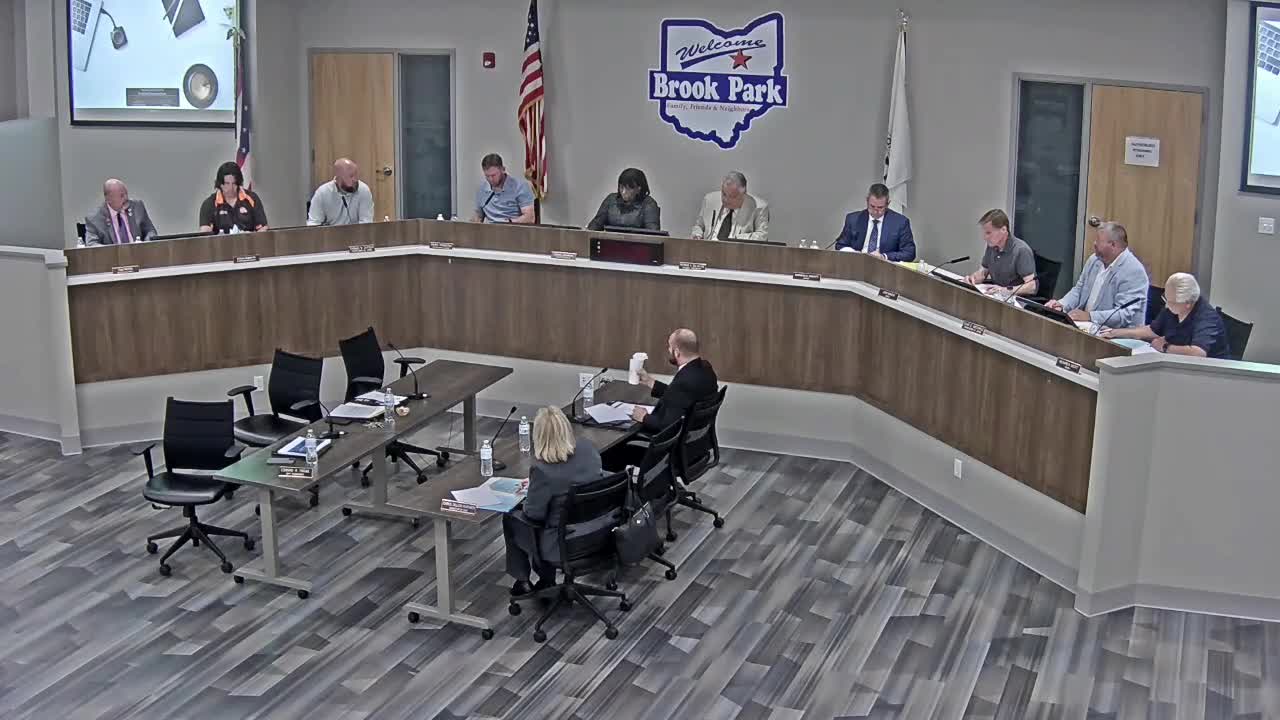
Brook Park council debates mandatory arborist inspections, financial aid for dangerous trees
Summary
Council discussed whether to pursue legislation requiring arborist inspections or other action on large trees that overhang neighbors’ property after recent storm damage; members raised liability, cost and program options including existing assistance programs.
Brook Park — City council members on June 10 debated whether to pursue a municipal program or ordinance requiring arborist inspection and possible removal of large or hazardous trees on private property, and discussed possible financial assistance to owners.
Councilman Troyer introduced the matter after receiving repeated constituent complaints about large trees and limbs falling on garages and yards. “It’s something we should look at because we got some really big trees in this city,” Troyer said, urging council to consider requiring arborist review for trees above a certain size.
Council members exchanged the legal and practical implications. Councilman Poindexter said he supported the idea but warned about liability and how inspections and enforcement would work: “Who’s arborist? Do they have to hire their own arborist? Does the city hire an arborist to inspect them?” he asked. The mayor and service director noted insurance and liability constraints: the mayor said city staff going on private property to perform work could create insurance exposure and that any program design would need careful detail; the service director noted residents sometimes use notarized letters from insurers to prompt neighbor action.
Nut graf: council did not adopt new rules at the meeting but recorded broad interest in a program that balances resident safety, insurance and the costs of tree removal. Several council members recommended researching ordinances used by peer cities and designing a program that could include financial assistance similar to HMAP (Housing Maintenance Assistance Program) or planting requirements tied to removals.
Key points: council members described the problem as recurring and sometimes expensive for homeowners. They distinguished dead trees (which are visible hazards often addressed through insurance notices) from apparently healthy but risky trees that only an arborist can assess. Councilman Poindexter suggested the city could create a program for inspection and assistance; the mayor suggested that if the city helped fund removals, it could require planting replacement trees in city parks as part of conditions. Councilman Dufour and others raised homeowner‑burden concerns, noting many large trees predate current owners.
Action and next steps: council supported a motion that the item be discussed (roll call recorded yes votes). Several members asked staff to research ordinances from comparable cities and to explore program design, including options for private arborist certification, liability limits, and targeted financial assistance for low‑income homeowners.
Context: council referenced recent storm-related tree failures and an earlier tornado; members said private insurance remedies often start the process (insurer letters or homeowner action) but that out‑of‑pocket tree removal is costly. No ordinance text or formal program was introduced at the meeting.