
Lorain County holds second hearing on proposed quarter‑percent sales tax to fund sheriff operations
Get AI-powered insights, summaries, and transcripts
Subscribe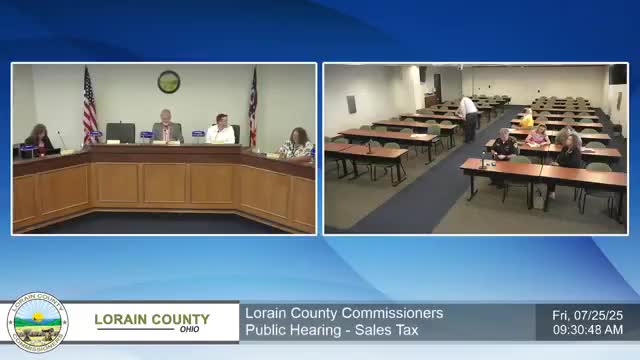
Summary
Lorain County commissioners held a public hearing July 25 on a proposed quarter‑percent sales tax to provide a dedicated revenue stream for the Lorain County Sheriff’s Office, with county staff and the sheriff explaining budget shortfalls, proposed uses and the projected impact on taxpayers.
Lorain County commissioners held a public hearing July 25 on a proposed quarter‑percent sales tax to provide a dedicated revenue stream for the Lorain County Sheriff’s Office, with county staff and the sheriff explaining budget shortfalls, proposed uses and the projected impact on taxpayers.
The county replayed a presentation from an earlier hearing so all viewers would receive the same information. Commissioner Riddell opened the session by describing the proposal as an increase under the Ohio Revised Code to sections 5739.021 and 5741.021 to add 0.25 percentage points to the county sales tax, with revenues earmarked for sheriff operations.
The chief deputy (presenting budget slides) told commissioners the sheriff’s office overall budget for the current year is $31,232,398 and that next year’s budget is estimated at about $35,500,000. The presentation listed personnel, equipment leases and supplies as the largest line items and identified a proposed prisoner transport unit as a key new cost driver and potential area of savings.
"On a $100, it is a quarter," the chief deputy said when illustrating citizen impact; she added that on $10,000 in purchases the increase would total $25. She said the quarter‑percent, if approved, would “keep the public safety strong, preserving funds for other county needs, and avoiding future cuts or emergency fixes to fund this sheriff’s office.”
Sheriff remarks: budget gaps, transport costs and recent incident
The sheriff told the commission the proposed sheriff’s budget for 2026 is $34 million and said the office was cut $750,000 between 2024 and 2025 and later had to return to the commissioners to request funds to pay bills incurred in 2024. The sheriff said an additional $1,800,000 error appeared on spreadsheets produced by the prior administration and described the total shortfall as the reason for the ask.
The sheriff emphasized the prisoner transport workload and related costs. He said the county spent about $1,100,000 last year on transporting prisoners and keeping them in local custody for court duties and that the sheriff’s office expects a dedicated transport team to remove an estimated $750,000 in costs from the operating budget by reducing overtime and the need to take deputies off the road.
"That $1,100,000 does not include the hospital cost," the sheriff said, describing additional medical and overtime expenses tied to transports and medical escorts. He also noted that once people enter a correctional facility, Medicaid benefits are suspended under existing federal practice, which shifts medical costs to the county.
The sheriff described operational responsibilities that he said support a dedicated funding stream: managing major investigations and task forces, a crime lab capability he said was upgraded using restricted funds, and county‑level coordination during a recent multiagency response to an ambush of local officers. He described explosive devices found at that scene and said county resources — SWAT, bomb technicians, air support — were coordinated through the sheriff’s office.
Public comment: mixed support and opposition
Speakers during the public comment portion expressed both support and opposition. Michael McCray of Elyria voiced support for using local funds to ensure jails provide access to mental‑health care and to address trafficking and drug issues. "These people have mental health issues. They need the care," McCray said.
By contrast, Paul Elic, a resident on a fixed income, said he could not afford any additional taxes and expressed frustration with property valuations and county spending. "I can't vote for another levy for anything," Elic said.
Homer Taft, who identified himself as a Vermilion property owner and former attorney, urged the commissioners to consider a broader law‑enforcement purpose for the revenue rather than dedicating funds exclusively to the sheriff, and he pressed for clearer answers about the cost and financing of a potential new jail.
Commissioners’ comments and county context
Commissioner Bridal framed the proposal as restoring a sales‑tax rate that would keep Lorain County near the lower end of Ohio counties and told listeners that sales tax is largely paid by purchasers, including nonresidents who shop in the county. Bridal said the commissioners do not control property valuations (the auditor does) and that most property taxes flow to schools rather than county government.
Commissioner Gallagher and others said the county is working on a long‑term plan that includes jail design and capital needs; several commissioners noted the county recently received a large state grant (referred to in the hearing as the "61 19" grant) and said staff are still developing plans for how capital projects and operating needs will be paid.
Sheriff and staff said they had identified specific budget misstatements inherited from the previous administration, moved certain line items into restricted funds and pursued grants and asset forfeiture proceeds to reduce pressure on the general fund. The sheriff said the office has a corrections business manager who reviews medical and transport bills and that the office has already identified six‑figure recoveries this year from incorrect billing.
Procedural notes and closing
The hearing closed after public comment and a brief exchange among commissioners. The commission observed a moment of silence for officers injured in the recent incident and then adjourned the session; commissioners recorded aye votes as the meeting ended.
What’s next
The sales‑tax change would appear on the ballot if commissioners authorize placement; commissioners said they expect additional public outreach and more detailed budget materials before any final placement decision. No formal vote on the tax change occurred at the July 25 hearing — the session was a public hearing for information and comment.