
Planning Commission recommends denial of Ladysmith data center rezoning and special‑exception requests after public hearing
Get AI-powered insights, summaries, and transcripts
Subscribe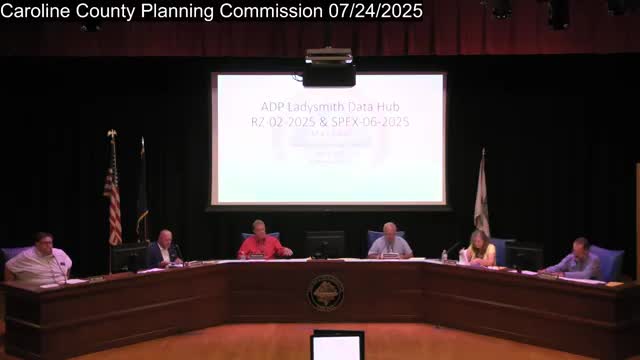
Summary
The Caroline County Planning Commission on July 24 recommended denial of a rezoning/proffer amendment and a companion special‑exception permit for the ADP Ladysmith Data Hub, and found a proposed substation on the applicant’s GDP not substantially in accord with the comprehensive plan.
The Caroline County Planning Commission on July 24 voted to recommend denial of a proffer amendment/re‑zoning (RZ022025) and the companion special‑exception permit (SPEX 062025) for the ADP Ladysmith Data Hub, a proposed data center campus on a 140.38‑acre M‑1 parcel near Green Road and Interstate 95. The commission also separately found that the applicant’s proposed public‑utility substation was not substantially in accord with the county comprehensive plan.
The applicant, Avaya Digital Partners (ADP) / ADP Ladysmith Data Hub LLC, sought replacement of the 1995 generalized development plan (GDP) and associated proffers to permit construction of a two‑story, approximately 315,000‑square‑foot first data center building and a 10‑acre substation in Phase 1, with a future development area that could accommodate up to four additional data center buildings in later phases. The applicant’s future‑development exhibit showed a possible campus totaling roughly 1.6 million square feet across all phases; staff noted that the future development exhibit is not proffered and could be developed for other M‑1 uses unless additional commitments are made.
Staff highlighted several proffers the applicant offered, including a 100‑foot vegetated perimeter buffer, a construction mitigation plan, an emergency action plan, reimbursement up to $100,000 for certain third‑party inspection costs, and a commitment to enclosed, muffled backup generators. Staff also noted concerns: the proffers do not require a closed‑loop cooling system (they restrict open‑circuit evaporative cooling but do not prohibit future cooling technologies with higher water use), the future development area is not proffered, the transportation proffer lacks a timing commitment, and the third‑party inspection reimbursement cap may not be sufficient for a multi‑phase project.
ADP representatives described the Phase‑1 building layout, noise and emissions controls, closed‑loop cooling intent, rainwater capture for irrigation and the firm’s willingness to clarify proffer language. ADP said each completed building would use about 1,500 gallons of water per day in a closed‑loop system (they told the commission irrigation could raise consumption on some days and that an open‑loop evaporative system could use far more water). ADP also said it had applied for 300 megawatts of utility service for the entire campus but that Dominion Energy and Rappahannock Electric were still determining routing and delivery timetables; ADP said the timeline for transmission upgrades can be multiyear.
More than a dozen residents and property owners spoke at the public hearing. Concerns included potential increases to residential electric bills or local ratepayer charges if transmission costs are socialized, long‑term water demand implications for Lake Caroline and local wells, noise and generator emissions (particularly during outages or monthly maintenance runs), visual impacts and light pollution, traffic during construction and operations, potential loss of private land use to utility easements, and the scope of the applicant’s future‑development exhibit. Several speakers urged the commission to deny the application or to impose tighter, specific proffers (for example: require closed‑loop cooling only, a firm limit on water usage, proffering the future development area to data center uses, and clear timing for road improvements).
Following the staff presentation and applicant rebuttal, Commissioner Steve Rollins moved to recommend denial of the rezoning/proffer amendment (RZ022025); the motion was seconded by Commissioner Lee Tingler. The motion to recommend denial passed on a commission vote recorded as 4 in favor of denial and 2 opposed (summary recorded by the clerk). The commission later voted 4–2 to recommend denial of the special‑exception permit SPEX 062025.
On a separate procedural item under Section 22‑32 of the county code, the commission considered whether the applicant’s proposed public‑utility substation (shown on the GDP) is substantially in accord with the comprehensive plan. After discussion the commission voted that the proposed substation was not substantially in accord with the comprehensive plan; one commissioner recorded an abstention and one commissioner voted against that finding. The commission’s recommendation and the 22‑32 finding will be transmitted to the Board of Supervisors, which has final authority over zoning, special exceptions and any actions tied to county land‑use consistency findings.
Staff and several commissioners recommended further refinement of proffer language if the applicant wishes to return, including stricter language on cooling technology, explicit phasing/timing tied to power delivery and construction improvements, stronger commitments on buffer planting sizes and replacement timing, clearer third‑party review reimbursement language and caps, and explicit limits on what the future development area may contain. The applicant and staff said they would continue to work on revised proffers and that certain technical reviews (VDOT traffic impact analysis, DEQ, Army Corps of Engineers for wetlands, and power‑interconnection engineering) remain outstanding.
The Planning Commission record will be forwarded to the Board of Supervisors with the commission’s recommendations and the public testimony transcripts; the Board will schedule its own public hearing before making a final decision.