
City staff: commercial development is addressed through project‑specific mitigation, not a standardized commercial impact fee
Get AI-powered insights, summaries, and transcripts
Subscribe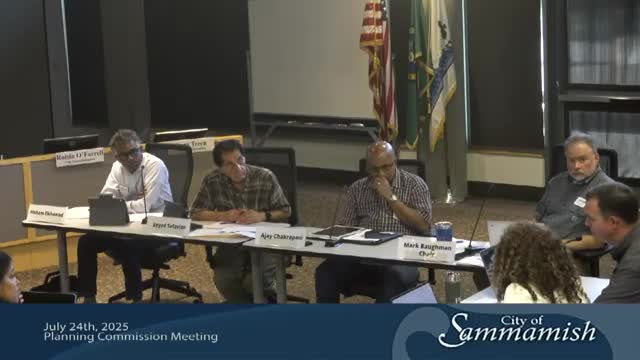
Summary
Commissioners asked whether commercial projects pay impact fees; staff said Sammamish’s fee schedule currently lists residential fees and that commercial or mixed‑use impacts are typically handled through project‑specific traffic analyses, frontage requirements, SEPA mitigation and negotiated contributions.
Commissioners asked on July 24 whether Sammamish levies a standardized commercial impact fee like it does for residential units. David Pyle told the commission that the city’s current fee schedule does not list a blanket commercial impact fee. Instead, staff explained, commercial and mixed‑use impacts are typically addressed through project review tools — traffic impact analyses, frontage improvements, SEPA mitigation, and negotiated developer contributions — and those outcomes can include cash payments or required on‑site and off‑site construction.
Pyle described the practical reasons: commercial uses vary widely in trip generation and timing, so a single per‑unit fee is difficult to apply fairly. He said the city routinely evaluates the proposed use, square footage and trip generation at permitting and that mitigation can be customized to that use and location. He added that if a tenant or new use increases trip generation, the permitting and occupancy process is the point at which impacts are evaluated and any mitigation is determined.
Staff committed to return with a clearer written explanation and examples at the Aug. 7 workshop. Commissioners asked for specific examples showing how mitigation is calculated for commercial uses, how developer frontage work interacts with impact fees, and whether mixed‑use projects pay residential fees for their housing components while nonresidential floors are handled separately; staff said they would provide those clarifications.