
Public commenters press commission to use fees and policy to encourage 2‑bedroom and affordable units
Get AI-powered insights, summaries, and transcripts
Subscribe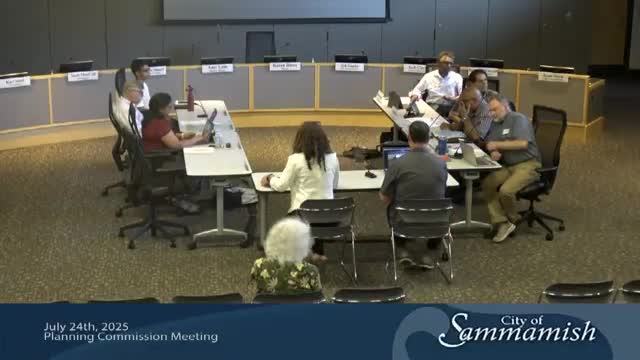
Summary
Several public commenters urged the Planning Commission to use the impact‑fee update and other policies to encourage two‑bedroom and smaller units to address affordability and senior housing needs; staff said the city currently allows an 80% AMI reduction and is examining broader AMI bands and implementation options.
At the start of the July 24 meeting several residents urged the Planning Commission to consider bedroom mix and affordability when the city updates impact fees. Richard Johnson told commissioners he hoped the fee structure could “encourage more 2‑bedroom units,” saying regional builders now favor studios and one‑bedroom apartments and that Sammamish’s housing stock skews toward three‑and four‑bedroom ownership homes.
Paul Stickney and Mary Wictor also asked the commission to integrate housing targets and to consider demographic shifts, including a sizable senior population. Wictor cited previous packets and analysis suggesting that smaller units generate fewer school and traffic impacts than large single‑family homes and said town‑center housing for smaller households could support transit and reduce vehicle trips.
Staff responses: David Pyle said the city’s code already provides a fee reduction for affordable units; the current code contemplates an 80% AMI affordable unit with an 80% fee reduction. Pyle and Starce told commissioners the staff and consultant team are exploring how to implement state law that requires fees to vary by square footage, bedrooms or trip generation, and staff said their recommended administrative approach is to use square footage because it is harder to misclassify during permit administration.
Policy tradeoffs discussed: Commissioners and staff discussed administration, enforceability and the strength of incentives. Pyle warned that bedroom‑based approaches can be easier to “game” (for example, converting a flex room into a bedroom late in construction) and said square footage is more objective for permitting. Commissioners suggested more granular AMI bands and asked whether the city could exempt deeply affordable units or scale reductions across multiple AMI levels; staff said the code currently only contemplates the 80% example but that they plan to propose a more detailed approach.
Next steps: Staff said they will refine implementation language with consultants and return proposals at the Aug. 7 workshop; a public hearing in September will give residents an opportunity to comment on proposed fee schedules and any proposed affordability reductions.