
Commissioners press staff on concurrency, traffic analyses and how impact fees feed the city’s CIP
Get AI-powered insights, summaries, and transcripts
Subscribe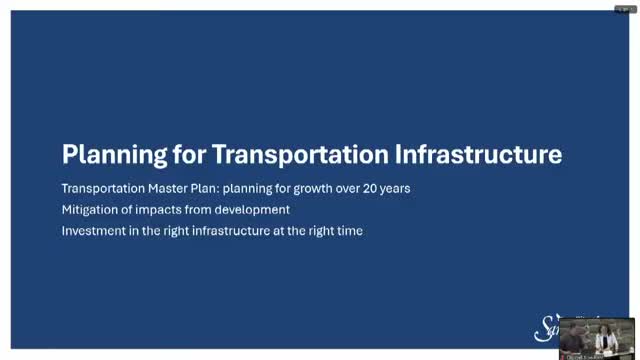
Summary
Planning commissioners questioned how concurrency reviews, traffic impact analyses and capital improvement prioritization connect to impact‑fee calculations, and staff described the city's review process and scoring system for transportation projects.
Audrey Starce, the city’s public works director, told the Planning Commission on July 24 that transportation planning for Sammamish is rooted in the Transportation Master Plan and related implementation documents, and that the city uses several tools during project review — a concurrency evaluation, traffic impact analysis (TIA), SEPA mitigation and impact fees.
Starce said the city’s review is multidisciplinary and that permit applications are evaluated by planning, development engineering, traffic engineering, inspections and maintenance staff. “Frontage improvements is a requirement for most applications,” she said, adding that those frontage improvements must meet the city’s public works standards for roadway width, sidewalks and bike facilities.
Starce described the project life cycle from policy and vision through six‑year capital planning, two‑year budgets and the design/construction phases. She said Sammamish scores candidate transportation projects on a 100‑point system that accounts for feasibility, risk, need and cost estimates; projects that score high are placed into the six‑year CIP and budgeted during the city’s biennial budgeting cycle.
Commissioners pressed staff on several points. Commissioner Syed Safavian asked how partially funded or unfunded CIP projects factor into impact‑fee calculations; Starce said staff and the consultant team are reviewing the city’s project lists and estimates and will provide methodology details at the Aug. 7 workshop. Commissioner Ajay Chakrapani raised questions about frontage improvements and whether a developer may deduct frontage construction costs from fees; staff said that question will be checked with development engineers and returned to the commission.
Staff emphasized how different tools interact. Starce and Pyle said concurrency certificates reserve capacity for a proposed development (valid for 180 days under the current practice) and a TIA is required for developments that generate more than 10 peak‑hour trips. Where impacts are identified, the TIA, SEPA mitigation, frontage requirements or negotiated developer improvements are the common ways to remedy problems; impact fees are intended to fund broader capital needs tied to adopted levels of service. Pyle noted that state law defines delivery as concurrent if improvements are in place at development or a financial commitment is in place to complete them within six years.
Commissioners also asked about multimodal measures and whether nonmotorized levels of service are being integrated; Starce said the city is moving toward multimodal planning and will reflect bike/pedestrian levels of service and the mobility‑hub work in standards and the upcoming public‑works update. Staff committed to provide more detail on how multimodal metrics and trip types (vehicle versus person trips) will appear in the consultant methodology on Aug. 7.