
Sammamish staff outline timetable and basics for citywide impact-fee update
Get AI-powered insights, summaries, and transcripts
Subscribe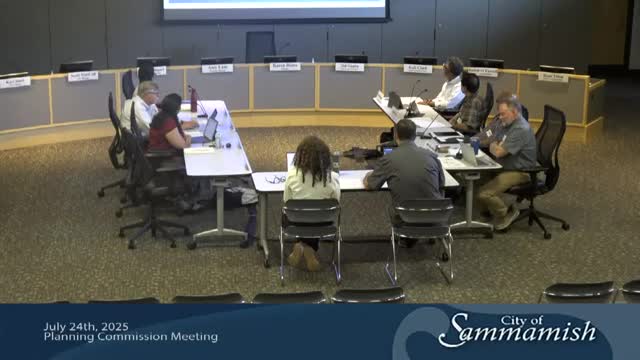
Summary
City staff told the Planning Commission on July 24 that consultants will deliver a proposed impact-fee model at an August 7 workshop and a public hearing is planned for September, and explained how fees are calculated, collected and restricted.
Sammamish staff on July 24 told the Planning Commission they will bring proposed updates to the city's impact-fee formulas to a workshop on Aug. 7, with a public hearing slated for September and adoption to follow at the City Council. The presentation described impact fees as “a one-time charge on new development” intended to fund capital projects so that new development pays a proportional share of infrastructure costs.
The discussion, led by David Pyle, Department of Community Development, and Audrey Starce, public works director, explained legal limits on fees and the city's next steps. Pyle said the fees must show a nexus and proportionality under long‑standing court precedent and noted the work follows the city’s recently adopted comprehensive plan and several supporting master plans.
Why it matters: The city has not updated its impact fees since 2015. Staff and consultants are recalculating fees to reflect new levels of service in the comprehensive plan and to comply with a 2023 state law noted in the meeting (identified there as “Senate Bill 5258”), which requires residential fees to scale by square footage, bedrooms or trip generation.
City staff outlined how impact fees are used and constrained. Pyle said fees are collected at building-permit issuance (with statutory options to defer payment until sale in some cases) and are limited to capital costs — land acquisition, design and construction of new or expanded facilities — but may not be used for ongoing maintenance. He noted state law defines “concurrent” infrastructure delivery as either being in place at development or supported by a funding commitment to complete within six years.
Staff gave concrete examples used in the presentation to illustrate how current fees apply: a hypothetical new single-family home in a portion of the city would incur roughly $36,000 in combined school, parks and roads fees; a multifamily town‑center apartment example showed about $13,000; and an 80% AMI affordable townhome example illustrated an 80% reduction in the fee (to roughly $5,000 from about $24,000 in the staff example). Pyle said the exact formulas and proposed rates will be finalized by the consultant and returned to the commission on Aug. 7.
Staff also explained collection mechanics. Pyle said developers may either pay at permit issuance or record a covenant to defer payment until escrow at sale, a practice that some builders use to manage cash flow. He said the city works to collect fees for developments just outside the city limits when developers build facilities that affect Sammamish.
The presentation closed with a timetable: consultants will present methodology and proposals at the Aug. 7 workshop, a public hearing is planned for September, and later the council will consider adoption of any updates.