
Five development teams present competing plans for 5146 Eden Avenue; HRA moves to closed session
Get AI-powered insights, summaries, and transcripts
Subscribe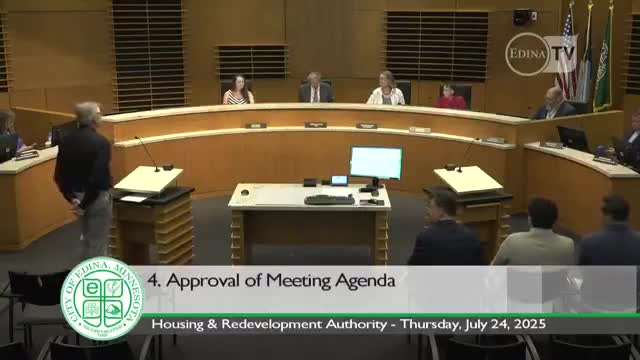
Summary
The Housing and Redevelopment Authority of the City of Edina on July 24 heard five competing developer presentations for the city‑owned former public works site at 5146 Eden Avenue and voted to move into a closed session to discuss the proposals.
The Housing and Redevelopment Authority of the City of Edina on Thursday heard presentations from five development teams competing to redevelop the city‑owned former public works site at 5146 Eden Avenue.
Board members scheduled a closed session at the end of the meeting to discuss the proposals and next steps. Commissioner Jackson moved to go into closed session “as permitted by Minnesota Statute 13D.05 subdivision 3 to review and discuss the proposals for the sale of land at 5146 Eden Avenue,” and Commissioner Agnew seconded. The motion passed on a voice vote.
The presentations, each allotted roughly 30 minutes for a presentation and questions, displayed a range of approaches for the 3.3‑acre Grandview site. Proposals included owner‑occupied townhomes and condominiums, mixed rental housing with an on‑site commercial node, a 60‑unit senior cooperative paired with a 100‑unit affordable senior rental building and a concept centering a restaurant/event venue and public green.
“Our plan highlights, we have proposed 70 for‑sale townhome and condominiums here, and about 7,500 square feet of retail,” said Mr. Katter, president of Hempel Companies, describing his team’s submission (Hempel Companies with Monarch Development Partners, Jester Concepts and Rokos Advisors). He added, “We do plan to deliver 10% of our units to meet your inclusionary housing goal here,” a figure the presenters calculated as seven inclusionary units out of 70.
Hempel’s team emphasized a clustered rowhouse/condominium design intended to work with the site slope, private garages for two stalls per unit, no curb cuts on Arcadia Avenue and a restaurant pad at the corner. The Hempel team said it anticipated purchasing the land outright and confirmed a land purchase price in its materials of $4,000,000.
Opus Development Group presented a scheme with a mix of housing types and a commercial node on the north end of the site. Nick Bernan of Opus said the team “felt that creating this neighborhood vibe within this Grandview District was really important.” Opus’s initial RFP submission listed a land offer of $2,250,000; the team said that price reflected the density they proposed and that they did not intend to seek public financing for their concept.
A team led by Noor Companies in partnership with Wellington Management described itself as a local, minority‑ and women‑owned developer/contractor. Noel Noor said Noor Companies is “the largest minority and women owned development and construction firm in the Twin Cities.” Wellington Management’s submission included an offer of $4.5 million for the property and proposed a mix of townhomes and apartments with a north‑end commercial opportunity, noting they would not seek TIF in their underwriting.
Lifestyle Communities and Ron Clark Construction presented an all for‑sale proposal focused on cooperative units on the north end and single‑level flats and live/work‑capable units on the south, totaling roughly 80 units. The team described a cooperative product sized to be boutique and neighborhood‑oriented and discussed using the site grade to minimize visible parking and preserve open space.
A consortium led by Onward Investors proposed a multi‑asset approach: a 60‑unit senior cooperative, a 100‑unit 55+ affordable senior rental building, an approximately 9,000‑square‑foot restaurant/event space (branded in the presentation as a cafe/bar and an attached modular event center) and a public corner green. Onward’s presentation included a $4,000,000 acquisition price and noted the team would seek tax‑increment financing for buried parking and pedestrian improvements and pursue bonding with Minnesota Management and Budget to support a Low‑Income Housing Tax Credit (LIHTC) financing path for the affordable senior building. Onward said it expected the full project to be complete in the first quarter of 2028 if financing moves on a typical schedule.
Several presenters addressed site constraints raised by commissioners and staff: the steep grade north‑to‑south, proximity to the railroad berm, the pedestrian bridge connection that lands at the upper deck of the Jerry’s Foods parking garage, and parking and curb‑cut impacts on Arcadia and Eden Avenues. Designers from multiple teams said they would place most resident parking below or behind buildings to maximize green space and street activation, and several teams said they planned to limit curb cuts on Arcadia.
Sustainability and permeable surface were raised repeatedly. One presenter estimated more than half of the site could be left permeable in a higher‑green plan; another team reported about 25% permeable area under their concept. Onward’s presentation estimated roughly 35–40% permeable surface in the layout they showed. Several teams said they would consider rooftop photovoltaic readiness, native landscaping and stormwater strategies; a few said more advanced systems such as geothermal or passive‑house techniques would depend on the ultimate financing and buyer preferences.
The HRA convened the presentations in public session and then adopted a motion to move to closed session to discuss the proposals and pricing. No final selection or development agreement was announced at the meeting; the HRA stated it would use the closed session to deliberate and negotiate next steps.
What’s next: the HRA will review proposals in closed session as permitted by Minnesota statute. Any decision on sale terms, selection of a negotiating partner, or requests for public financing would return to the HRA for public action and for any required public hearings.
(Reporting note: quotes and attributions come from the meeting transcript of the July 24, 2025 HRA special meeting. Financial offers and unit counts reflect figures presented by developer teams during that session.)