
City of Olney pitches partnership with district to renovate older homes using high‑school trades program
Get AI-powered insights, summaries, and transcripts
Subscribe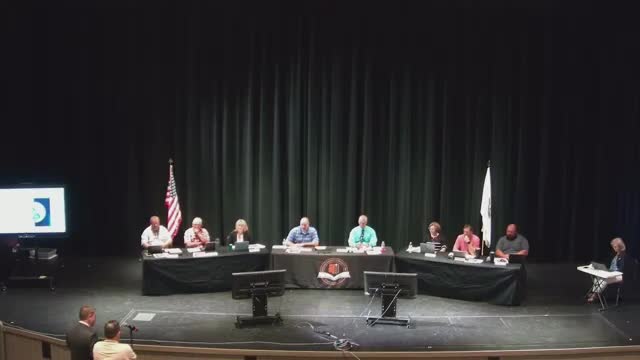
Summary
City officials proposed acquiring older properties for renovation by a revived high‑school trades program, offering materials and property acquisition while asking the district to operate the hands‑on student program; board members asked about liability, instruction and student interest.
Councilman Bryce Fehrenbacher and Mayor Lambert told the Richland Community School District No. 1 board that the City of Olney would like to partner with the district to renovate older houses rather than build new homes, and to use the district’s trades program to give students hands‑on remodeling experience. "We would acquire the property. We would provide all the material," Fehrenbacher said, adding that the city would handle asbestos abatements, code inspections and property acquisition.
The city proposed a model in which the district would run the renovations as a trades program: students would perform demolition and remodeling as part of instruction, the city would supply materials and coordinate property transfers, and renovated houses would be sold on the private market with proceeds returned to the program. Fehrenbacher described the approach as a way to speed worker training and revitalize neighborhoods that “have maybe fallen into disrepair.” He said the city has discussed the idea with the State Board of Education and has not found an identical program elsewhere.
Board members and district staff raised questions about liability, prevailing‑wage obligations and insurance coverage. One board member asked whether the district had considered using contractors; Fehrenbacher and others responded that contractor costs plus prevailing‑wage rules could make projects unaffordable without student labor. "The problem with some of this is going to be prevailing wage," a city representative said; "Otherwise the city can't afford to do it."
Other practical questions included the age and condition of likely homes (Fehrenbacher estimated many would be 65–80 years old and structurally sound), whether demolition would occur before students work on sites, and how to provide trade instruction for electrical and plumbing work. The city said it has discussed HVAC partnerships with Illinois Eastern Community Colleges (IECC) and Olney Central College and that the city’s building inspector had expressed interest in participating.
Fehrenbacher asked the board for permission to investigate the proposal further and for the district to poll student interest. The board agreed to explore the idea; the superintendent said staff would poll students and invite the district’s TNI instructor, Mister Ellison, to a future meeting to comment on feasibility and instruction. No formal binding agreement was approved; participants described the next steps as feasibility study and community and staff follow‑up.
Fehrenbacher estimated that roughly 10% of the city’s housing stock — about 300 houses of 3,000 — could be candidates for the program and said the project would likely take a year or more to establish. He characterized the initiative as self‑funding over time if houses sell for roughly the cost to acquire and renovate them.