
Committee on Parole hears dozens of clemency requests; recommends two commutations and two pardons, denies several others
Get AI-powered insights, summaries, and transcripts
Subscribe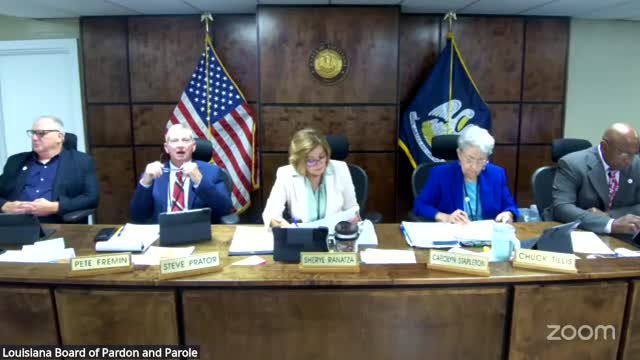
Summary
Baton Rouge — The Louisiana Committee on Parole held a hybrid hearing June 16, 2025, in which members heard applicants, victims, family members and advocates over a series of clemency cases.
Baton Rouge — The Louisiana Committee on Parole held a hybrid hearing June 16, 2025, in which members heard applicants, victims, family members and advocates over a series of clemency cases. The panel voted to recommend commutations for two inmates, approved two misdemeanor pardons with restoration of firearms, and denied several other commutation requests after hearing victims' statements and reviewing institutional records.
Why it matters: The committee’s recommendations go to the governor. For commutations the board recommended reducing life sentences to terms of years with immediate parole eligibility in two cases; in other cases the board declined clemency after victims, prosecutors, or law enforcement opposed release and after members weighed rehabilitation, risk, age and medical issues.
What the committee recommended
• Commute sentences to a term of years with immediate parole eligibility — The committee voted to recommend commuting the life sentences of Keith Alexander (Calcasieu Parish, sentenced 1988) and Ronald Johnson (Plaquemines Parish, sentenced 1987) to terms of years (both recommendations recorded as commutation to 99 years with parole eligibility). Supporters, including the Louisiana Parole Project, cited decades of programming, trusteeship, religious involvement and low institutional risk scores. The committee’s public record shows strong victim and prosecutorial opposition in at least one of those files, but the majority concluded the combination of age, conduct and time served supported a recommendation to the governor.
• Pardon with restoration of firearms — The committee unanimously recommended a pardon and restoration of firearms rights for Chamoria Broadway, whose 2019 misdemeanor theft conviction carried a $100 fine; members noted her statements of remorse and that she has not reoffended. The committee also recommended a pardon with restoration for Earl Jones (municipal/simple battery matter), citing the time elapsed and that the victim did not oppose relief.
What the committee denied or declined to recommend
The committee denied commutation requests for multiple applicants after hearing victim statements, law-enforcement opposition, and reviewing prison disciplinary histories. Denials recorded during the session included applicants who had lengthy institutional records of rehabilitation but faced strong victim or DA opposition. Among the denied cases were Eric Proctor (Lafayette Parish sentence, denied), Brian Dietrich (East Baton Rouge Parish, denied), Joseph Norfleet (Orleans Parish, denied), Curtis Frank (Avoyelles/Angeline Parish, denied), Jeremy Jones (Orleans Parish, denied), Franklin Jones (Calcasieu Parish, denied), and Everett Fuller (forcible sex offense case, denied). In many denials members cited the heinous nature of the underlying offense, persistent victim opposition, or unresolved factual questions revealed in the record.
Voices from the hearing
Channing Blake of the Louisiana Parole Project, who spoke repeatedly for multiple applicants, summarized the group’s position: “Based upon his record, rehabilitation, and strong support system, we ask that the board grant a favorable recommendation,” a line he repeated on several cases to describe the program’s reentry offers and transitional supports. Several applicants expressed remorse at their hearings. Eric Proctor told the board: “I do hold this regret and shame for what I did 30 years ago,” while victims’ relatives offered contrasting accounts calling for continued confinement; one victim family member said bluntly, “He murdered my mom when I was 8 years old,” as part of remarks opposing relief.
Process notes and next steps
The committee took each application in turn, heard applicant statements, statements from victims and supporters, and received institutional summaries from wardens and classification staff. Where required by committee procedure the board moved into executive session to discuss confidential records before returning to public session for votes. Committee recommendations for commutation or pardon are advisory and proceed to the governor for final action. Denials are final before this board but applicants may reapply under the rules governing repeat petitions.
Votes at a glance (formal outcomes recorded June 16, 2025)
- Eric Proctor (Lafayette Parish): Application for commutation — denied (4–0 recorded tally to deny). Note: victims opposed; board recorded denial. - Brian Dietrich (19th JDC, East Baton Rouge): Application for commutation — denied (vote split, insufficient favorable votes). - Joseph Norfleet (Orleans Parish): Application for commutation — denied (1 favorable, 3 unfavorable). - Curtis Frank (Avoyelles/Angeline): Application for commutation — denied (majority unfavorable). - Keith Alexander (Calcasieu Parish, sentenced 1988): Application for commutation — board recommended commutation to 99 years with immediate parole eligibility (majority vote recorded). - Eric Jenkins (2012 misdemeanor possession): Pardon with restoration of firearms — denied (fell short of required favorable votes). - Jeremy Jones (Orleans Parish): Application for commutation — denied (majority unfavorable). - Ronald Johnson (Plaquemines Parish, sentenced 1987): Application for commutation — board recommended commutation to 99 years with immediate parole eligibility (majority vote recorded). - Franklin Jones (Calcasieu Parish): Application for commutation — denied (did not receive required favorable votes). - Everett Fuller (forcible sex offense): Application for commutation — denied (board cited nature of crime and plea agreement). - Chamoria Broadway (Caddo Parish misdemeanor theft, 2019): Pardon with restoration of firearms — recommended unanimously. - Earl Jones (municipal/simple battery matter): Pardon with restoration of firearms — recommended by board (majority).
Records and context
Warden and classification summaries presented institutional records (work assignments, trustee status, programming completed, Tiger risk scores and disciplinary history) that committee members cited repeatedly when weighing risk and rehabilitation. Several applicants were noted as class A trustees who worked on maintenance or prison enterprise assignments; others had medical or advanced age considerations factored into votes. Victim statements, DA or sheriff’s office opposition, and any law-enforcement letters were explicitly mentioned by board members as decisive in multiple denials.
What to watch next
The committee’s recommendations will be forwarded to the governor’s office for review. Cases the board recommended for commutation will be subject to further executive consideration and, if approved by the governor, would be amended to the sentence noted above and may include immediate parole eligibility depending on the governor’s action and subsequent parole procedures.
Ending note: The Committee on Parole met over many hours and heard dozens of witnesses and statements. Committee members said they balanced institutional programming against the seriousness of underlying crimes, victim harm, and public-safety considerations in their votes.