
Lebanon City proposes $715,929 CDBG budget, backs pilot county housing director with modest city contribution
Get AI-powered insights, summaries, and transcripts
Subscribe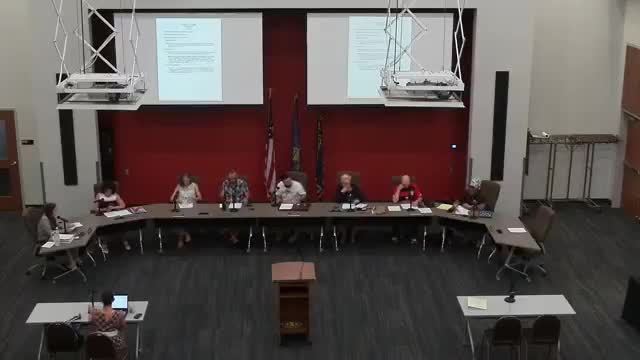
Summary
At a public hearing, Lebanon City staff presented the 2025–2029 consolidated plan and a $715,929 2025 annual action plan for Community Development Block Grant funds and proposed a $5,000 city contribution this year toward a county-wide Housing Development Director as part of a braided funding model.
Lebanon City on Tuesday held a public hearing on three Community Development Block Grant items including a 2025–2029 consolidated plan, the 2025 annual action plan and an amendment to the city’s 2023 annual action plan.
City community development staff member Janelle Groh said the 2025–2029 consolidated plan “identifies the community development and housing needs in Lebanon and outlines strategies and goals for investing our Community Development Block Grant or CDBG funds over the next 5 years.”
The nut of the 2025 annual action plan is its first-year budget: Groh said it allocates $715,929 in CDBG funding — the city’s estimated $695,929 2025 entitlement plus $20,000 in program income — and proposes the following distribution: $104,000 for public services (crime prevention and increased police engagement in low- and moderate-income neighborhoods), $200,000 for milling and resurfacing of city streets in qualifying areas, $130,000 for code enforcement, $151,929 for acquisition and rehabilitation or demolition of hazardous and blighted properties, and $130,000 for planning and administration.
The administration budget, Groh said, also includes a proposed city contribution to help fund a new county-level Housing Development Director position run through a public–private partnership. “We included it as an initiative in our 5 year plan,” Groh said, adding that the city’s portion would come from planning and administrative CDBG funds and is subject to HUD rules and the city’s annual entitlement amount.
Nikki Mower Gray, executive director of the Community Health Council, outlined a braided funding approach tied to a separate $750,000 grant to Lebanon County Christian Ministries from WellSpan Health. She said the WellSpan grant has four components — shelter capacity expansion, emergency housing and eviction-prevention services, a new Lebanon County housing collaborative, and funding toward a Housing Development Director — and that the housing director role would be partly supported by the WellSpan funds and by other partners.
Gray said the grant is three years but the partners are “putting some money in reserve each year to stretch the grant to 5 years.” The county has also committed to contribute $500,000 over 10 years using Act 137 funds, Gray said. The city’s proposed contribution would be $5,000 in the coming program year and $20,000 annually for the next four years, subject to annual subrecipient agreements and HUD eligibility for using CDBG administrative funds for that purpose.
Gray described the planned position’s responsibilities as convening the county housing collaborative, facilitating cross-sector partnerships, pursuing funding and tracking outcomes. She said the position would be employed by Lebanon County Christian Ministries for the first three years for fiduciary reasons, overseen by a five‑member advisory board that would include city and county representatives, and could be based with hoteling space at LCCM with some time in city offices.
Groh and Gray answered council questions about recruitment and oversight. Gray said they have a job description and plan to begin recruiting soon; she emphasized the role would prioritize coalition building and fundraising if a single candidate cannot be found with deep technical housing experience.
As part of the same hearing, Groh presented a proposed amendment to the fiscal year 2023 annual action plan to reprogram $45,000 in unspent FY2023 CDBG administrative funds to support public-facility and recreation improvements at Northeast Park, specifically to complete upgrades to the playground. Groh noted the annual action plan language allows some flexibility; if the specific site cannot be used, the funds could be directed to a comparable eligible recreational facility after environmental review and required procedures.
Groh also noted recent program-income history and carryover that allow the city to fund the proposed items without exceeding the HUD administrative cap. She cited program-income receipts in previous years (examples provided at the hearing included $31,000 in 2015, $37,000 in 2016, $26,000 in 2018, $61,000 in 2019, $58,000 in 2020 and $85,000 in 2023) and said the city estimates $20,000 in program income annually for planning purposes.
No formal council vote on the consolidated plan or the amendment took place at the hearing. Groh said the city will accept public comments through July 30 and will submit the annual action plan in early August ahead of the Aug. 16 HUD deadline. The council scheduled resolutions to approve the 2025–2029 consolidated plan and to amend the FY2023 annual action plan for the next council meeting; Groh said the proposed $5,000 city contribution for the housing director is included in the packet for that vote but would still be subject to the contingencies she described.
Ending: The public comment period remains open through July 30; Groh provided a city email for written comments and said the administration will consider all comments before final submission to HUD.