
Planning commission endorses creation of SOLA allocation area to enable $300 million mixed-use solar project
Get AI-powered insights, summaries, and transcripts
Subscribe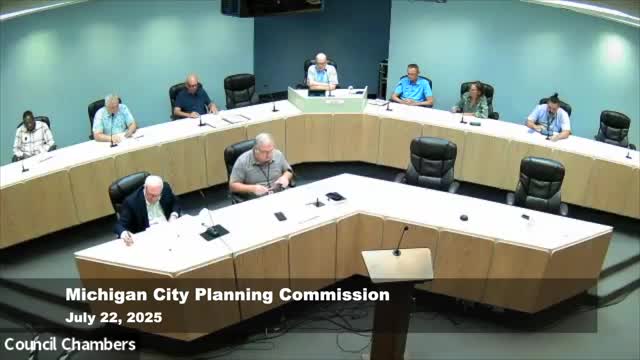
Summary
The Michigan City Planning Commission voted to approve Resolution 3-2025, a recommendation to create the SOLA allocation area that would let developers finance a proposed roughly $300 million mixed-use project through developer-backed bonds paid from future tax increment revenue; the measure now goes to city council.
The Michigan City Planning Commission voted Tuesday to approve Resolution 3-2025, recommending creation of the SOLA allocation area that would allow developer-backed bonds to be repaid with tax-increment revenues if a proposed mixed-use solar project advances. The vote sends the allocation-area measure to the Michigan City Common Council with a favorable recommendation.
The allocation area is a legal step, not a bond issuance. Alan Sernak, attorney for the Redevelopment Commission, told the commission the body must first find the proposed allocation area "comports with a development plan of the city" before the council can consider tax-increment tools and developer-backed financing. "If you had asked us a year ago, six months ago, even three months ago whether this project was ever gonna become a reality, I think my pessimistic nature would have said, I don't think so. I was wrong," Sernak said. "This thing has a chance of becoming... a very dynamic reality for all of Michigan City." Attorney Hale confirmed the resolution, as revised, "comports with the legal requirements."
If approved by council and later finalized by the Redevelopment Commission, the allocation area would permit the developer to secure bonds backed by the tax increment generated inside that area. Skyler York of the planning staff described the project components presented in the attached project analysis: a roughly 242-room hotel, about 21,000 square feet of retail and commercial space, approximately 188 condominium or townhouse units, and an approximately 385-space parking structure. Sernak said the overall development has been described as about a $300,000,000 project and that the allocation area would allow the developer to pledge the increment (taxes above a base assessment) toward retiring developer-backed bonds; "it's not city money that's being put at risk," he said.
Commissioners asked about the mechanics and risks. Sernak and York said no bond is being issued tonight and that a series of further steps are required: Redevelopment Commission action, common council approval, and, if approved, public hearings before final RDC action. York described two procedural benchmarks in the developer's economic development agreement—Aug. 19 and Dec. 19—intended as deadlines for advancing approvals and securing financing. Sernak said the allocation area, if bonded, would typically have a 25-year period tied to the bond and that the existing North TIF is set to expire in 2027.
Public commenter Scott ("Great Scott") Mellon, who gave his address as 200 Kenwood Place, urged the commission to approve the resolution, saying, "If you want Sola to have a chance of happening, you pass this forward. If you want to kill Sola, you vote no." Mellon and staff also noted potential short-term revenue gains such as hotel taxes even while property-tax increments would be used to retire bonds over the TIF period. York said some units in the planned residential portion have already been sold and that 36 units had closed so far, including a top-floor unit sold for about $2.3 million, figures York and staff supplied at the meeting.
The motion to approve Resolution 3-2025 (items 1–5 as presented) passed on roll call with the following recorded votes: Commissioner Bolling — yes; Commissioner Connolly — yes; Commissioner Dabney — yes; Commissioner DeMedici — yes; Commissioner Hoffman — aye; Commissioner Clender — yes; Commissioner Tejeda — yes; Commissioner Warner — aye. The commission approved forwarding the resolution to the common council with a favorable recommendation.
The commission and staff emphasized control points: no city general-obligation pledge was authorized; the allocation-area step simply makes financing tools available to the developer. Sernak and York said that if the developer fails to meet financing or milestone benchmarks the allocation-area designation would effectively do nothing and the project could be reissued or re-proposed by another developer. The commission noted the standard in state redevelopment law is that the allocation area must "comport with a development plan of the city," and that the planning commission's role at this stage is to confirm that finding before council review.
Next steps: the item will go to the Michigan City Common Council for review and ordinance action; if council approves, additional hearings and final RDC action would be required before any bond is issued or construction begins.