
Barrow County Board of Education rolls back millage, agrees to cover SRO salaries
Get AI-powered insights, summaries, and transcripts
Subscribe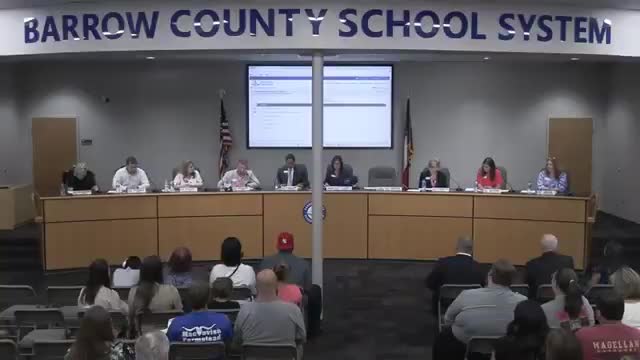
Summary
The Barrow County Board of Education voted unanimously to roll back its millage to 15.193 mills and to pay 100% of direct salary-and-benefit costs for 24 approved school resource officers beginning with the 2025–26 school year; the board discussed fund balance, safety grants and intergovernmental agreements during the combined item.
The Barrow County Board of Education voted 9–0 on July 24 to roll back its millage rate to 15.193 mills and to pay 100% of the direct salary-and-benefit costs for 24 approved school resource officers starting in the 2025–26 school year.
The move came after the board combined discussion of the SRO (school resource officer) contract and the millage-setting item, a change the board approved at the start of the meeting. Ms. Houston, the district finance officer, told trustees the district’s 2026 general fund budget projected $226,300,000 in expenditures and $213,000,000 in revenue using a 15.5-mill rate, producing a planned use of fund balance of $12,900,000.
“After our tentative budget was set, the Board of Commissioners let us know that they wanted to adjust the amount the Board of Education was billed for school resource officers,” Ms. Houston said, summarizing the county’s requested change and the district’s options for balancing the budget. The district said the commissioners’ requested SRO billing would add roughly 0.195 mills (bringing the advertised rate to about 15.695 mills). The finance staff also identified 21.5 vacant positions that could be frozen, saving about $1,862,000 and lowering the required millage to about 15.268.
Board members discussed the trade-offs between the advertised rates and the calculated rollback rate provided by the county. Ms. Houston told trustees the county-calculated rollback rate would be 15.193 mills and that choosing that rate instead of 15.268 would increase the district’s deficit by roughly $300,000.
Board members and attendees also reviewed the district’s fund balance. Ms. Houston said the district’s projected total fund balance as of June 30, 2025, was $83,000,000, with about $16,000,000 assigned for future needs and $12,900,000 projected to be used this fiscal year to cover expenses that exceeded revenue. She told the board the district’s unassigned, unrestricted fund balance was about $54,100,000, or about 23.9% of the operating budget — roughly three months of expenditures by her calculation.
The tax commissioner, Jessica Garrett, briefed the board on senior property-tax exemptions after trustees asked about the impact of recent changes. “The first senior property tax exemption was in 1998, and it was House Bill 985 for seniors that were 62 and older. And it was a $20,000 exemption based on a $20,000 or less income,” Garrett said, then described later changes (including a 2007 bill that raised the exemption and more recent bills in 2025 that expanded eligibility). Garrett estimated roughly 5,000 active senior exemptions in the county and offered context on how those exemptions can affect local revenues.
Board members heard from Sheriff Smith and a district safety adviser, Dr. Bowen, about SRO costs and alternatives. Dr. Bowen summarized common cost-sharing arrangements used elsewhere and said a typical split seen in other systems is the school system contributing 70%–80% of salary and benefits. Sheriff Smith described the difference between direct and indirect costs and urged the board not to take on purchases such as weapons, vehicles or other law-enforcement equipment that the sheriff’s office normally procures: “I trust that you’re going to buy laptops and school buses. I don’t need my Board of Education buying pistols and AR‑15s,” he said, cautioning that equipment procurement is a different procurement lane and carries liability and operational implications.
Trustees said they wanted to balance safety priorities with fiscal stewardship. Trustee [name not specified in the transcript] moved to roll the millage back to 15.193 mills and to pay 100% of the direct salary-and-benefit costs for the district’s SROs; another trustee seconded the motion. The board approved both parts of the motion by voice votes: the millage rollback passed 9–0, and the motion to cover 100% of direct SRO salary-and-benefit costs for the 24 approved SROs (and for any future additional SROs) also passed 9–0.
During the discussion trustees and staff noted other safety-related funding the district has received and ongoing costs that are not covered by grants. The district described a federal grant award of about $1,097,000 (Project Serve) related to recovery after a September incident, and staff said state safety funding provided roughly $2,000,000 this year; district staff also listed planned or needed capital and multi‑year expenditures, including a Syntegix alert-system renewal they estimated near $900,000, camera and access-control upgrades, and ongoing pod leases and site work that are not fully reimbursed by federal or state grants. Ms. Houston told the board some construction-related costs and future renovations would not be eligible for grant reimbursement.
Trustees framed the unanimous votes as an effort to preserve safety while providing taxpayers relief via the rollback. Board members and Sheriff Smith repeatedly emphasized that the SRO program is governed by an intergovernmental agreement among the school district, the sheriff’s office and the board of commissioners and said the agencies should coordinate to avoid duplicating services.
The board adjourned after thanking Sheriff Smith and the tax commissioner for attending and answering questions.
Votes at a glance: - Roll back millage to 15.193 mills — Passed 9–0. - Pay 100% of direct salary-and-benefit costs for 24 approved SROs starting 2025–26 (and for any additional future SROs) — Passed 9–0.
(Where numbers or dates were not specified in the transcript, the article uses the district’s stated figures as presented to the board.)