
California Energy Commission: efficiency rules and programs deliver large net savings and should be preserved
Get AI-powered insights, summaries, and transcripts
Subscribe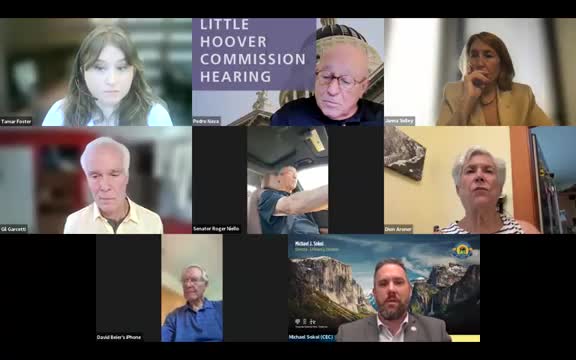
Summary
The California Energy Commission told the Little Hoover Commission that statewide efficiency standards, school ventilation and plumbing grants, equipment listing work and the EPIC research program produce net savings and other benefits that contribute to affordability, reliability and emissions reductions.
Michael Sokol, director of the Efficiency Division at the California Energy Commission, told the Little Hoover Commission the agency reviewed its ratepayer-funded programs after Governor Newsom's affordability executive order and concluded that "the big energy efficiency programs remain highly cost beneficial and deliver substantial savings to customers" while helping meet the state's clean-energy goals.
Sokol summarized four program areas: codes and standards, CalSHAPE (school ventilation and plumbing grants), the statewide solar equipment lists that streamline permitting and interconnection, and the Electric Program Investment Charge (EPIC) research program. He said California's appliance and building efficiency standards have saved Californians more than $200 billion cumulatively and that the most recent building code updates are projected to yield $4.8 billion in energy savings over 30 years.
On CalSHAPE and school funding, Sokol said the program has awarded 273 plumbing grants and 841 ventilation grants totaling $789 million and noted that Proposition 2 (voter-approved school facilities funding) provides $10 billion for school upgrades; unencumbered CalSHAPE funds (about $200 million) could be repurposed, he said, and the governor's May budget revision proposed reverting unencumbered CalSHAPE funds to utilities for reliability work (legislative action pending).
EPIC and equipment lists: Sokol described the EPIC program as a leading state R&D program (roughly $148 million annually) that has invested about $1.4 billion since 2011 and helped recipients attract roughly $19 billion in additional private funding. He said the solar equipment lists cost about $1.3 million per year and deliver labor and time-savings for utilities and building departments well in excess of that cost.
What the CEC did not propose: Sokol said the CEC is not recommending major cuts to these programs and emphasized continuous monitoring, cross-agency coordination and ensuring equity-focused benefits for vulnerable customers. His testimony urged that efficiency remain central to affordability efforts because saved energy permanently reduces customer bills.