Emergency Operations Center outlines storm-response roles, capacity and pathway to request state resources
July 26, 2025 | Mobile County, Alabama
This article was created by AI summarizing key points discussed. AI makes mistakes, so for full details and context, please refer to the video of the full meeting. Please report any errors so we can fix them. Report an error »
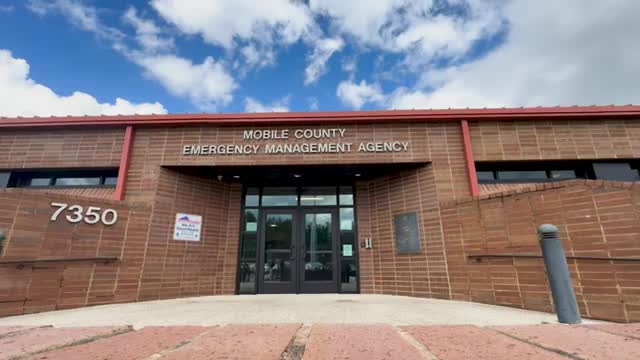
"Stakeholders will be a representative from each municipal jurisdiction, individual from the county commission, all of these other partner agencies doing these different 15 emergency support functions," the staff member said, adding that mass care and logistics responsibilities include "shelters, food, water, medical."
The staff member said the EOC separates responsibilities into an operations section and an infrastructure group. "We have an operation section that's generally made up of law enforcement, fire, EMS," the staff member said. On infrastructure, "that's mainly focused on infrastructure. That's city engineering and public works, county engineering and public works. Alabama Power has several people in here to help us coordinate that effort."
The staff member described the facility’s capacity and redundancies: "This room comfortably will seat about a 100 personnel and we have everything in here has a redundancy," and said the intent is that the building remain functional so "our public officials can make decisions and they can prioritize what resources we have available." When local resources are insufficient, the staff member said the EOC will "reach out to the state of Alabama and start working those resources in our community."
Discussion: The remarks in the meeting explained how the EOC organizes personnel and partner agencies during pre-storm, impact and post-storm phases. The presentation identified stakeholder representation from municipal jurisdictions and the county commission, a set of 15 emergency support functions that include mass care and logistics, an operations section staffed by law enforcement, fire and EMS, and an infrastructure group that coordinates city and county engineering and public works along with Alabama Power.
Direction and next steps: The staff member stated that when the center’s internal resources cannot resolve an identified problem, the EOC will escalate by requesting assistance from the state of Alabama. No formal motion, vote or formal policy adoption occurred during the recorded remarks.
Background and context: Emergency support functions are commonly used in multi-agency emergency management to organize response activities such as mass care, communications, transportation and public works. The speaker emphasized built-in redundancy in the EOC to maintain operations and to provide decision-makers the information needed to prioritize resource requests.
The remarks were explanatory in nature and did not include requests for specific state resources, dollar amounts, operational orders, or changes to local ordinance.
Don't Miss a Word: See the Full Meeting!
Go beyond summaries. Unlock every video, transcript, and key insight with a Founder Membership.
30-day money-back guarantee
Sponsors
Proudly supported by sponsors who keep Alabama articles free in 2025

